If your products are manufactured in China, a shared production shoot can supply several marketing channels. The harder question is whether those assets answer the different questions people bring to each channel. A beautiful product film may introduce a brand well while leaving a comparison shopper's most important doubt unresolved.
Amazon's September 29, 2026 announcement makes that distinction more useful. Full-Funnel Campaigns entered open beta in the United States for advertisers selling on Amazon, coordinating sponsored, display, video and streaming TV advertising within one campaign. This is a specific US rollout, not worldwide general availability.
ONCE's interpretation is that simpler media orchestration increases the value of a deliberately planned footage library. It does not remove the need to decide what each creative should communicate. That is a production recommendation, rather than a claim that Amazon has established one universal creative formula.
Start with jobs, then count films
There is a reasonable case for making one good film first. Amazon's own guide, Boost full-funnel performance with a single video, describes that approach. A straightforward product with one clear benefit may fit an introduction, demonstration and recognizable product ending into the same film. A lean launch should not buy extra productions merely because someone has divided the funnel into three stages.
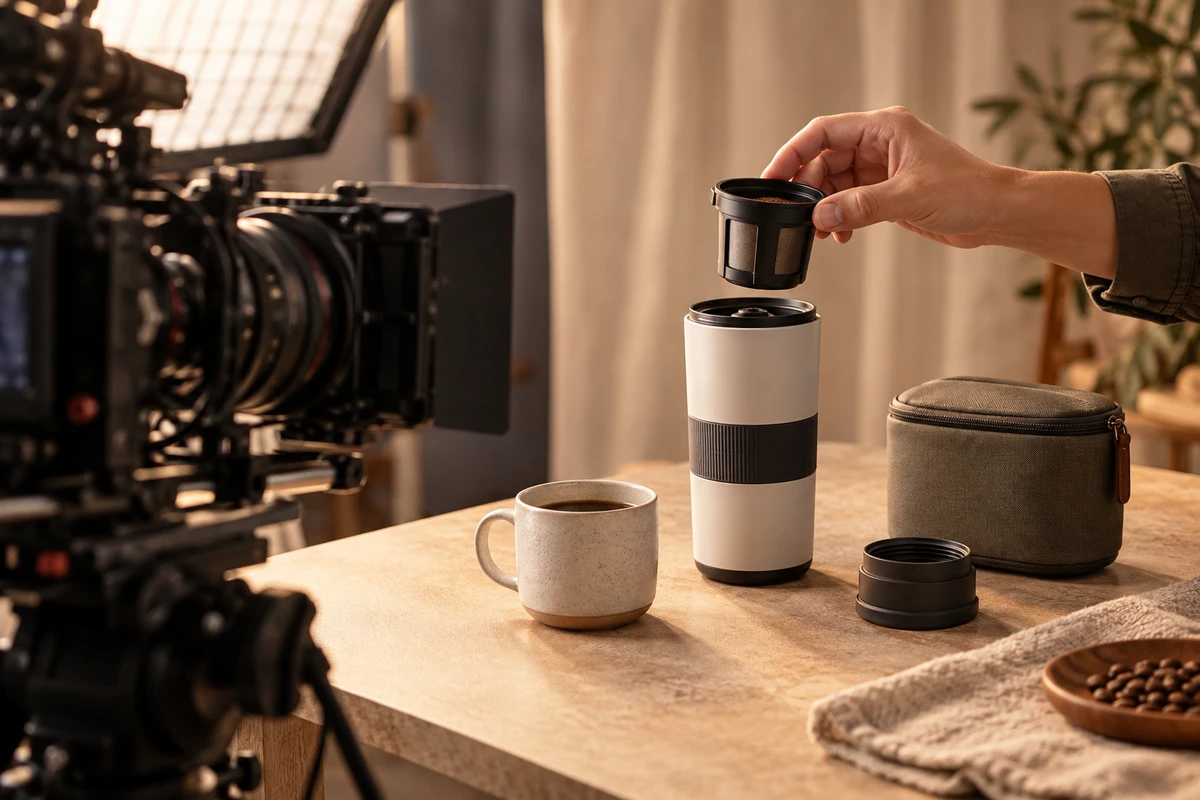
Additional versions become useful when they address different questions. Consider a hypothetical portable coffee maker: a traveler discovering the category needs a compelling use case; a shopper comparing products may want to see the cleaning process. Those are different creative jobs, even if both edits can use footage from the same day. This example is illustrative, not an ONCE client result.
ONCE proposes a Discovery–Proof–Action brief, or DPA. These are three jobs to cover, not a mandatory order and not a requirement to commission three separate films.
| Creative job | What the viewer should gain | What to approve before delivery |
|---|---|---|
| Discovery | A reason the product matters and a recognizable impression | A visible connection between the situation, problem and product; a distinctive benefit that the images communicate |
| Proof | An answer to a specific buying concern | A real demonstration or detail that makes sense as a standalone clip |
| Action | Product recognition and an appropriate next step | The correct model, destination and availability, with a prompt suited to the viewing environment |
For every planned sequence, ask: Who is this for? Which uncertainty does it resolve? Can it work without the preceding sequence? A single edit can satisfy all three jobs. Several exports can still fail to satisfy even one.
For the coffee maker, a hotel-room scene could establish relevance, a clear cleaning demonstration could supply proof, and a recognizable view of the available model could help the shopper find it. Glossy close-ups alone would not substantiate “easy to clean.” Generated imagery should not invent a mechanism or performance the actual product cannot deliver.
Reusable footage needs independent meaning
Existing Amazon placement rules show why adaptation needs more than a new crop. Sponsored Brands video starts muted. Non-interactive streaming TV runs in non-clickable environments, where button-style click prompts are unsuitable. Sponsored Products video guidance describes feature clips that may be reordered, with audio removed. These are examples from specific ad products, not a claim that they constitute the new campaign's upload requirements.
The production implication is straightforward: capture essential evidence so it remains understandable without narration, and record complete feature actions that do not rely on one fixed edit order. Sound can enrich the film; it should not be the only place where the product benefit exists.
When commissioning a shoot near your Chinese supply chain, approve the actual sample and the evidence shots before capture. Plan clean beginnings and endings to actions, useful alternate angles, and composition that leaves room for intended adaptations. The team can then change the opening, proof sequence and ending for a different job. A horizontal, vertical and square export of the same story represents three formats, not necessarily three creative hypotheses.
Ask for a shared base and explicit incremental costs
ONCE recommends evaluating production proposals with this model:
Total production budget = shared planning and capture + additional proof footage + role-specific editing and exports + localization and usage rights.
This is a scoping model, not a market price benchmark or an ONCE rate card. It helps a buyer distinguish work that can be reused from work that must be commissioned again.
Reusing approved footage for a different opening or language may chiefly require editing. A new setting, changed product, different demonstration or expanded talent license can add capture or rights costs. Those dependencies should appear in the proposal. AI generation may assist with appropriate visual treatments, but it does not eliminate the need to demonstrate a real product claim accurately.
Compare cost per approved version that actually serves an intended placement, while checking how many distinct hypotheses the package contains. Ten size exports are not automatically ten useful tests. Ask for the footage-to-version map, the included revision scope, and the conditions under which a new shoot becomes necessary.
Match the asset plan to commercial readiness
Before expanding reach, reconcile the footage with the listing and supply plan. Is the featured variant available? Does the destination support the same claim? Can inventory and fulfillment support the launch? A media optimizer cannot correct an inaccurate demonstration or an out-of-stock product page.
Keep measurement definitions separate, too. Amazon's Long-Term Sales metric includes immediate conversions and estimated future value. It can inform a decision, but should not be booked as realized cash revenue. Review actual orders, contribution margin and acquired customers alongside any modeled measure.
To assess a proof sequence, compare versions under similar audience, timing, offer and inventory conditions where possible. If placement and budget allocation change at the same time, describe the result as campaign-level performance; do not attribute the whole movement to one creative choice.
For a remote production brief to ONCE, provide the approved product facts and limitations, target markets, intended placements, three recurring buyer questions, and the rights attached to existing footage. Agree on the DPA coverage before deciding the film count. That gives the Shenzhen production team a clear basis for a shared shoot and gives your marketing team a practical way to approve the outputs. Budget efficiency comes from reducing repeated setup and unused versions while retaining the evidence that helps customers decide.
Sources and boundaries
Platform details checked October 1, 2026:
- Amazon Ads: Grow total sales with Full-Funnel Campaigns, September 29, 2026 — US open-beta scope and the long-term metric definition.
- Amazon Ads Agent announcement, September 29, 2026 — product announcement context.
- Boost full-funnel performance with a single video — the single-film option, not a guarantee of performance.
- Sponsored Brands video creative, Streaming TV & Prime Video ad specs, and Sponsored Products video guide — placement-specific examples.
The DPA brief and cost decomposition are ONCE's planning recommendations. This article reports no proprietary client test, production saving percentage or guaranteed conversion improvement.
Production examples and next steps
Separate product explanation from the requirements of each Amazon placement. The CHiQ refrigerator film shows a product and installation setting; the portfolio page does not establish Amazon ad performance.
Review Amazon product video production and CHiQ Built-in Black Refrigerator Product Video: Use Alignment and Door Opening to Illustrate Space Adaptation. To discuss your project, send the product page, approved claims, placement and caption requirements through the English project enquiry form.