When a new product has only one production day, the tempting plan is simple: finish the horizontal launch film, ask the talent to repeat a few actions, and assume the short-form assets will take care of themselves. The result is often a polished hero film with no action that works in the opening seconds of a vertical ad. Or the shoot chases so many short-form hooks that the launch film loses the pacing it needs to build the brand.
An effective launch-film and short-video package does not come from cropping one edit into multiple ratios. The two content systems can share the product, art direction, lighting, locations and parts of the performance, but each needs its own opening, shot duration and information job. At the briefing and quotation stage, the budget is easier to evaluate when it is divided into three layers: shared production, hero-film-specific work and variable creative versions.
Watch the monitor: the same action serves a different job
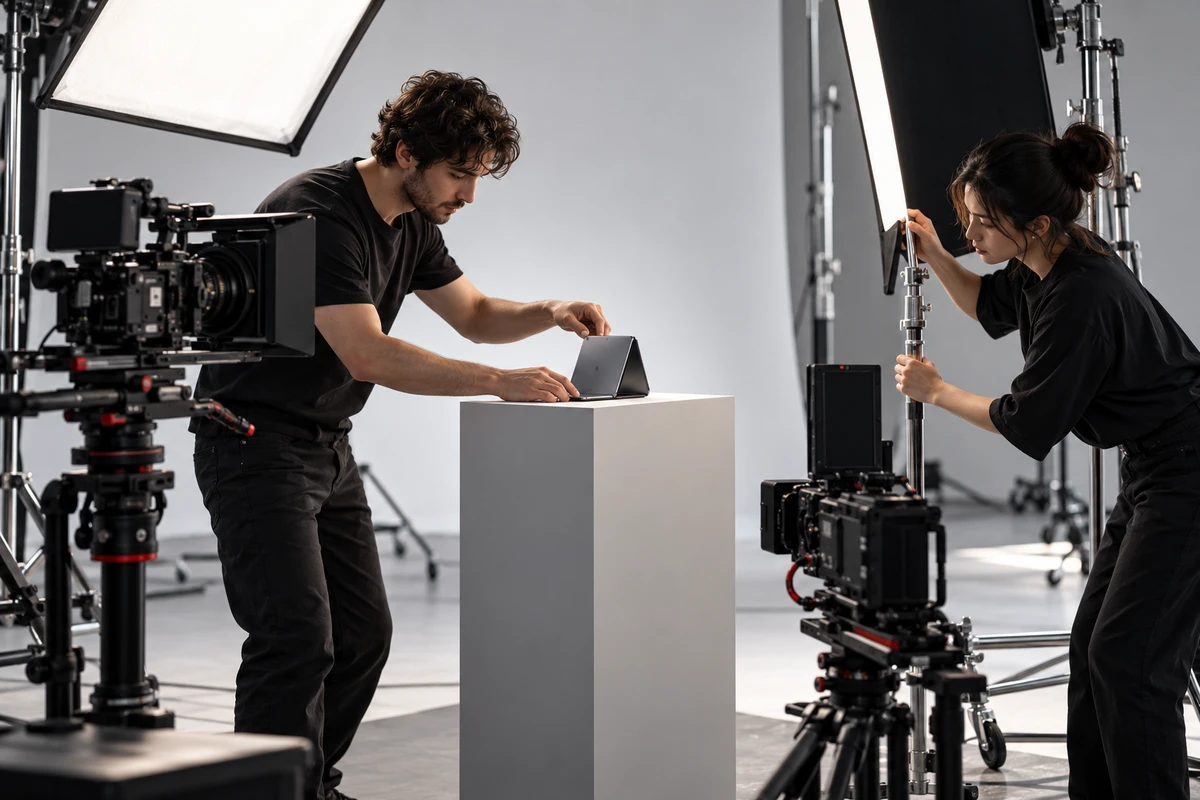
Imagine the crew is filming a foldable device opening and closing. The launch film may need a complete, restrained shot: establish the environment, let a hand enter frame, show the hinge movement, and hold on the product in a carefully designed brand light. The shot creates material quality, design language and memory.
A performance-oriented short does not have the same job. It may need three separate openings: start on the snap of the hinge, introduce a user problem before revealing the product, or lead with an extreme close-up of the mechanism. These versions can share the same product, set and even the second half of the demonstration. They cannot be created reliably by cropping the hero shot after the main edit is locked.
Google Ads' current ABCD guidance recommends getting to the heart of the story quickly, branding early and naturally, and giving the viewer clear direction. Its video experiment documentation also supports keeping a test focused when a team needs interpretable results. TikTok for Business likewise emphasizes creative quantity and diversity in its official materials. The production implication is straightforward: a short ad is not a reduced hero film; it is a controlled unit with a defined variable.
That is why the content architecture for a multi-format launch shoot needs to be decided during shot planning rather than rescued after picture lock.
Share a footage library, not one finished edit
Before production, sort the shot list into three groups: a shared footage library, hero-film assets and variable shots.
Shared footage: use expensive on-set resources well
The shared layer is best for material that does not depend on one narrative order:
- Clean product views, materials, ports and key physical actions.
- Establishing shots, user interactions, hand details and environmental texture.
- Medium shots and close-ups that allow deliberate horizontal and vertical reframing.
- Clean room tone, product sounds and action without voice-over.
- Packaging, accessories, colors and production status that have been approved as accurate.
The goal is not simply to shoot more. Each shot needs enough structure to be reusable. Important actions should show a clear start, process and completed state. Framing should anticipate vertical crops, and a product claim should not depend entirely on a large block of text added later.
Hero-film assets: protect the brand promise and emotional arc
Hero-film-specific work often includes the branded opening, the core visual idea, emotional turns, a definitive product beauty shot and the final resolution. These shots do not need to explain every feature. They do need to answer why the product deserves to be remembered and how its character differs from alternatives.
That may require a longer build, more complex camera movement and a complete musical progression. Cutting all of those moments into fragments for short-form speed does not save production value; it removes the reason the hero film exists.
Variable shots: change one useful factor at a time
Variable creative needs its own rows in the shot list. “Capture some social content while we are there” is not a production instruction. Useful variables include:
- Opening: problem, product action, outcome or human reaction.
- Message: feature, use case, design detail or offer mechanism.
- Presenter: engineer, user demonstration or product-only treatment.
- Direction: visit the site, explore a feature, book a demo or view the product page.
If the goal is to compare openings, keep the following body reasonably consistent. If the team is testing presenter style, avoid changing the message, music and duration at the same time. This does not guarantee media results. It makes the result easier to interpret and gives the next production cycle a clearer brief.
Do not split the budget into “one long film” and “ten shorts”
The value of a combined shoot depends on which costs can genuinely be shared. Product preparation, location, art direction, lighting, core talent, the base camera package and selected shots belong in the shared production layer. Complex choreography, special builds, hero shots and the musical arc belong in the hero-film layer. Hooks, direct-to-camera delivery, vertical compositions, alternative endings and test edits belong in the variable-version layer.
Instead of asking only for the price of one hero film plus ten shorts, ask the production proposal to identify:
- Which shots are designed for both content systems.
- Which short-form openings must be filmed independently.
- How many actions, lines, aspect ratios and edit versions each variable requires.
- Which changes in the product, script or media plan would require a reshoot rather than a re-edit.
This structure does not automatically make the budget smaller. It makes the budget legible. If the product demonstration, performance and environments overlap heavily, one production can create meaningful efficiency. If the hero film depends on a large cinematic setup while the short-form program needs creator-style delivery and frequent refreshes, forcing both into the same day may under-serve both.
When one shoot is the wrong answer
Separate the work when the product is at a different stage. If the hero film can accurately show the final industrial design but the software demonstration is not stable, schedule the interface and operation footage after the feature is confirmed. Do not use post-production to present unfinished behavior as a completed fact.
Separate it when the human task changes. An actor in a brand film may be building mood and context, while a performance short needs a credible explainer, a creator-native tone or an authentic operating rhythm. One performance approach may not satisfy both.
And separate it when the learning cycles differ. A launch film may lock before the release date. Performance creative should continue to evolve with media feedback. The first shoot should establish a strong footage library and an initial set of variables, not pretend to cover the entire launch lifecycle.
Approve an asset table before the camera rolls
The table can be simple. Each row records the communication job, shot content, horizontal and vertical framing, sound requirements, shared uses, variable name, product status, approver and reshoot condition. The script protects the overall story; the asset table protects the deliverables.
If your team is preparing a launch, align the brand-film production approach with the actual channel plan before deciding the role of the hero film and short-form ads. The ONCE VISUAL brand and product content team can help map the shared production layer, hero-film layer and variable-version layer against product readiness and launch timing.
Sharing one shoot should never mean forcing every asset to obey one edit. The useful form of sharing is a production system that delivers two clear types of expression: a hero film that builds brand memory, and short-form creative that can introduce, test and iterate specific messages.
Planning a coordinated hero film and short-form launch package? Request a launch video content plan.
Production examples and next steps
Plan the story, sound-off information and edits around the viewing placement. Huawei App Services provides a reference for short stories built around everyday actions.
Review Short-form video production in Shenzhen and Huawei App Services: Lifestyle App Story Advertisement Collection. To discuss your project, send the channel, audience, story premise and required edits through the English project enquiry form.