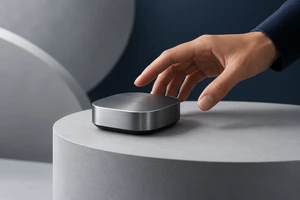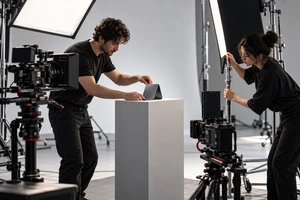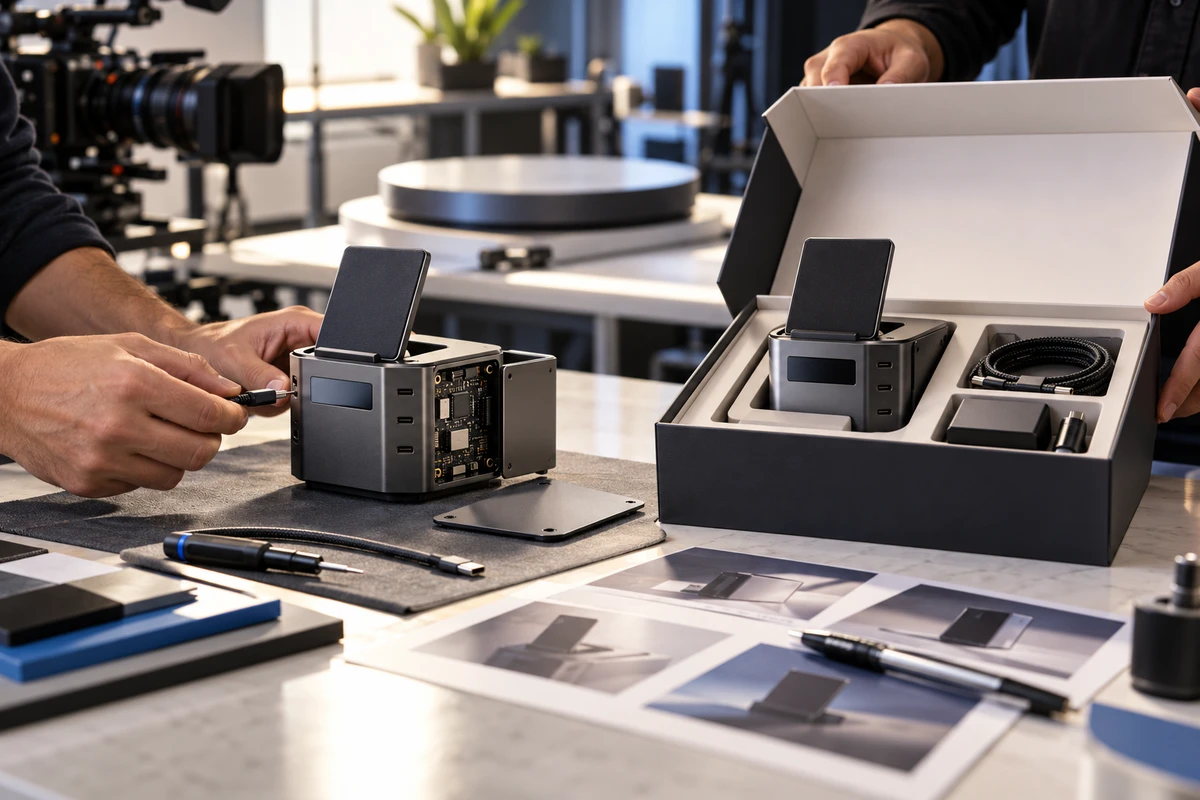
Imagine a smart hardware product preparing to launch on Kickstarter, then moving to Amazon and Shopify after crowdfunding. The obvious production plan is to make one two- or three-minute hero film and cut a shorter product-page version later.
The footage can often be shared. The story order usually cannot. A crowdfunding viewer is deciding whether the idea, the team, and the working prototype deserve support. A product-page shopper is already at the shelf, asking whether the product fits their needs, how it works, and whether they have misunderstood its size, compatibility, or features. The risks are different, so the first question each video must answer is different.
A product launch video content package should therefore start with three decisions, not a deliverable count: where the viewer is in the buying journey, which functions genuinely exist today, and which uncertainty each asset is meant to remove.
Crowdfunding builds confidence first; product pages reduce buying mistakes first
Kickstarter's official story handbook asks creators to explain who they are, what they are making, why they are making it, how far they have progressed, and what their plan and schedule look like. Its hardware and product design rules require a working prototype and do not allow photorealistic renderings to stand in for one. Kickstarter's rules also state that demonstrations must reflect the product's current state; creators cannot use CGI or effects to present functionality that does not yet exist as if it were working.
That means the first half of a crowdfunding film normally has three jobs:
- Make the problem and product vision easy to understand.
- Show the real prototype and its core action early, proving that the project is more than a concept.
- Introduce the team, development progress, production plan, and remaining risks.
Amazon's official guidance on product videos is closer to purchase assistance. A product-detail video should help customers understand features, size, and functionality, and can cover an overview, unboxing, setup, how-to use, or troubleshooting. A shopper on the detail page may not need the full founder story before seeing what the item is, how it works, and whether it fits their space or equipment.
Product-page videos should therefore put product identity, the core action, and the usage result earlier. The founder and brand story can still appear, but should not displace information that affects the purchase decision.
Label every claim by maturity before the shoot
The greatest risk in a crowdfunding film is not that the images look insufficiently polished. It is that information at different levels of maturity is edited into the same tone of certainty. Add a claim-status column beside the script and divide statements into at least three groups.
1. Prototype verified
This means the current unit can perform the action reliably, the team can demonstrate it repeatedly on set, and the product owner is willing to approve the claim. Use the real prototype, real interface, and repeatable operation wherever possible—for example, a folding mechanism, sensor trigger, connection flow, or software function that already works.
The same footage can appear in both the crowdfunding film and product-page videos, but the edit has a different emphasis. Crowdfunding says, “This is what we have already achieved.” The product page says, “This is how you will complete the task when you receive the product.”
2. Mass production pending
A working prototype does not mean that the production version is final. Battery life, material color, port layout, water-resistance rating, app screens, package contents, and delivery timing can still change. These points can be discussed as development progress or risk, but should not be presented as unconditional promises.
When a project includes several models or colors, separate prototype, final sample, and mass-production status before deciding which shots can be shared and which need to be captured again after production units arrive.
3. Product vision
Vision describes where the product intends to go, not what it can do today. Concept animation or generative visuals can help an audience imagine a future experience, but they must remain clearly distinct from filmed prototype evidence. This is especially important for hardware crowdfunding: viewers should never mistake mood footage, CGI, or AI-generated sequences for a demonstration of current functionality.
A practical notation is P, M, and V: P for prototype verified, M for mass production pending, and V for vision. Use the same status column in the script, storyboard, campaign copy, and subtitles. This catches problematic claims before post-production turns them into expensive revisions.
Share shot modules, not one universal timeline
The reusable unit is not the finished edit order. It is an approved module of footage. One cross-border launch production can be planned in four groups.
Founder and project story
Capture why the team is making the product, who is involved, what has been completed, and what comes next. This material primarily supports the crowdfunding page, the brand's About section, media interviews, and later project updates. The interview does not need to dominate the hero film; collect short statements, clean room tone, and vertical compositions at the same time.
Feature proof
For every core benefit, film a complete trigger-process-result sequence. Preserve a locked-off safety shot, operation close-ups, the product's response, and any necessary screen recording. The crowdfunding film can select the segments that best prove the prototype works. Amazon and Shopify can separate the same evidence into shorter answers about installation, usage, compatibility, cleaning, or storage.
FAQ and risk answers
Turn likely comment-section questions into a shot list: What are the dimensions? Which accessories are required? Is it compatible with a certain device? How is it charged? Which functions depend on an app? What may change between prototype and production?
Not every answer belongs in the hero film, but the production should leave enough evidence for page GIFs, campaign updates, customer-service replies, and paid landing pages.
Ad openings and multiple aspect ratios
A short ad is not simply the most energetic few seconds of the hero film. It needs to establish the problem, product identity, or key action faster, while keeping the subject inside safe areas for 16:9, 9:16, and 1:1. Our guide to a launch content system explains how the hero film, product-page modules, and social assets perform different jobs.
Localization is an editable interface, not just translated subtitles
Kickstarter advises creators to consider captions, translation, and audiences in different languages. YouTube's caption tools also support timed subtitle files and multiple languages for the same video. The safest production workflow is not to burn English subtitles into the only master. Preserve a clean-textless master, separate subtitle files, narration scripts, and split music and effects stems from the start.
Localization also needs four checks:
- Do units, dimensions, plugs, regulatory wording, and package contents change by market?
- Does the screen recording need localized interfaces, and is the operating sequence identical?
- Do talent, voice, music, and footage licenses cover the target territories and media channels?
- Are captions, disclaimers, and buttons inside each platform's safe area?
If the campaign may later use AI voice, a digital presenter, or lip-syncing, write the person's voice and likeness permission into the agreement separately. A standard filming release should not be assumed to grant global, perpetual, generative rights.
A content package is complete when the decisions are covered
Before delivery, a useful product launch video content package should answer seven questions:
- Does the crowdfunding film show the real prototype, the team, and current progress?
- Do product-page videos prioritize size, operation, compatibility, and the usage result?
- Is every feature claim marked as prototype verified, mass production pending, or product vision?
- Does each important FAQ have supporting footage instead of relying on page copy alone?
- Do landscape, vertical, and square ads have their own openings rather than mechanical crops?
- Are textless masters, subtitles, narration scripts, split audio, and license records complete?
- If the production version changes, is it clear which shots must be captured again, who approves them, and what triggers the reshoot?
A shared shoot still makes sense because the location, art direction, lighting, talent, and product actions can be reused. A shared shoot does not mean a shared final narrative. Crowdfunding must present an unfinished project honestly enough to deserve support. A product page must help a ready-to-buy customer avoid a mistaken purchase. Separate those two jobs first, and the package can carry a credible story into a real sales process.
If your product is preparing to launch across crowdfunding, Amazon, Shopify, and overseas social channels, share its current maturity, target markets, and launch date through the ONCE cross-border launch content solution. We will map claim status and platform evidence order before planning the hero film, feature videos, FAQ assets, and multilingual versions.