Batch-producing TikTok ad creative is often treated as an export exercise: change the captions, swap the music, replace the background, and call the result twenty different ads. That creates files, but not necessarily useful learning. A strong first creative batch keeps the product facts, audience, budget, and campaign objective relatively stable, then changes one main variable at a time. The result should answer a specific question: did the opening fail to earn attention, did the product proof feel weak, or did the offer and call to action remain unclear?
TikTok Ads Manager's Split Testing Variables guidance, updated in January 2026, lists creative, videos, CTA copy, and the opening two to three seconds among the elements that can be tested. It also states that only one variable can be selected for each split test. Google Ads gives similar advice for video experiments: keep settings such as audiences, bids, and ad formats consistent when the purpose is to understand the effect of different video creative. Neither platform can decide which five assets a brand should shoot, but both point to the same practical issue. If the talent, scene, claim, offer, and ending all change at once, even a winning ad may not explain why it won.
Make the first round answer one question
Before production, write the learning goal as a statement that could be disproved. For example: "For this portable projector, opening on the result in a campsite will retain more of the intended audience than opening on specifications." This hypothesis concerns the hook and the order of product proof. It does not also change the price, audience, landing page, and bidding strategy.
If the team is still developing a broader launch asset system across hero film and short-form content, start by identifying one control segment that will not change during this round: what the product is, how the core function works, and which claim can be shown truthfully on camera. The first variations should sit before or after that segment. A successful hook can then connect back to the same product facts instead of forcing the brand to reshoot an entirely different ad.
A minimum variable matrix that can go into the shoot brief
The framework below is not a fixed prescription for how many videos every brand needs. It is a way to control complexity. When budget or traffic is limited, select one group first. Move to the next group only after the previous test produces a useful direction.
Control C0: establish the common base
- Opening: Show the product in a real use context without an exaggerated problem statement.
- Proof: Demonstrate the core function in one continuous action and retain the steps viewers need to understand it.
- Offer: State only commercially confirmed information. If the offer is not final, keep it out of the shot.
- CTA: Use a neutral next step, such as "Learn more."
Hook H1 to H3: change only the first two to three seconds
- H1 opens on the result, then returns to the operation that produced it.
- H2 opens on a familiar user problem without overstating the pain point.
- H3 uses a creator-native decision line, such as, "Why I take this one with me."
All three versions keep the same product proof, offer, and CTA. If H2 performs differently, the team has a reasonable basis for attributing the difference mainly to the opening instead of wondering whether the second half also changed.
Proof P1 to P2: keep the winning hook
- P1 uses a complete operational demonstration for products where the steps matter.
- P2 uses a result comparison or close detail for functions whose effect can be verified directly on camera.
A comparison does not have to be a side-by-side frame. Matching conditions, continuous action, sound, or a close-up can demonstrate the difference without misleading the viewer. If the effect cannot be reproduced reliably on set, use accurate spoken or written qualification instead of manufacturing a dramatic visual result.
Offer and CTA O1 to O2: change conversion language last
- O1 keeps the creative body unchanged and changes only a confirmed offer.
- O2 keeps the offer unchanged and tests a clearer next action.
This group should wait until pricing, inventory, and the landing page are stable. Otherwise, the commercial conditions may change before the creative is live, leaving the result just as difficult to interpret.
Shoot modularly without producing every possible combination
The efficient option is not to multiply three hooks, two proof styles, two offers, and two CTAs into twenty-four finished ads. Organize the shoot by modules:
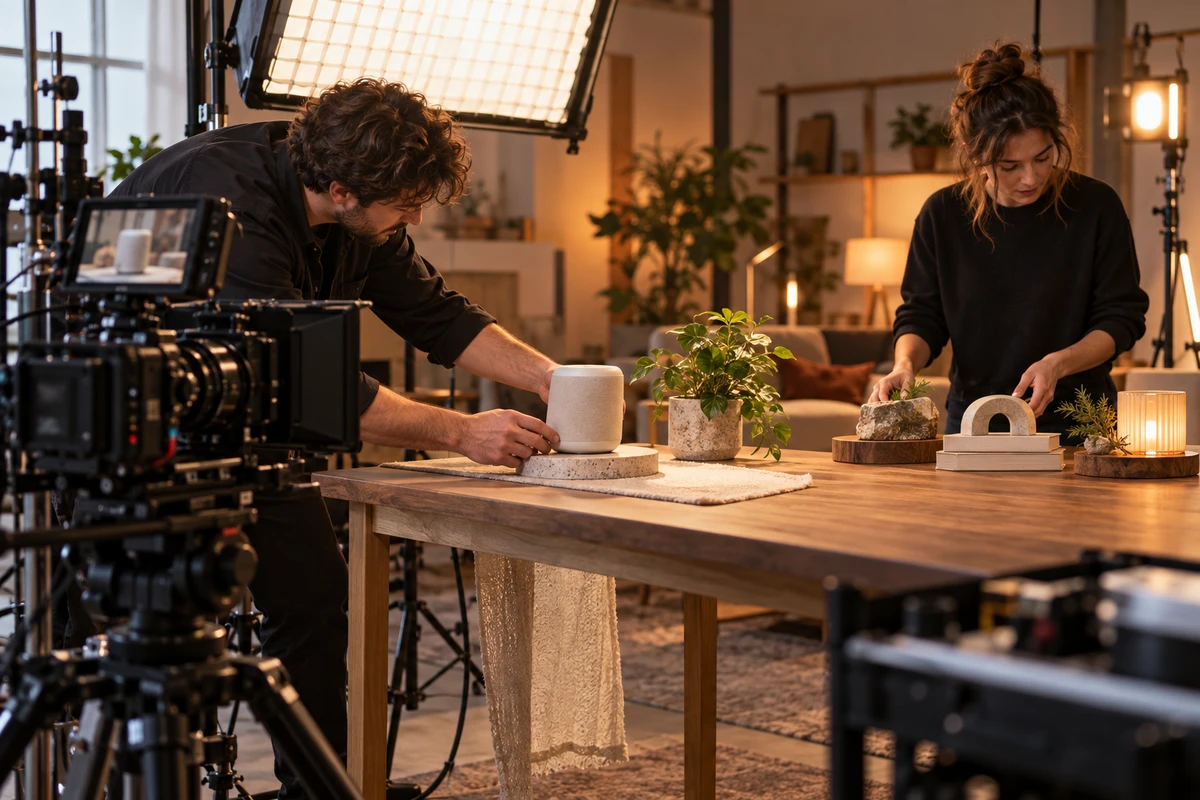
- Lock the camera position, lens, product state, and prop placement, then capture one complete control version.
- Maintain wardrobe, framing, and lighting while recording H1 through H3 in one block.
- Capture the actions and close details required for P1 and P2, logging product settings and shooting conditions.
- Record offers and CTAs as separate spoken or end-card modules, and keep one clean plate without speech.
This is different from consolidating several SKUs into one production day. A multi-SKU plan is mainly about sharing the crew, location, and lighting setup. Creative testing is about controlling variables. The latter depends more heavily on a shot log, module IDs, and a clear relationship between source takes and finished versions.
Use version names that production and media teams both understand
Avoid names such as final, final2, and new-final. Use a naming pattern that exposes the variable:
Product_Platform_Audience_Variable_Version_Ratio_Date
For example: Projector_TT_Camping_Hook-H2_V01_9x16_0929. If the proof module changes to P2, change only that field. In the media log, add the ad group, launch date, and target metric. When results arrive, the team can return to the exact production module instead of relying on memory.
A new batch also does not require discarding everything on a weekly schedule. First check whether the same asset is weakening under comparable delivery conditions. Then decide whether the opening has become familiar, the proposition has already been absorbed, or the audience and commercial context have changed. If the learning question is still unresolved, avoid changing the creative, audience, budget, and landing page simultaneously.
When a single-variable test is the wrong approach
Single-variable testing is useful for an early learning round and a relatively clean experiment, but it should not become a ritual. A major seasonal identity change, a new product position, entry into a different country, or a platform whose native storytelling conventions differ substantially may require a new creative hypothesis rather than a minor edit to the existing control. Treat that as a new round: define a new control and success criterion.
Platform recommendations about creative quantity are operating guidance, not a mandatory production quota. The right scale depends on budget, traffic, useful asset life, product risk, and the team's ability to review results in time. At ONCE, the practical starting point is to define the variable and the proof that can actually be filmed, then determine how many core assets, openings, and aspect-ratio versions the campaign needs. Delivery should also preserve clean masters, captions, and naming conventions, as outlined in our corporate video delivery checklist.
Six items the production brief should contain
- The single learning question for this round.
- The product facts and images that must remain constant in the control.
- The main variable and the hypothesis behind every version.
- The target platform, aspect ratio, duration, and safe area.
- The owner responsible for approving offers, regulated language, and the landing page.
- The decision metric, observation window, and next action after launch.
If you are planning a batch of TikTok performance creative, send us the product, market, existing assets, and campaign objective. We can organize the control, variable matrix, and production list before deciding how many versions genuinely need to be produced. Share your campaign objective and request an asset plan.