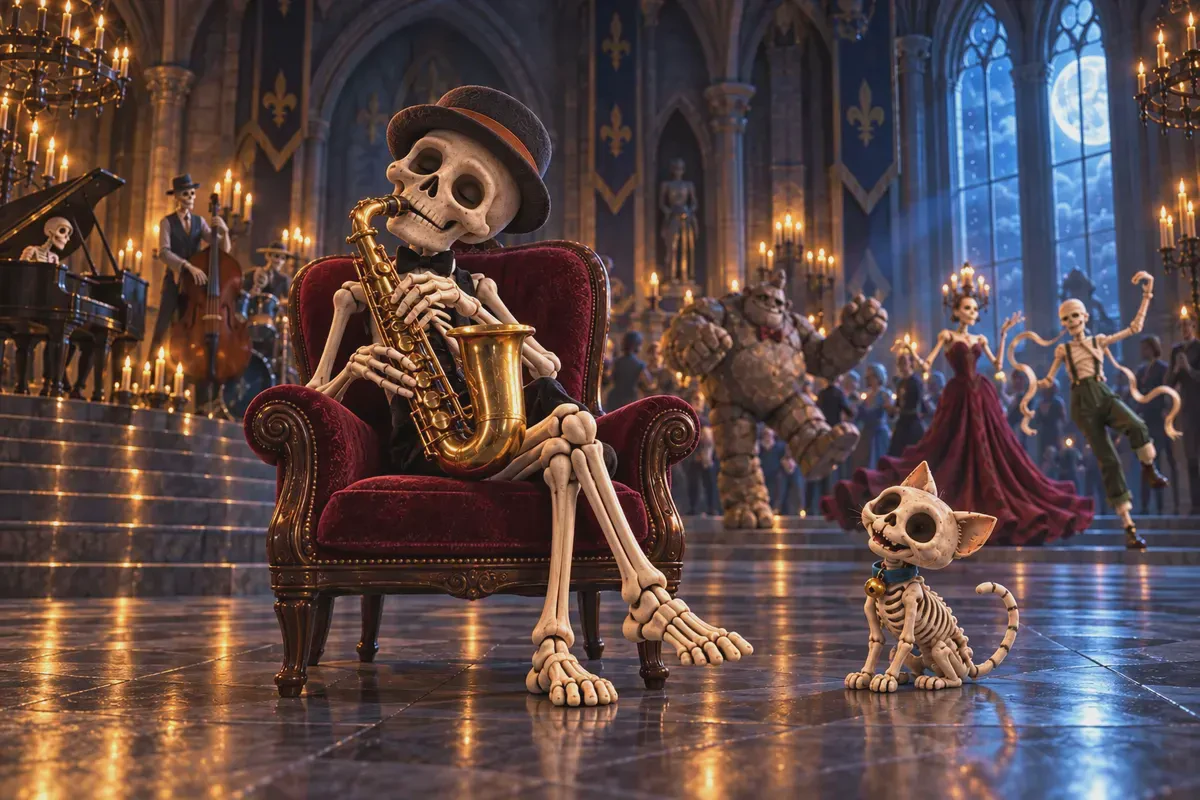
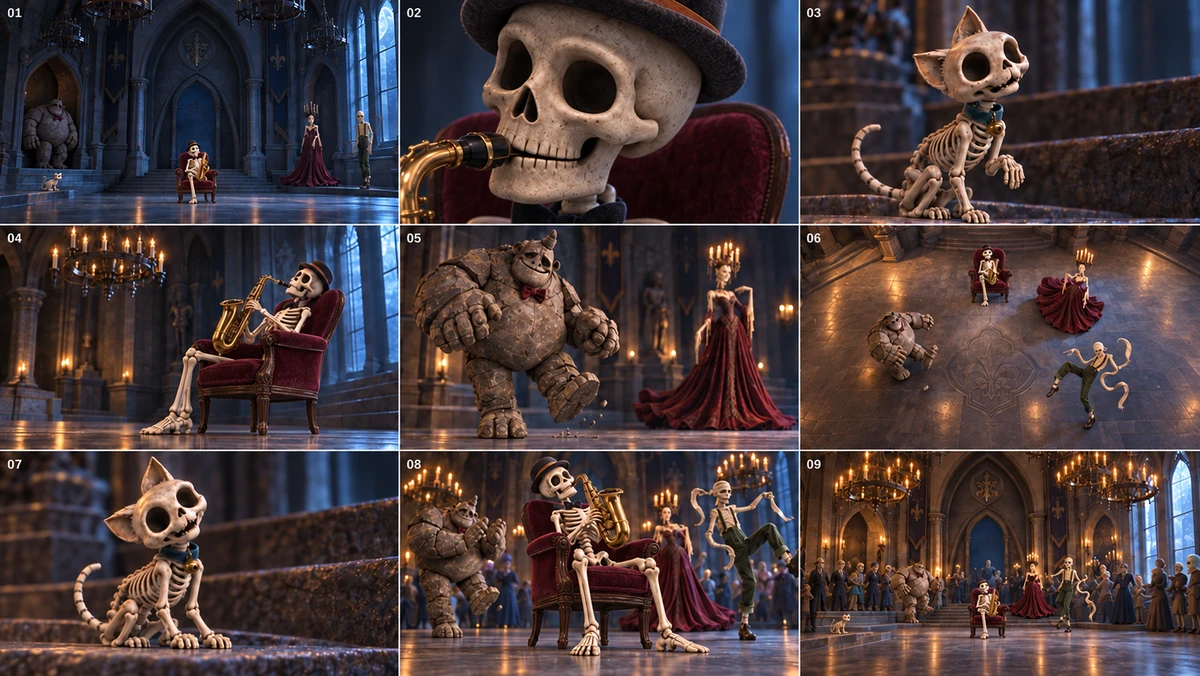
A long saxophone note hangs in a cold, empty castle. It sounds like a warning. Then the camera finds its source: an elderly skeleton in a bowler hat, taking his musical duties very seriously. A moment later, he decides the room would sound better with some jazz.
Four Nights with Grandpa is an animation concept built around that character. Four short stories, each conceived at roughly 20 seconds, follow him through music, a deadline, a video game and an inconvenient visitor. This ONCE development diary presents AI-generated character studies and storyboard concepts, not footage from completed animated films.
A character who refuses to rush
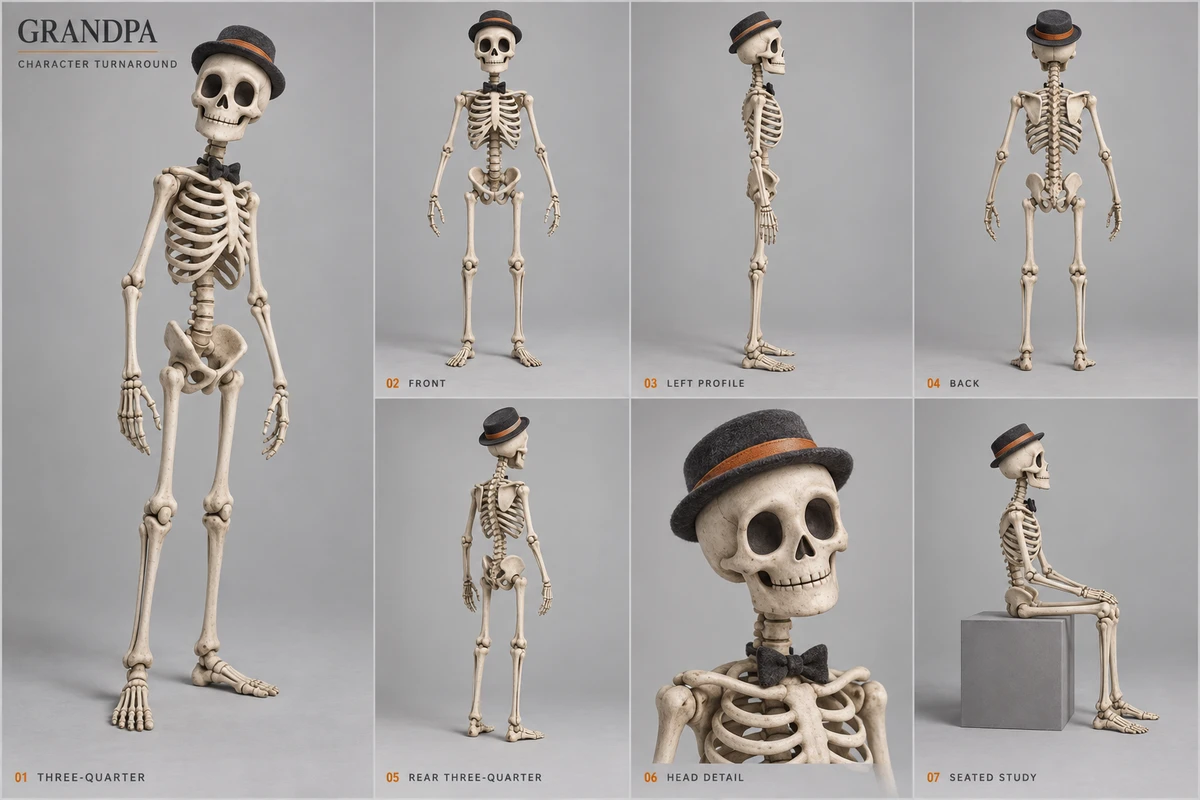
The skeleton is a starting point, not the joke. Grandpa is capable, slightly theatrical and particular about how he spends his time. His dark felt hat, warm ribbon and small bow tie give him the air of an old-fashioned performer. A large head and slender body make changes in posture easy to read.
With no conventional eyes or eyebrows, much of the performance has to come from head angle, jaw shape, shoulder position and the pause before an action. His calm must remain active. He adjusts to a musical phrase, types with precision and arranges a footstool before returning to his book. These choices give the four stories a shared personality.
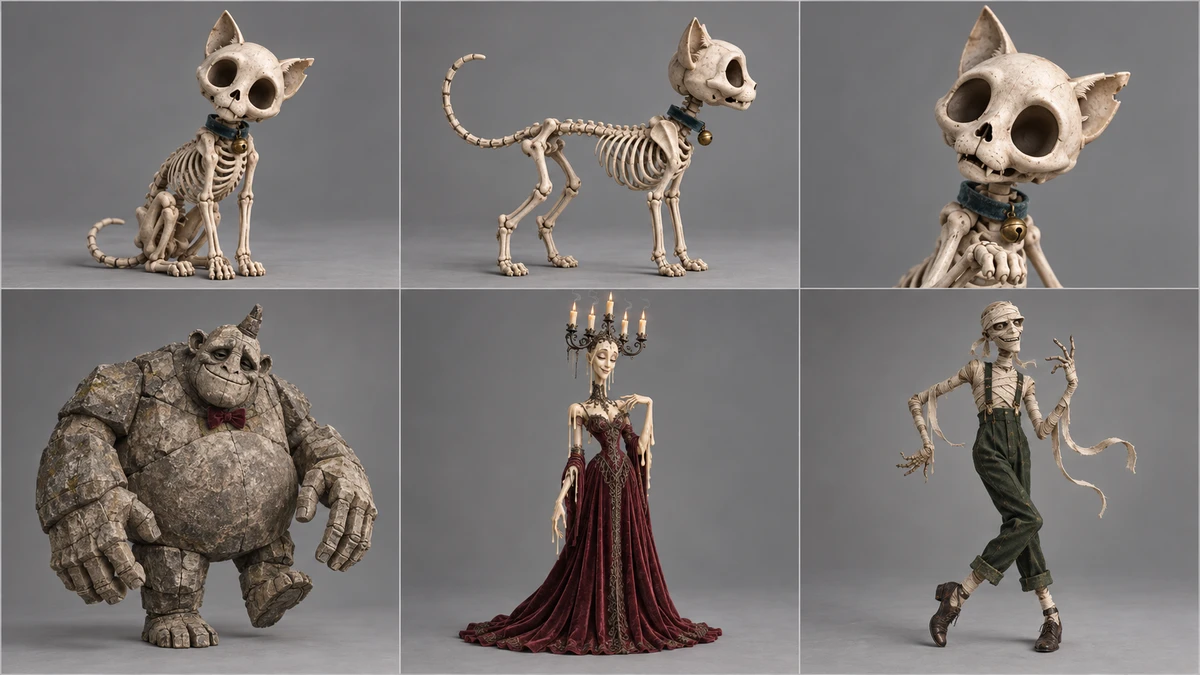
A small skeleton kitten provides a less impressed point of view. Sometimes it is startled; sometimes it simply yawns. The larger supporting cast uses contrasting silhouettes: a heavy stone monster, a candle-crowned dancer and a loose-limbed figure in bandages. They need to remain distinct when the room fills with movement.
Rest in Jazz: the haunted house forgets its job
The opening needs enough space to feel intimidating. Pointed arches, cold window light and a low viewpoint make the castle seem larger than its occupants. The saxophone initially belongs to that atmosphere. Once we move closer to Grandpa, his tapping foot and relaxed shoulders begin to suggest a different kind of evening.
The musical turn spreads through the room. The stone monster sways, the candle-crowned lady turns and the bandaged dancer joins in. Warm light gradually brings the gathering forward. What began as a haunted-house performance becomes an after-hours jazz club.
The wider ensemble shot belongs near the end, where it can answer the empty opening. Grandpa does not announce that he has taken over. He keeps playing with professional seriousness while everyone else quietly abandons the business of being frightening.
Deadline: the audience worries for him
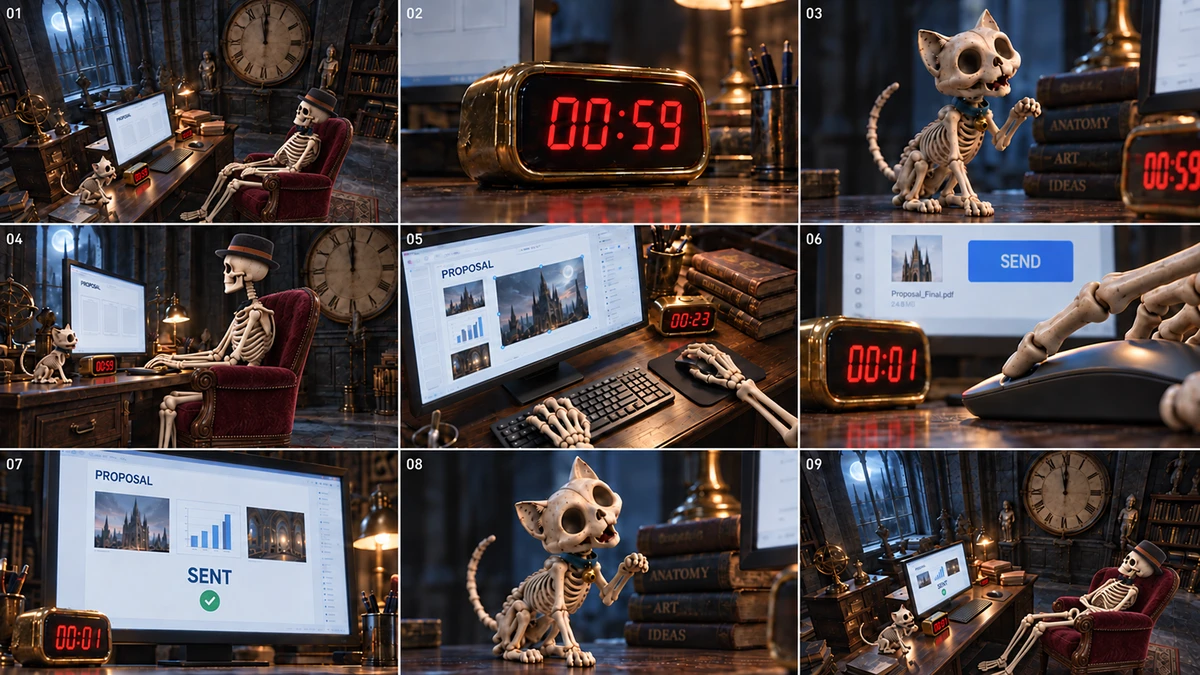
A submission timer reads 00:59. Alerts and ticking suggest trouble. The wider shot reveals Grandpa resting in his velvet armchair, apparently waiting for the right moment to start. He sits forward and gets to work.
The sequence does not need to show an entire work session. A few selected inserts can carry it: the timer, fingers on the keyboard, his focused face and the changing screen. At 00:01, a finger hits SEND. The confirmation arrives just as he settles back into his original position.
Matching the opening and closing compositions makes the task feel like a brief interruption. His proposed line, "Not my first deadline," lands after the action. The pause matters as much as the words. He has been around long enough to know exactly how much time he needs.
Small Case: an action climax becomes a quiet evening
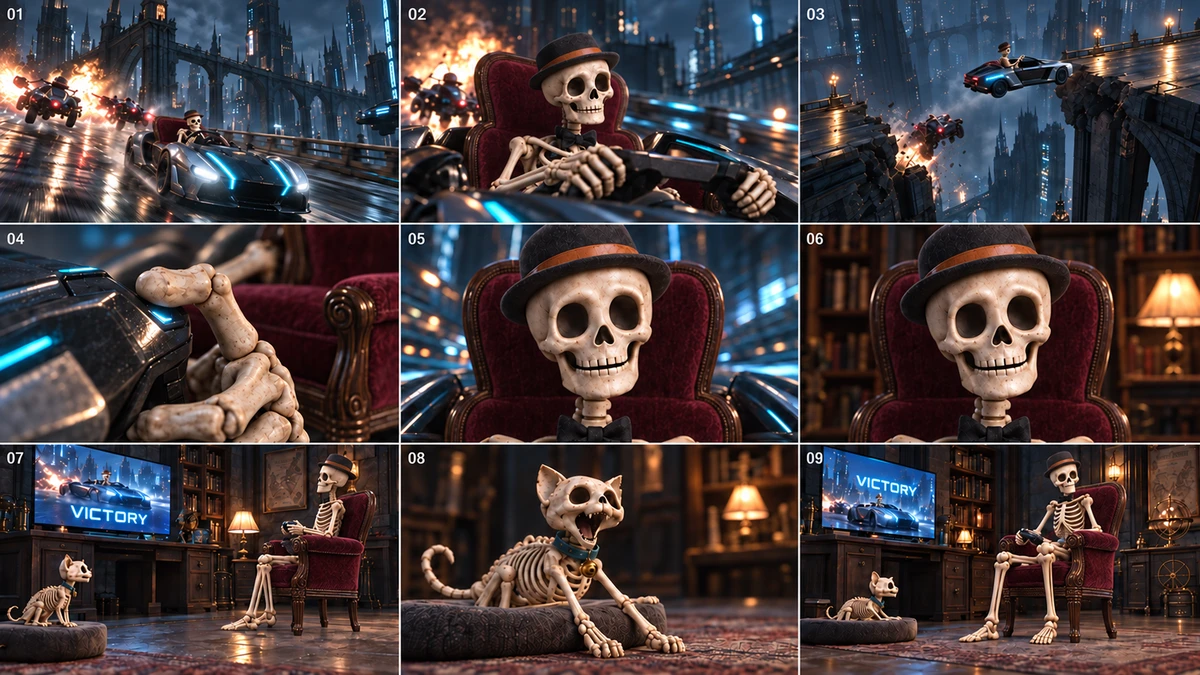
The third story starts at full scale. A cyber car races through a night city, pursued toward a broken stretch of road. Wide views establish the geography and the drop. Inside the car, Grandpa makes small, controlled movements with a game controller.
The reveal is designed around two closely matched shots of his face. Cold city light becomes warm lamplight, but his angle, expression and burgundy seat remain recognizable. Only then does a wider view explain the change: he has been playing a video game in his study all along.
The screen reads VICTORY. The kitten yawns. Its reaction punctures the grandeur without making Grandpa incompetent. The game was spectacular; his evening is still perfectly ordinary. That difference in scale supplies the ending.
Five More Minutes: Death arrives too early
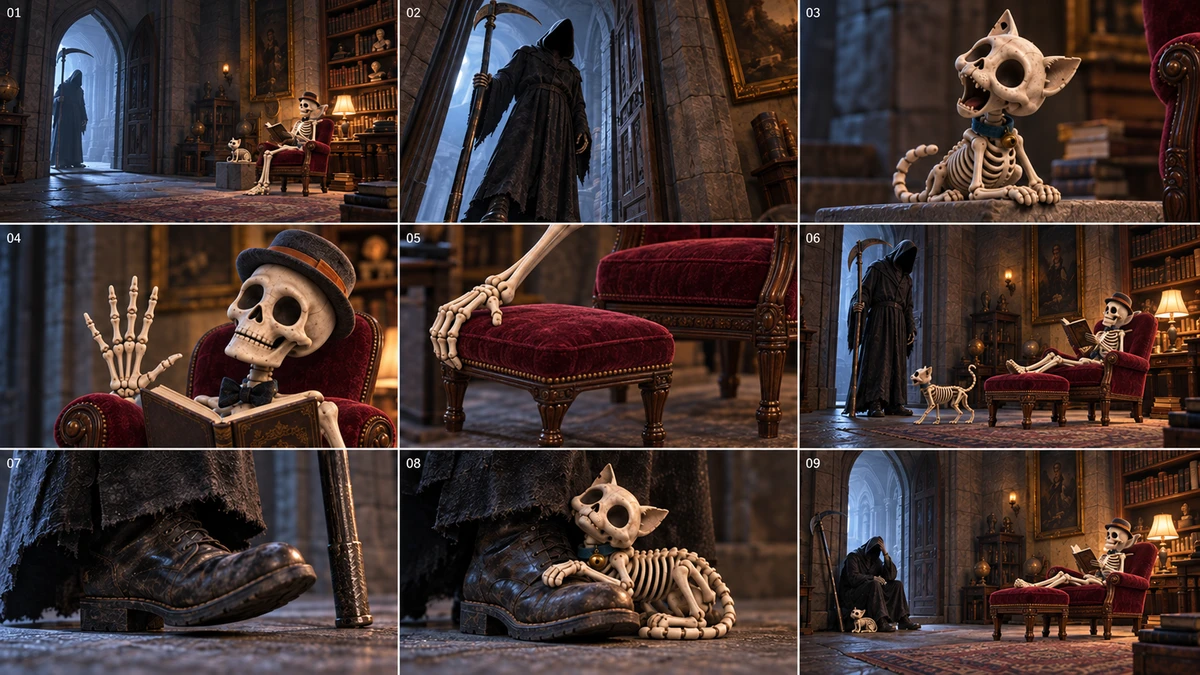
A tall cloaked figure appears in the doorway, carrying a scythe. A low angle gives the visitor authority. The kitten reacts first. Grandpa looks up from his book and raises a hand: wait.
Instead of getting ready to leave, he draws a separate footstool closer, puts his feet up and finds his place on the page. "Five more minutes." The line turns an encounter with fate into an everyday scheduling problem.
The final complication is affectionate. The kitten settles against Death's boot, giving the imposing visitor a small reason not to move. In the last wide composition, Grandpa reads, Death waits and the kitten rests between them. The castle has become a household.
Cinematic composition has to survive the cut
For this AI animation storyboard, the useful question is not whether every frame looks expensive. It is whether the next frame arrives for a reason. Wide shots establish the problem. Closer views let us read an attitude. Inserts isolate information that changes the scene: a timer, a button, a controller or a boot that has stopped tapping.
A centered doorway gives Death a formal entrance. Off-center framing can leave room for movement or a character's gaze. These are choices, not boxes to tick. An artificial foreground object would add little if it obscured the action. In the game reveal, consistent eyelines, hand positions and the chair silhouette matter more than an individually impressive angle.
The material goal is equally specific: felt should read differently from bone, brass from velvet, and window light from a nearby lamp. Lens and depth-of-field language guide the images; they do not mean these concepts were captured on a physical cinema camera or certified for a particular exhibition format.
What still has to be tested
A nine-frame board cannot prove that a 20-second film works. The next step is a timed animatic with temporary sound. Each story poses a different question: how slowly can the jazz take over, how long must a countdown remain readable, when should the game reveal become obvious, and how much silence does Death need before the kitten moves?
Production would also require shot-by-shot checks of skeletal proportions, finger counts, instrument contact, prop positions, screen text and lighting continuity. Some generated hand and prop details remain concept-level. These images are discussion material, not finished motion assets.
For the wider production context, see How AI Previsualization Reduces Commercial Film Rework and ONCE's AIGC content and AI workflows. What ties these four concepts together is a simpler ambition: give the character a recognizable way of living, then let the world interrupt him.