If your product is in China and your customer is in the United States, the short answer is this: start with China-local production when the asset is product proof—features, tabletop demos, white-background footage and remotely approved modules. Choose U.S.-local production when a U.S. person, U.S. setting, natural English delivery and local commercial rights are themselves the creative asset.
“More cost-effective” is not shorthand for “the cheaper country.” It means that the same dollar buys the footage that must happen where it is being made. A China-based supplier that leads the creative or post-production is only comparable with a U.S. turnkey team on U.S.-localized work if its price fully includes U.S. field capture, talent, locations and rights.
This is an audit of public price cards and official labor statistics, not a national market average or a big-data census. We reviewed published supplier cards in Shenzhen and Los Angeles, public venue prices, standardized SKU output prices and official labor data. That gives a useful view of which costs can move and which cannot; it does not replace written all-in quotes against one shared brief.
Put only like things on the same level
Public price cards are useful because they reveal boundaries, not because they produce a credible average. Shenzhen supplier Yinghua Media lists product-only videos without talent at about ¥500–¥1,500 each in its product-video guide. Los Angeles supplier AD.JUST lists e-commerce product videos at $500–$2,000 per video in its 2026 production guide. Both pages use the phrase “product video,” but they do not standardize runtime, shot count, revision rounds, music, rights or delivery formats. They show the direction of published price cards, not proof that U.S. production costs a fixed multiple of China production.
| Cost layer | Shenzhen public sample | Los Angeles public sample | The correct reading |
|---|---|---|---|
| Product-only display | ¥500–¥1,500 per video; no talent, white or black background; scope varies by quantity and length | $500–$2,000 per e-commerce video | The closest directional comparison, but still not one shared brief |
| Minimal SKU output | Heshi Commercial Photography lists ¥1,000 for shooting and editing a product video, including a hand-model demonstration | Expozme lists $149–$295 for a 360° product video spin | Both are low-complexity product assets, but a hand demo and a video spin are not the same deliverable |
| Lifestyle / location work | The Shenzhen guide lists ¥5,000–¥20,000 per day | Willow Studios lists a downtown Los Angeles one-floor location from $4,000 for 12 hours | Facility scale, parking, set support, insurance and crew are different; do not turn this into an “average studio rent” |
| High-spec production | A public contract from the Shenzhen Institutes of Advanced Technology discloses a ¥345,000 bilingual institutional-film total | U.S. product and brand-film price cards likewise span small single-SKU jobs to campaign work | A useful counterexample: China can be expensive too when the deliverable is high-spec |
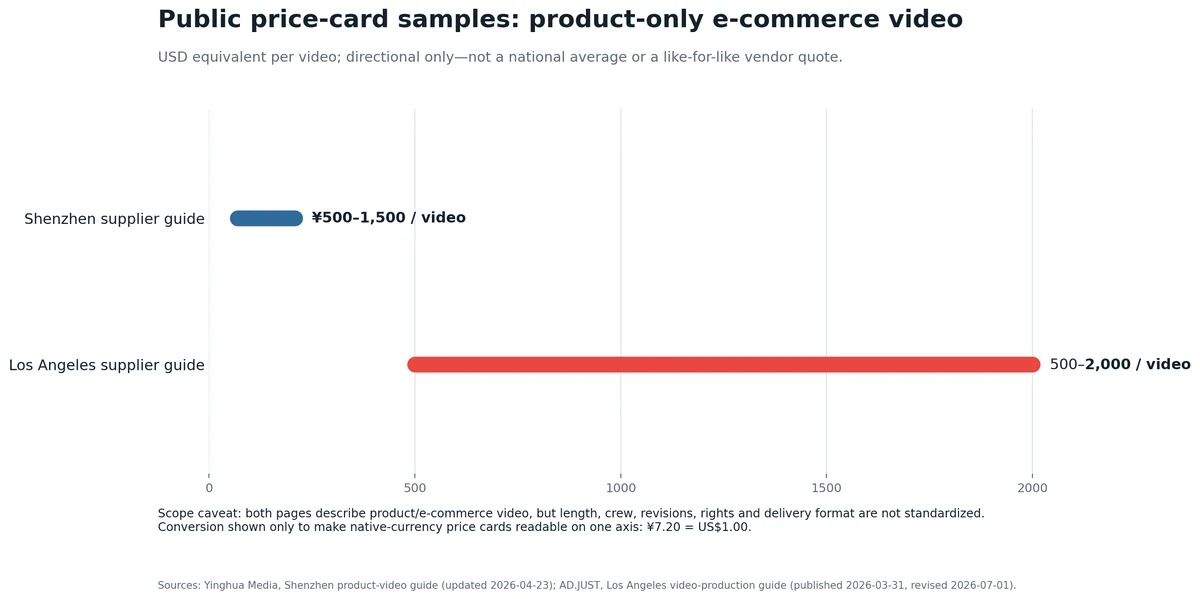
The chart uses a fixed visual conversion of ¥7.20 = US$1.00 only to put native-currency cards on one readable axis. It is not an invoice rate. In procurement, preserve each original currency and calculate tax, payment fees and the quote-month exchange rate separately.
Labor data explains pressure; it is not a production quote
The U.S. Bureau of Labor Statistics reports May 2025 median annual wages of $74,990 for television, video and film camera operators, $75,420 for film and video editors, and $90,360 for producers and directors. The editor/camera-operator page and producer/director page describe employee wages—not freelancer day rates, and not an agency price that also covers kit, management, insurance, margin and overtime rules.
China’s National Bureau of Statistics reports 2024 annual average wages in urban culture, sports and entertainment of ¥126,040 in non-private entities and ¥61,669 in private entities. Its methodology and source table cover legal entities with five or more employees and exclude individual businesses and freelancers. Those values cannot responsibly be divided into a camera-operator day rate either.
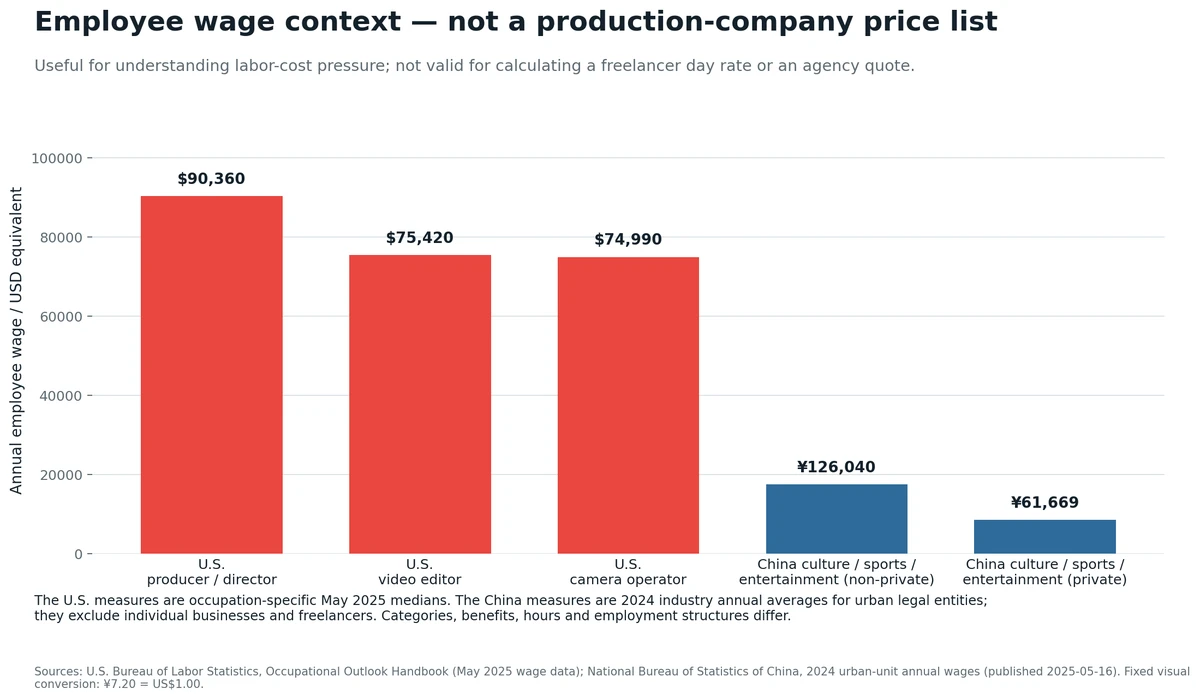
The figure supports one limited observation: the labor-cost context is different. It does not answer how much a particular China team is cheaper than a particular U.S. team. Blending employee wages, studio-hour prices, supplier starting prices, talent fees and complete production packages into one country-average bar is a common and costly budgeting error.
The decision metric is an all-in cost stack
Ask every supplier to price the same stack:
cash cost = pre-production + field crew + equipment + studio/location + talent/casting + talent/music rights + styling/props/HMU + post and versions + product shipping/insurance/customs + local travel + project management + tax and payment fees
If any line is missing, the totals are not comparable. Four items most often erase the intuition that “shooting in China is simply cheaper”:
- Samples and reshoots. The farther the product is from the crew, the more logistics, customs, backup samples and reshoot time matter.
- U.S. authenticity. U.S. talent, homes and streets, native English delivery and culturally legible detail are not automatically interchangeable with overseas casting.
- Usage rights. Paid social, Amazon PDP, web, retail displays, territory and duration can all change talent, music and licensing costs.
- Remote rework. Time zones are not the cost. Unlocked shot lists, color standards and revision ownership are.
Three briefs that produce a fair answer
Do not request quotes for vague labels such as “U.S. shoot” and “China shoot.” Use three fixed deliverable definitions instead:
- Product-only studio proof pack: one SKU, neutral white tabletop, 20 retouched stills, fixed shot list and two revision rounds. Compare Shenzhen-local capture with Los Angeles-local capture only after product courier/return and insurance are included.
- U.S.-audience UGC performance pack: one specified U.S.-resident English-speaking non-union creator in the same U.S. city; one eight-hour home-style day; six 20–30 second 9:16 videos, captions, fixed cutdowns, two revisions and three months of U.S. paid-social usage. The valid comparison is U.S. turnkey contractor versus a China-led supplier that actually includes and controls U.S. capture.
- U.S.-localized lifestyle mini-campaign: two specified adult models in the same U.S. city; one eight-hour location day; 30 retouched stills, three 15-second vertical videos, one year of U.S. digital usage and two revision rounds. Exclude a China supplier from this comparison if U.S. location, talent and rights are absent from its price.
So which side is more cost-effective?
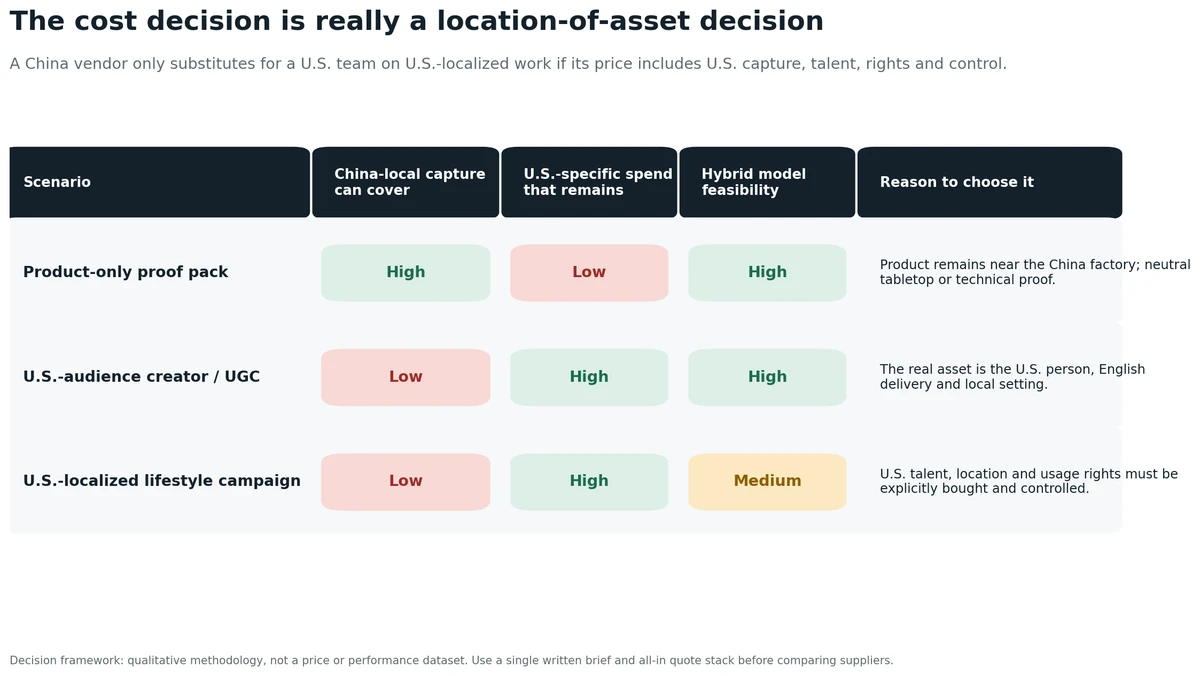
Lead with a China-local team when the product is near the factory and the job is structure, material, functionality, white background, macro detail, installation steps or other studio work that can be approved remotely. Product logistics, spare samples, technical communication and repeatable volume production tend to be shorter—and the price advantage is more likely to survive into the true cash budget.
Lead with a U.S.-local team when credibility comes from U.S. people, U.S. spaces, natural spoken English, live creative direction or fast local reshoots. In that case, the U.S. content asset is the deliverable, not a decorative premium. Removing it to chase a lower price changes the work rather than lowering its cost.
Lead with a hybrid model when the work contains both. Make technical proof, product close-ups, stills and reusable modules in China; make U.S. creator, lifestyle and rights-bound footage in the United States. The saving does not come from pretending a U.S. shoot is a China shoot. It comes from not asking every shot to carry U.S. field-production cost.
Finally, require every quote to specify day length and overtime, people and kit, sample responsibility, location, talent identity and usage term, music, revision rounds, delivery formats, tax and payment terms. The decision is not “which country is cheaper?” It is which production path buys the target market’s necessary footage at the lowest total risk.
For related planning, see ONCE’s Video Marketing insights.