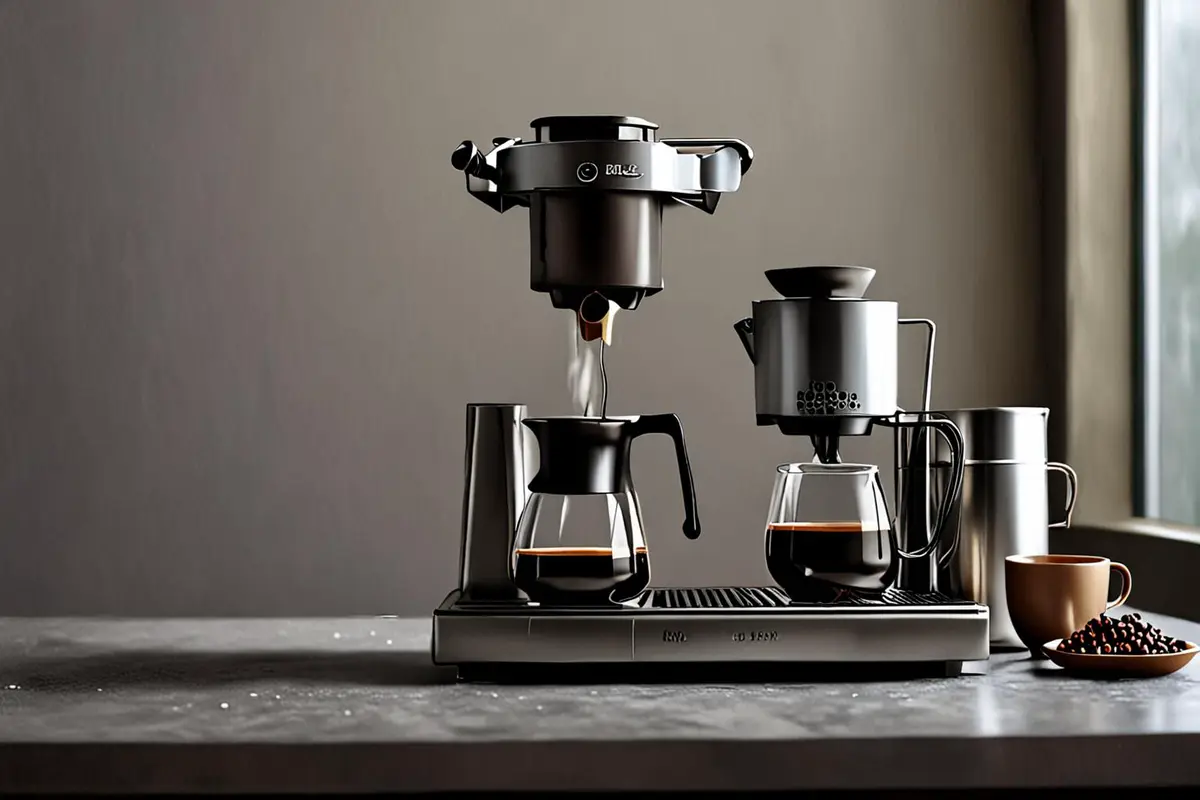
A coffee machine is cleanly cut out and placed in an AI-generated morning kitchen. The product edge is sharp, the visual style is consistent, and even the tree shadows outside the window move. Yet the machine does not seem to press into the countertop. Its metal side reflects a window that does not exist, and when a hand reaches toward it, the fingertips appear to slide across the surface. Every detail looks plausible on its own, but the machine never truly enters the space.
When an AI background weakens product realism, the problem is often not the beauty of the background. The product and environment have failed to affect each other. A product is more than an image placed in front of a scene. It blocks light, presses into surfaces, reflects its surroundings, receives human touch, and changes its relationship to foreground and background as the camera moves.
The useful question for hybrid production is not simply whether a background can be generated. It is: which small part of the world must remain physically connected to the product?
A background is more than the wall behind the product
Conventional cutouts encourage a closed-outline model: pixels inside the outline belong to the product, and everything outside belongs to the background. In practice, a product’s effects extend beyond that outline. Its shadow falls on a surface. Highlights contain a window. Glass reflects a person. Vapor obscures the distance. A transparent shell lets the color behind it pass through. These effects sit outside the product mask, yet they determine whether the object feels present.
Adobe Research’s 2026 Object-WIPER project treats shadows, reflections, translucent traces and mirror effects as visual effects associated with an object. Its task is object removal, but the reverse lesson is useful for insertion: adding only the subject pixels is not enough. Thinking Outside the BBox at ECCV 2024 and LayerDecomp at CVPR 2025 likewise treat shadow, reflection, viewpoint, scale and transparent effects as separate compositing problems.
These papers do not show that a particular AI background will reduce ad performance. They clarify the production problem: an object’s presence is distributed beyond the object itself. The more photorealistic the background becomes, the more visible missing contact relationships can feel.
Preserve a real contact zone around the product
A practical hybrid method is to identify the product’s real contact zone: the small area that it presses, touches, blocks, reflects or changes. That zone might be a section of countertop, a hand, a water surface, the inside of a drawer, or the seat cushion that deforms beneath a person.
Film the product and this contact zone together, then assign the distant wall, window view, city, exterior landscape or non-interacting set to generative tools. The captured plate is no longer an isolated product asset. It is a piece of reality in which a physical relationship has already occurred.
A real surface gives the product weight
For a tabletop product, capture part of the actual surface beneath and around it. The darkest point of the contact shadow, the load-bearing edge and the way texture disappears under the base all tell viewers where the object sits. If the product alone is cut out and the model must invent the surface, the base can acquire an even halo, an implausibly soft shadow or the wrong apparent scale.
A real body makes the product usable
Gripping, pressing, wearing, sitting and lifting involve more than occlusion. Skin compresses around an edge. Fingers reposition in response to resistance. Clothing folds. The product shifts slightly under load. When the selling point depends on these actions, the performer and product should usually remain in the same captured layer. Generating the hand and product separately often sacrifices the credibility of the function itself.
Water, vapor and transparent materials carry the background into the subject
Beverage, bathroom, beauty, cleaning and transparent-shell products allow foreground and background to pass through one another. Water reflects the room. Vapor reduces contrast. Glass bends lines behind it. Clear plastic takes on environmental color. If the product is first captured as a perfectly isolated asset, post-production must reconstruct not only the background but the background after it passes through the material.
AI backgrounds work best where nothing needs to touch
Using less AI is not automatically safer. Generative backgrounds are strongest when they build the distant world: seasonal views outside a window, a skyline, an abstract space, an inaccessible location, a distant crowd or an environment layer that does not directly interact with the product. They are also easier to control when the product sits on a self-contained plinth, the camera is nearly locked, and lighting can be planned as one system.
One way to evaluate a shot is to ask what the product changes. If the background still makes complete sense after removing the product, the generative area is usually larger. If removing the product should also remove a shadow, a mirror image or the support for a person’s action, that part of the scene is already bound to the product and should not be left entirely to the model.
Creative direction can deliberately reduce risky contact. Instead of generating a complex kitchen and repairing ten inconsistencies, place the product on a real surface in controlled side light, then extend the distant architecture. The world can remain rich while the product keeps a credible landing point.
Shadows and reflections are not decorative layers
The CVPR 2024 paper Shadow Generation for Composite Image Using Diffusion Model describes realistic shadow generation for inserted foregrounds as a difficult compositing task. Earlier work on Intrinsic Image Harmonization separates foreground-background mismatch into material reflectance and illumination. For commercial production, the useful implication is that a shadow is not a gray patch added beneath the product, and an incorrect reflection cannot be solved through a global grade alone.
A contact shadow describes distance from the surface and where weight is carried. A cast shadow also reveals light direction, source size and spatial depth. Reflections are stricter still: metal, glossy plastic and screens bring the whole room onto the product surface. When the background changes from a living room to an exterior, the shape, color and motion of those highlights need to change too.
For campaigns that need many environments, capture a mirror ball, gray ball, color chart and clean plate, and preserve room to adjust product highlights and shadows. With highly reflective products, recording reflections from the intended environment can be faster and more faithful than painting them from nothing later.
Camera movement moves the seam into the whole scene
A convincing still frame does not guarantee a convincing shot. During a lateral camera move, the near surface, product and distant background should travel at different rates. During an orbit, new side information appears and reflections move with the view. Small handheld shifts require every layer to respond within the same space.
If a live-action product only translates in two dimensions while the AI background shows strong three-dimensional parallax, the product can feel like a sticker. If its reflection remains fixed while a window moves from the left side of the scene to the right, viewers may not name the error, but the image can still feel unstable.
Design the camera move to reduce the mismatch. Lock the camera and move the product or light; or previs the camera path and use the same path to drive the live-action plate, a 3D proxy and the generated environment. When a shot combines a complex orbit, strong reflections and human interaction, a physical set, LED stage, CG environment or fuller 3D workflow may be more efficient than a purely two-dimensional generative composite.
Four hybrid methods offer different kinds of freedom
The first method uses a real product and real contact zone with an AI-extended distance. It suits many hero shots: preserve the surface, shadow and nearby props, then vary the wall, window view and distant space.
The second keeps the performer and product interaction real while AI changes the atmosphere. Capture the person, hands, clothing and product together, then replace weather, architecture or an abstract environment. This works well for wearables, beauty devices, tools and appliances.
The third combines a controlled CG product with a generated environment. When a reliable 3D model exists and the shot needs an orbit or exploded view, CG can provide stable geometry, reflections and camera relationships while AI supports art exploration and environmental texture.
The fourth is a fully generated concept shot. It can serve emotion, metaphor, transition and impossible worlds, but should not carry product structure, functional action or performance results that viewers need to verify. The more abstract the sequence becomes, the more useful a real product anchor is before and after it, making the boundary between imagination and product clear.
These methods do not form a hierarchy. Match the generative scope to the importance of the selling point. If the benefit occurs at the point of contact, make the contact real. If the value lives in environmental imagination, let AI expand the world.
Different categories need different real relationships
Kitchen products need credible relationships among containers, ingredients, vapor and operating hands. Beauty and wearable products need skin contact, pressure and body movement. Furniture needs body load, cushion deformation and floor shadows. Consumer electronics need screens, ports, controls and reflective surfaces. Cleaning products need continuity among stains, tool paths and results.
Packaging, fragrance and conceptual consumer goods can allow greater visual freedom in the AI environment, but brand identity, label copy, package proportions and material reflection should still come from controlled assets. The environment may be dreamlike; the product identity cannot drift.
Decide what must remain real before deciding what to generate
The value of AI hybrid production is not the removal of every physical set. It is the ability to reserve production effort for the relationships viewers use to judge the product. Before filming a shot, ask what the product touches, changes, reflects and blocks, and what must move with it when the camera moves.
If the answer carries the selling point, keep that element in live action or controlled CG. If it carries only atmosphere, distance or world-building, it is a stronger candidate for generative tools. This does not reduce creative freedom. It gives the generated world a credible physical anchor.
ONCE’s AIGC hybrid production approach separates the real product layer, contact zone, performer interaction and generative environment before choosing live action, CG, compositing or generated video. If you are planning a multi-scene or multi-market product campaign, use our project enquiry page to share the sample, 3D assets, target environments and core selling points. We can decide which relationships must remain real before designing the AI background system.