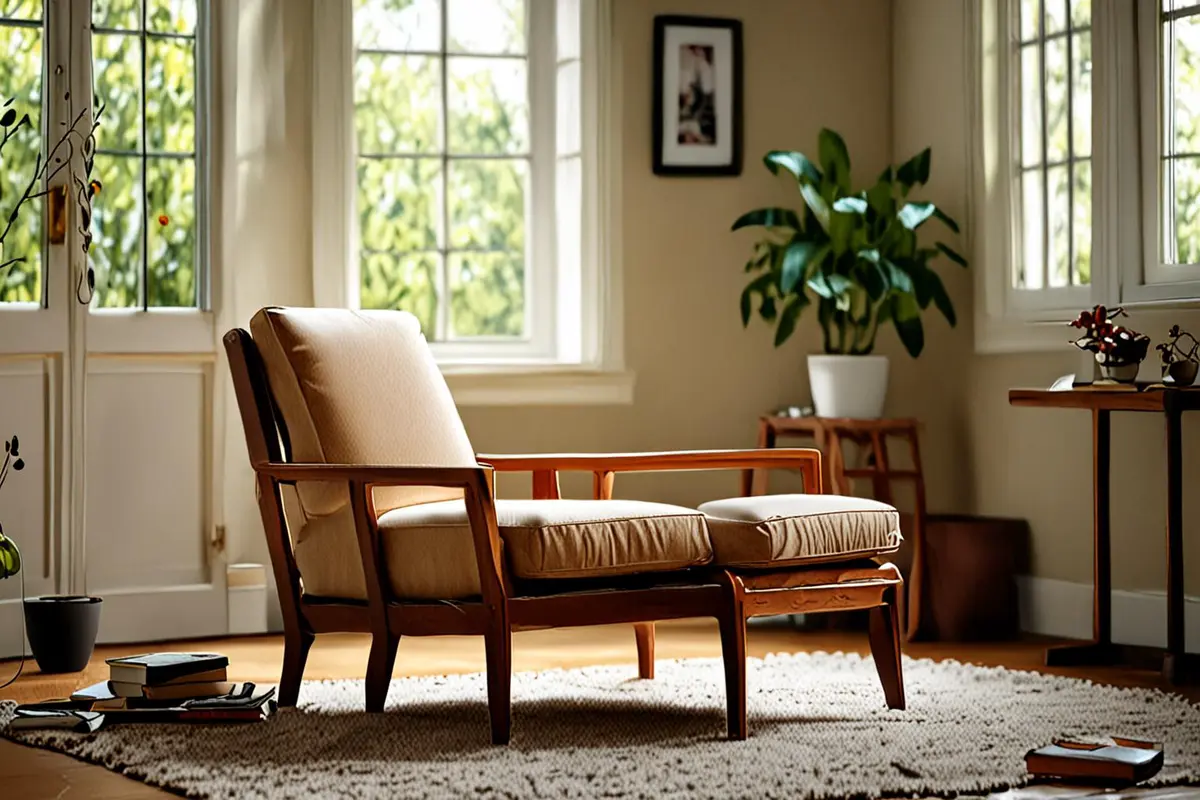
Your new accent chair looks excellent in the campaign image. The customer’s sofa has also disappeared, the window is wider, and the floor has changed. What exactly is the customer being asked to buy?
For overseas furniture and home brands working with Chinese manufacturers or production teams, this is a useful distinction to settle before commissioning AI lifestyle imagery. A scene can make the whole room more desirable while making the featured product’s individual contribution harder to judge. ONCE proposes a single-purchase test: does the main reason to buy survive when the customer keeps the rest of their room?
A personal room creates a different expectation
On October 19, 2026, Pinterest announced a Barbie experience within Restyle, using uploaded room photographs and themed edits, with options to add or swap decor. Its announcement described Restyle as a beta for eligible English-language users aged 18 and over on iOS in the United States and Canada.
That establishes a specific brand experience and availability boundary. It does not establish dimensional accuracy, practical renovation feasibility or a sales uplift. ONCE’s interpretation is narrower: when inspiration starts with a person’s own room, the things that stay become part of the purchasing question.
A generic campaign interior says, “Imagine this world.” An image derived from someone’s home can suggest, “This could work here.” If generating that suggestion silently removes an existing sofa or alters a doorway, the proposed purchase has changed along with the picture.
Brief the purchase before briefing the style
A complete room makeover is a legitimate creative task. It can suit a collection launch, a design consultation or a shopper already planning several replacements. A single-product page may serve someone who intends to keep almost everything they own. These require different acceptance criteria.
For a chair launch, a useful brief might read: “Show how this chair could join a living room whose dark sofa remains.” The design team still has choices about framing and mood. It no longer has permission to remove the sofa merely because a different room would look more coherent.
When the product team is in China and the marketing team is overseas, agree on those retained conditions together. A plausible-looking generated interior is not evidence that the target audience has that much floor space, owns those accessories or can alter a rental property.
Run ONCE’s single-purchase test at review
Remove the new item from the discussion
Look past the featured product and compare the result with the source photograph. Are the major existing furnishings, openings, surfaces and fixed features still recognizably the same? This is a review of buying conditions, rather than a demand for identical exposure or shadows.
Moving a magazine to reveal a side table is different from removing a dining table to make space for it. Ask the production team to identify substantial changes as generation errors, agreed presentation adjustments or approved makeover decisions. “The model improved the room” does not resolve which purchase the image represents.
Keep the old belongings and challenge the benefit
Suppose the proposed message is a better reading corner. If the result depends on a new lamp, a footstool and a larger window, the image demonstrates a broader arrangement. Either explain that arrangement or find a reason for the chair that holds with the existing room: its seating position, arm support or relationship to the available space.
The product owner should take part in this review. Art direction can assess appearance, but the team responsible for the item must establish which benefit it actually supplies. An image cannot supply missing installation provisions, electrical conditions or product capabilities.
Name the other work the shopper must do
Record additional purchases, disposal of existing items, installation and changes to the home. For each, identify whether it is required, who carries it out and whether the communication makes it apparent. Use confirmed supplier or brand figures when costing an item; leave unknown amounts unresolved.
Keep these burdens separate. A small additional purchase and permission to alter a wall are not interchangeable costs. For a renter, an unavailable permission may invalidate an otherwise attractive proposal. A single score would hide that condition.
Choose between an addition image and a makeover proposal
Consider a hypothetical chair launch, not an ONCE client result. One deliverable shows the approved chair joining an existing environment. Another develops a full interior direction around it. The latter may change several furnishings and finishes, provided that scope and the illustrative nature of the proposal are clear.
Price and review those deliverables separately. The addition image requires source-photo assessment, product checks and review of retained surroundings. The makeover proposal also requires decisions about companion items and room changes. Generating an unrestricted redesign first and asking for all the old belongings back later creates a different task.
For images intended to inform a purchase, verify the product variant, dimensions, materials and use conditions separately. Passing the single-purchase test does not establish fit or installation feasibility. Where important surroundings cannot be retained reliably, consider controlled photography and compositing, a verified 3D scene, or a clearly limited inspiration image.
Save the buying conditions with the asset
For repeat content production, archive more than the final attractive room. Retain the featured item, the intended existing environment, what had to remain, approved changes and the buying question the image was meant to answer. Those conditions help the next team decide whether a scene is reusable for another SKU.
This gives a production partner a repeatable service boundary: each new batch can be assessed against a known purchase task. It is ONCE’s proposed operating approach, not a claim of measured time savings or conversion improvement.
When briefing ONCE’s product and AI content team, bring one priority item, an authorized reference-room photograph and a description of what the audience intends to keep. Decide whether one purchase delivers the principal benefit before multiplying the style variants.
Source and limitations
Pinterest Newsroom, “Pinterest and Barbie bring DreamHouse inspiration to your space with Restyle,” October 19, 2026; checked October 29, 2026. The platform facts above describe the announced experience and beta scope. The decision test and procurement recommendations are ONCE’s analysis. The original AI-generated cover is a conceptual commercial scene, not a customer home, platform demonstration or fit verification.