If a brand approves three attractive frames of a recoloured product, has it approved the video? Not yet. The revised finish may look right while the object is still, then change as a hand passes in front of it or a reflection travels around its surface.
For global brands reusing footage from a China-based shoot, the buying decision is therefore more specific than whether AI can make the change. Can the change survive the actual movement in this source clip without altering the product? ONCE recommends separating approval of the desired appearance from acceptance of the complete moving result.
A useful research signal—with an important release caveat
The October 8, 2026 paper Transforming Image Editors into Video Editors introduces Anchor-based Video Editing, or AVE. Its two-stage approach edits selected keyframes, then generates the video between those anchors with guidance from source motion. The reported IVEBench and VIE-Bench results are research evaluations, not SKU-accuracy tests or commercial delivery rates.
There is also a material difference between the paper and the code a supplier can download. As checked on October 20, the authors' official repository says its public zero-shot release does not include the paper's trained motion encoder, control branch or fine-tuned image-editor weights. The released workflow uses a text-based motion description instead of that trained motion pathway. Do not transfer the paper's scores to the public pipeline, a vendor demo or your production schedule.
The procurement lesson is modular approval: decide what the revised image should be, then separately test how it persists through time. The review method below is ONCE's recommendation, not an AVE procedure or a claim that ONCE has deployed the system.
Start with an edit specification and a preservation specification
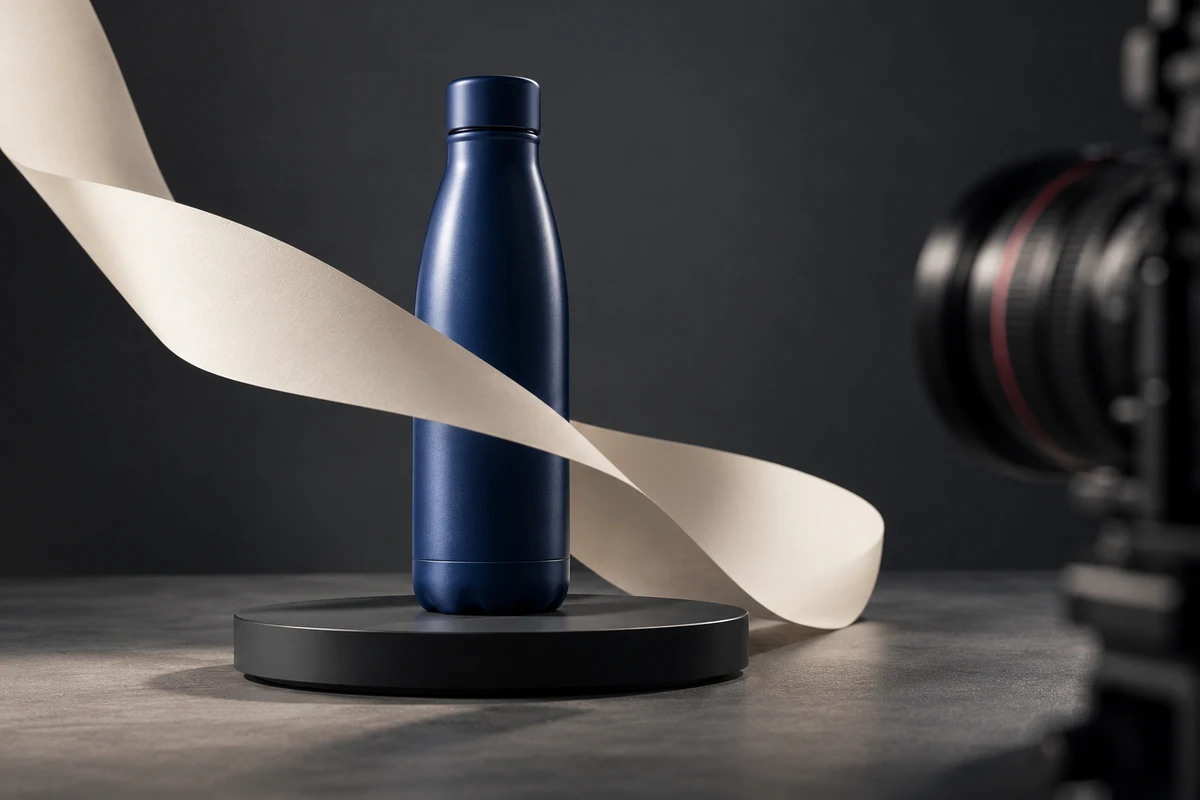
Consider a hypothetical insulated bottle filmed in silver, which the brand wants to show in an existing navy variant. This is an illustrative brief, not a client case.
The edit specification names the body finish that may change and the approved physical sample or colour reference. The preservation specification names what must stay: lid geometry, seams, opening proportions, hand position, grip, contact with the table and shot duration. A more attractive synthetic finish is not automatically the correct product finish.
State which secondary changes are allowed. A new environment may require a different reflection or shadow; it does not permit a different bottle diameter. Removing a prop does not authorise inventing a connector that the prop previously hid. If the target variant is a concept rather than an available product, evaluate it as such rather than presenting it as saleable stock.
Attach source timecodes and version identifiers to approved frames. Label that approval narrowly: appearance direction accepted, full temporal result still pending. A still cannot approve a surface it does not show.
ONCE's event-crossing review
Instead of choosing review frames only at equal intervals, locate changes of state in the shot. These events identify where closer inspection is useful; they are not a claim that a small sample guarantees the whole clip.
| Event in the source footage | Acceptance question |
|---|---|
| The object turns away from its front | Does the newly visible surface remain the same product, with the intended edit? |
| A hand covers the object and moves away | Do the seams, finish and texture return correctly, with proper overlap? |
| A highlight moves across a curved surface | Does the material respond continuously, without turning into a different material? |
| The product is lifted, placed or touched | Do the edge, contact shadow and hand action agree, without floating or intersection? |
For each event, inspect the approach, the transition and the recovery, keeping the complete event segment available. Watch at normal speed for a natural result, then examine product-critical areas frame by frame. Do not use slow motion as the sole judge of pacing, or normal-speed playback as an excuse to miss inaccurate product details. Text, graduations, ports and small mechanical structures may need full frame-by-frame review throughout their visible duration.
Finally, review the entire finished sequence and the actual delivery file. Event-based inspection directs attention; it does not replace final-file QA.
Diagnose the failure before buying another generation
The approved frames are already wrong
If the navy is wrong or the lid has changed shape, return to the image edit, reference or selection. Generating more motion around an incorrect design will not resolve a product-identity decision.
The frames are right, but the transition breaks
If the silver finish returns after a hand moves away, the issue is temporal persistence. Possible routes include shortening the shot, adjusting references, narrowing the edit, or using tracked masks and local compositing. Choose through a test on the actual source. A different prompt is an option to evaluate, not a guaranteed repair.
The required product information is absent
If a turn reveals an undocumented rear surface, a plausible generated detail is still a guess. Obtain another real angle, verify a 3D asset, or reshoot where necessary. The source of truth must remain the product, not the most convincing generated candidate.
These three diagnoses lead to different work. A supplier who can explain the distinction provides more decision value than one who simply offers more attempts.
Buy a difficult test segment before a batch of variants
Use a representative segment with the real complication—such as a turn combined with a hand occlusion—not the easiest locked-off shot. Isolate one requested edit and document any permitted lighting consequences. A trial that changes the colour, material, environment and action at once will be harder to interpret.
Structure scope around appearance references, a feasibility test on the event segment, and full-shot processing after the route is accepted. Define optional conventional compositing, 3D or reshoot work separately. No route is automatically the cheapest.
Before starting, agree on the non-negotiable preservation items, included trial revisions and the labour or cost ceiling that triggers a new decision. A client changing the target finish is different from a supplier repairing a broken seam that was always required to remain intact.
For internal comparisons, use: deliverable revision cost = reference approval + feasibility test + full-shot processing + manual repair and review + export checks. This is a scope model, not a market-price benchmark. Failed generations consume resources too; a low per-call price is not a completed revision price.
Preserve decisions that make the next revision easier
Keep the source clip, approved references, edit and preservation specifications, event timecodes, repair notes and delivered version together. Those review positions can be reused for a later colourway, but the new finish still needs inspection. Approval does not transfer automatically between variants.
For brands working with Chinese suppliers and production partners, this creates a practical handoff: the brand confirms the real product, the producer proposes an executable route, and the finishing team accepts the result across the timeline. ONCE's product video production in China can begin with that source-and-edit brief rather than a promise to generate an entire catalogue immediately.
The durable asset is not just the edited file. It is a documented understanding of which modifications survive the shot, which require conventional finishing and which need additional real footage. That knowledge can make later scoping more informed without pretending every new variant will be effortless.
Sources were checked on October 20, 2026. The cited research and repository support the technical description only. The event-crossing review, hypothetical bottle and commercial scope model are ONCE analysis; no original system test, client outcome or cost saving is claimed.