Before commissioning a batch of AI ecommerce graphics, decide which claims belong to each purchasable variant. An image can preserve the product's appearance and render every word correctly while still promising an accessory the customer will not receive.
That is the useful production lesson in CommerceGen-Studio, published on October 14, 2026. The Alibaba Group paper links SKU information extraction, layout rewriting and image generation. It explicitly addresses conflicts between listing-level images and a selected SKU, and distinguishes source-supported selling points from faithful rendering of approved text.
For an overseas brand working with a Chinese supplier, this moves part of the buying decision upstream. Agree who resolves the product information before asking a creative vendor to multiply it into languages, layouts and images. Here, “graphics” means placements that permit product, text and brand elements together; the paper's term “main image” is not a universal marketplace format specification.
Work backward from the promise in the finished image
The incoming folder may contain a family hero image, variant photographs, a specification sheet, listing titles and old promotion assets. They may describe different versions or offers. Putting them into the same generation request does not establish which statements remain valid.
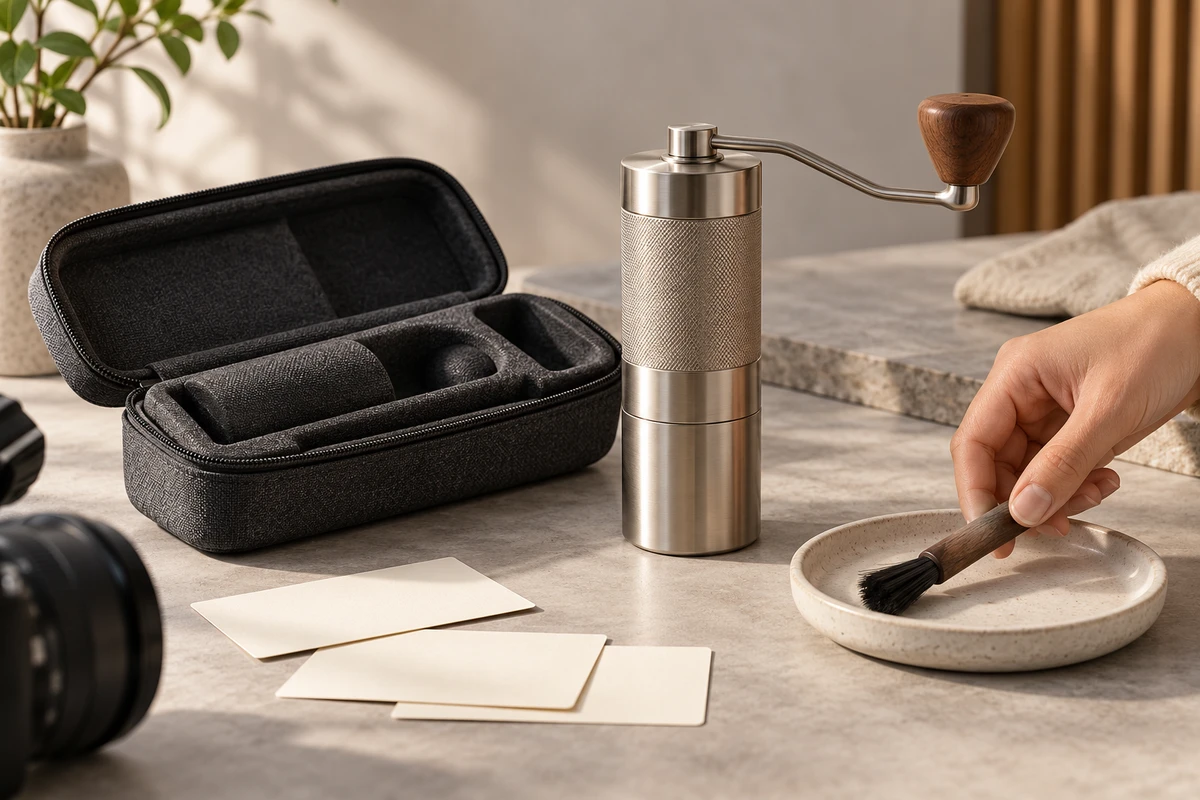
Consider a hypothetical portable coffee grinder sold as a standard unit and a travel bundle. The bundle includes a carrying case. An earlier promotion also offered a cleaning brush. This is an illustrative scenario, not an ONCE project.
A graphic showing all three items beside a phrase about travel essentials could leave the buyer with the wrong impression about the current offer. Checking only the grinder's color and shape would miss that problem.
Resolve the selling combination first. The product team confirms the item and its properties; the commerce team confirms the current bundle or offer; the production team expresses the approved meaning. A supplier's product-family asset can be useful without being authoritative for every variant your brand sells.
Use an ONCE Claim Source Record
ONCE proposes one short record for each approved selling point, reused across languages and formats. It can live in a simple table. It is a proposed working method, not a certification or a substitute for checking the product.
| Record | What the team needs to establish |
|---|---|
| Approved wording | What may be stated, and how freely may it be rephrased? |
| Product scope | Which model, variant, bundle and version does it describe? |
| Source location | Which approved document or inventory supports it, and where? |
| Conditions | Does it depend on an accessory, operating setup, offer period or market? |
| Owner and version | Who confirmed it, when, and who will notify later changes? |
Where sources conflict, surface the conflict for the responsible person. A family image showing a case and a standard-unit packing list omitting it require a decision about the current offer. Visual polish, repeated wording across pages or a more persuasive headline cannot settle it.
An unresolved claim can stay out of the batch while other confirmed material proceeds. That helps the marketing team distinguish a missing product decision from unfinished design work.
Localization should refer back to the same record. “Case included in the travel bundle” must retain its bundle qualification in another language. If that qualification affects what the buyer understands, it belongs with the claim in the final composition. When the words do not fit, reduce the intended message or revise the layout deliberately.
Send the correction to the stage that caused it
The paper's staged approach makes a practical distinction useful for commissioning. ONCE recommends identifying the cause before ordering another generation.
The product fact was selected incorrectly. The standard variant was described as including a case. Correct the claim record and identify all graphics that use it. A different image model cannot determine what the brand is currently selling.
The rewrite removed an essential condition. The approved record named the travel bundle, but the final copy dropped that restriction. Repair the wording and translation, then accommodate it in the layout. Correct product photographs and other visual elements may remain usable.
The rendering changed approved content. A character is missing, an extra accessory appears or the product structure changes. Address generation, compositing or typography. Where needed, use photography and conventional design to deliver the difficult detail. The correction follows the problem rather than a requirement to keep every step generative.
Research evaluation has its own setup and scope. This article does not convert benchmark results into a brand's publishing pass rate, conversion gain or production cost, and does not imply that ONCE has deployed CommerceGen-Studio. The product owner still needs to confirm the facts and intended sales use.
Buy information preparation and image production explicitly
A comparable scope identifies what approved material the client supplies, what the vendor must reconcile, who approves claims, how many visual and language variants are required, and how exceptions will be handled. Sorting conflicting historical assets is a different amount of work from laying out a clean, approved message.
For an initial batch, include a straightforward item, a visually similar variant, a bundle with additional accessories and a product with an unresolved information conflict. Observe where information approval and visual production each stall before expanding the relevant work. This is ONCE's proposed trial sequence, not the paper's experiment or a platform rule.
Keep a basic relationship between a claim record and the files that use it. If the case leaves the bundle, review the affected graphics and translations. A background-color change need not reopen an unchanged bundle decision, unless the new image changes the meaning. Broaden the review when a substantive dependency requires it.
This also gives an overseas team and its Chinese supplier a shared place to resolve changes. They can discuss a particular product statement and version instead of circulating screenshots with an instruction to “make it more accurate.”
For a production business, a versioned set of approved product information and its visual uses could become a reusable part of an ongoing content service. ONCE sees that as a business opportunity, not a measured client benefit. Information approval, batch production and ongoing maintenance each need a defined task and commercial scope.
If the underlying product references need to be filmed or photographed, plan those assets before commissioning the full graphic set. ONCE's ecommerce product production in China can help organize product evidence, photography and video as agreed deliverables. Bring the current variant list, packing details and the sources behind each proposed claim to the brief.
Source and limits
Xiaoli Xu and colleagues, Alibaba Group, CommerceGen-Studio: An End-to-End Framework for Commercial-Grade Main-Image Generation, arXiv:2610.20603v1, October 14, 2026; checked October 21, 2026. The method's information conflicts and output-consistency requirements inform this analysis. Deployment scale, speed and model rankings are not presented as customer outcomes.
The Claim Source Record, correction routes and procurement recommendations are ONCE's original analysis. The grinder and bundle are hypothetical.