Film the same portable speaker with a perfectly even orbit and it may look clean and polished without feeling substantial. The problem is not necessarily the product's size, and slow motion is not the only answer. Viewers infer weight from changes they can compare: when an object begins to move, whether the action appears to meet resistance, how speed builds, and how the movement resolves. Camera movement should give those changes a reference instead of performing every beat before the product does.
This is an easily missed tension in product advertising. A gimbal, slider, or motion-control rig can produce an exceptionally smooth path, but smoothness describes execution, not meaning. Panavision's filmmaking guide argues that a camera move should begin with a reason, and that a locked frame can sometimes be the strongest choice. Adobe similarly notes that tracking shots require coordination with subjects, lighting, and other moving elements. In a product film, the real design problem is therefore not the beauty of a curve but the relationship between the camera and the product's action.
Weight Comes From Change, Not Uniform Slowness
If the product and camera start at the same moment and travel at the same speed, the frame has no clear point of departure and may have no stable background reference. Motion is present, but the viewer cannot easily tell whether the object is applying force, the table is receding, or the whole scene is drifting together. That floating quality can suit a lightweight, frictionless, or futuristic idea. It can work against a speaker, tool, or suitcase that needs to feel grounded.
Weight is more legible at moments when before and after are visibly different:
- Before the move, establish a stable relationship between the product and a table, hand, or base.
- At startup, show preparation: fingers tighten, a wrist takes load, or the object briefly resists motion.
- During acceleration, consider letting the object move before the camera follows.
- At the stop, leave room for a hand to settle, a strap to swing, or a soft surface to compress slightly.
There is no universal number of frames or milliseconds for these beats. A speaker, perfume bottle, and suitcase differ in scale, while performance, focal length, shot size, and playback speed all affect perception. A more reliable method is to shoot comparable action variants, then decide whether the camera should synchronize, lag, or remain still.
Four Variables Turn Movement Into Meaning
1. Start Point: What Moves First?
When the product moves first and the camera follows, the viewer sees the object leave rest. When the camera moves first and discovers the product, attention is guided toward an object. When both start together, coordination and fluidity take priority. All three choices can work, but they do not say the same thing.
If the intended value is solidity, stability, or a confident grip, hold a brief fixed observation while the hand makes contact, then bring the camera into the action. If the value is lightness, portability, or freedom, the camera may join earlier and use a longer glide to connect product and space. The better choice is not the one that looks more expensive; it is the one closer to the intended use experience.
2. Speed Curve: How Does the Move Begin and End?
Constant speed is useful for presenting a silhouette and keeping packaging copy readable. A move with visible acceleration and deceleration is better suited to showing a physical process. A useful shot description therefore names the start, the point of acceleration, the action that triggers deceleration, and the final position.
Motion control can make a path programmable and repeatable. In its documented Silentnight commercial, production company oXyFire describes using motion control to repeat a planned camera path and maintain a consistent relationship with the bedroom composition. Repeatability is a production capability: it supports comparison, compositing, and retakes. It does not decide which speed curve is appropriate for a particular product.
3. Spatial Reference: What Stays Still?
Weight needs reference. A textured surface makes horizontal travel visible. A hand supplies scale. Shadows and contact points tell us where the object sits. If the background, focal length, product angle, and lighting all change while the camera moves, the viewer loses the basis for comparison.
Give a shot one main visible change whenever possible. Decide the product action first, then the camera path. If the lighting must transform or the product must rotate, consider moving that change into another shot. The same discipline helps with AIGC previs: define the subject, start and end points, speed, and constants separately rather than asking for a vague "cinematic slow orbit." If a generated clip changes the object's form, material, or branding, it remains a concept sketch, not evidence of the real product.
4. Stopping Allowance: When Does the Camera Stop Helping?
Many product moves fail at the end rather than the beginning. The camera continues to orbit after the object has landed because the team wants a silky finish, then the edit cuts away mid-motion. The viewer sees a path without a destination, and the product never quite returns to a use context.
Test three endings: stop the camera first and let the product enter the final frame; stop camera and product together to create a deliberate hero composition; or stop the product first and let the camera use a short final movement to reveal new information. The test is not which version is smoothest. It is whether the remaining movement gives the audience something worth seeing.
A Fictional Portable Speaker, Built as an Action Study
Imagine a 15-second film for an unbranded portable speaker. The goal is not to claim a specific weight, drop resistance, or anti-slip performance. It is to suggest that the object feels grounded in the hand yet easy to carry. The core action could be divided into four beats.
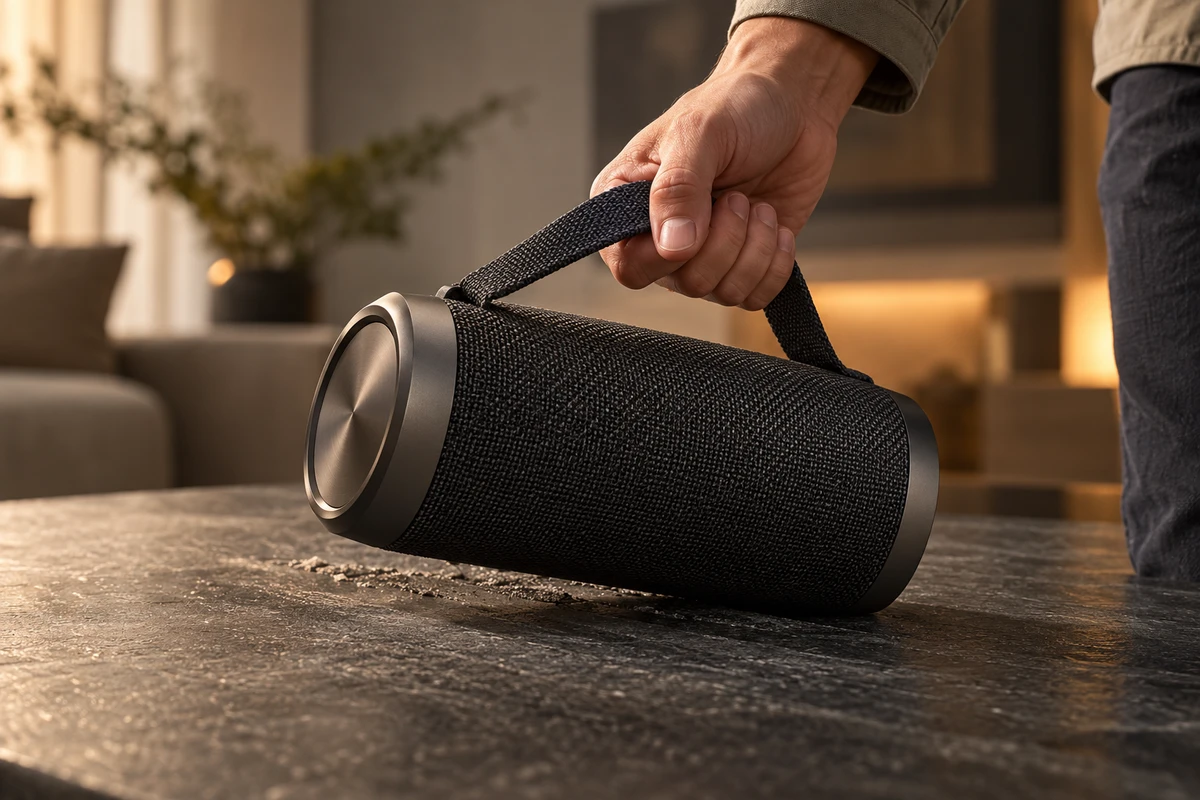
First, the speaker sits on a subtly textured stone surface in a locked frame. A hand enters, touches the strap, then tightens its grip. The pause establishes the product's relationship to the surface.
Second, the hand drags the speaker a short distance before lifting it. The camera does not follow immediately, allowing the surface texture to show displacement. Once the speaker leaves the table, the camera tracks alongside it. Drag, lift, and follow become three readable events.
Third, the performer turns and carries the speaker into a living space. The camera can now maintain a steadier speed because this beat is about portability rather than weight. A doorway or furniture edge supplies scale and travel distance.
Fourth, the speaker is placed on another surface. The camera decelerates before the object lands and settles into a three-quarter front view. The strap gets one natural swing, but no exaggerated vibration implies unverified weight or durability. Product information appears only after the frame rests, giving viewers time to read it.
This is not a finished-film template. Real weight, strap construction, surface friction, performer habits, and focal length all require sample testing. Its value is to translate "make it premium" into action relationships that a crew can rehearse and compare.
Live Action, Motion Control, and AIGC Have Different Jobs
Live action is best placed to record contact, resistance, and stopping because those details come from the actual interaction among object, hand, and surface. Gimbals and sliders can create a controlled follow, but their start and end points still need rehearsal. Motion control is useful when a move must be repeated for compositing, retakes, or version comparison. It solves repeatability, not creative intent.
AIGC is better used to test composition, path, and pacing hypotheses or to extend an environment that is impractical to shoot. Camera trajectory and object trajectory should be described separately, with product proportion, material, light direction, and background held constant. If the output changes construction, contact, or brand marks, it should not be used as functional proof. The right hybrid workflow depends on what the ad must substantiate, not on which tool was released most recently.
A Good Camera Move Makes the Product Easier to Believe
Three questions can expose whether a product-ad camera move is doing useful work. Without movement, is the product action still clear? After movement is added, does the viewer gain new information about scale, resistance, or direction? When the camera stops, does the thing the brand wants remembered finally appear?
If the only answer is "the image feels smoother," the move may still be decoration. Effective movement gives startup, weight, portability, and precision different rhythms instead of applying the same floating orbit to every object.
If you are shaping action and camera movement for a product launch, ONCE can turn the real sample, performer movement, camera path, and versioning needs into a testable shooting plan before production. Explore our product video and commercial visual production services, or bring the actual product and media context to a planning conversation.
Sources and Scope
The movement principles in this article draw on Adobe's guide to tracking shots, Panavision's camera-movement lesson with cinematographer Mia Cioffi Henry, and oXyFire's production record for its Silentnight motion-control commercial. The AIGC section also considers Vife's September 15, 2026 article on describing product-video camera paths. The portable-speaker example is an original fictional exercise, not a client case or product-specification claim.