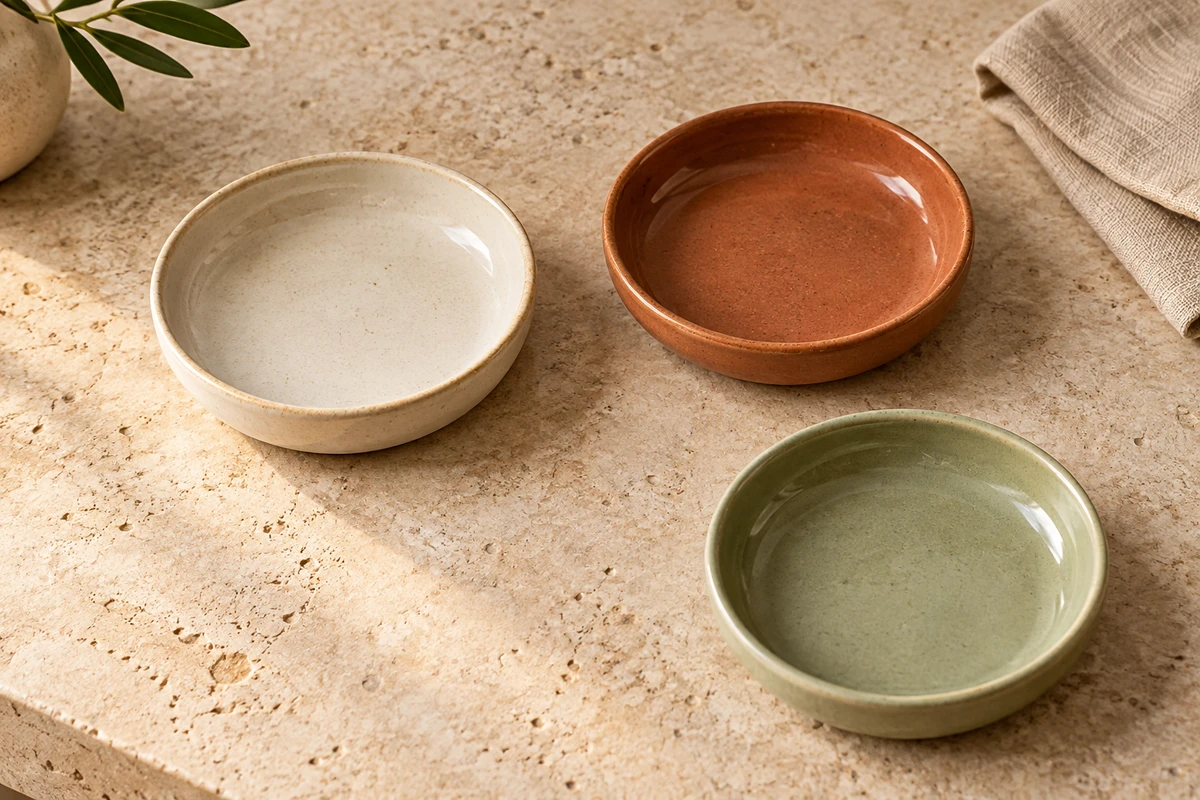
Two small dishes sit close together. A third slowly approaches from the edge of the table. The first two pause; one moves aside to leave a space. The newcomer enters, and the three settle into a small gathering.
This is an original, fictional tableware advertisement. There are no faces or hands, yet viewers may still read a simple action: making room for someone else. Product stop motion can develop its appeal through such relationships, beyond spinning, bouncing or arranging products into tidy patterns.
The proposal expresses an invitation to eat together. It is neither a claim that tableware moves automatically nor a material or durability test. Establish that intention before deciding how far to move a dish between pictures.
Find a verb before moving the product
Dragonframe's official Introduction to Stop Motion Animation describes moving physical objects between captured frames, then playing the images consecutively to create the appearance of independent movement. We use that basic principle, not a fixed frame rate as the definition of every stop-motion style. The page gives no publication date; it was consulted on 20 October 2026.
The method gives inanimate objects movement, but it does not decide their character. Three dishes travelling around a circle at a steady pace could make a lively product display. One dish stopping while another makes room concerns how they relate. Both directions can work; they do different jobs.
“Lively, playful and full of personality” is not yet enough to direct the movement. Try a specific verb instead: yield, catch up, avoid, wait, gather. Each asks whom the object relates to and what changes through its action.
For our tableware proposal, a space must actually be made. If all three rotate evenly throughout, the newcomer encounters no obstacle and the others never respond. The welcome may exist only in the presentation copy.
The same objects could perform a different relationship: two dishes continually occupy the space while the third approaches and retreats. That might express awkwardness, but it runs against a warm invitation. Motion design chooses a position, not just a speed.
A move needs an impulse, a passage and a landing
The dish making room could remain still until the third approaches, then move a little sideways. Once the space opens, it stays there while the newcomer enters. That final stillness lets the offered place become visible.
If it immediately circles away, viewers may see avoidance rather than invitation. If the first two form a perfect circle before the third approaches, the image may suggest an automatic formation. When the action happens affects how it can be understood.
When arranging individual frames, try varying the distance between successive positions: smaller at the start, opening out through the move, then approaching the landing. An abrupt, short movement is another option. No curve is inherently more sophisticated. Moving gently aside and springing away give the same yielding action different tones.
The object that stays still is performing too
Moving everything simultaneously can bury the relationship in activity. Keep two dishes still while the newcomer enters. Then let the newcomer wait as one dish responds. There is an opportunity to distinguish who initiates and who answers.
The camera must preserve that response. An overhead view can place the gap and movement path on one plane. A lower angle may show the rim and glaze more clearly, while increasing overlap between objects. Compare the actual compositions rather than assuming one angle inherently looks more like stop motion.
Music can organize the rhythm without demanding a jump on every beat. If the invitation needs a brief wait, allow it to extend across a musical accent. Otherwise, neatly synchronized dishes may seem led by the song rather than by their own reason to act.
Handmade character comes from choices, not every accident
Stop motion need not resemble continuous live action. A slightly interrupted movement can be an expressive choice. Deliberately brisk dish movement is different from a tabletop drifting or brightness changing without a reason.
The official Dragonframe Software Features page describes switching between live view and captured frames, overlaying images and playback. These tools help compare states; they cannot decide what the action means. We consulted the current page on 20 October 2026, without testing the software or camera compatibility.
A small motion test for this tableware could separate two questions. First, examine the action: is the space clear, and does the newcomer wait for a response? Then examine what should not be changing: the table edge, the orientation of the dish's pattern and the intended lighting. This is a production proposal, not a test performed for this article.
If the camera needs to move, design its motion alongside the dishes. Asking viewers to notice a small sideways response while sweeping across the table may conceal that response. More movement does not necessarily convey more information.
Personification does not require eyes or bending ceramic. Tableware can keep its original shape and rigidity, with distance, direction and waiting establishing the relationship. Replacement models, compositing or other deformation should be explicit animation choices, not fantasy shapes slipped into a factual account of product construction.
The same distinction matters when discussing AI imagery with a stop-motion look. Under the frame-by-frame definition above, interrupted movement alone does not establish that physical objects were photographed one frame at a time. A proposal can discuss a similar rhythm while production records accurately identify the method used. A familiar style does not establish correct product outlines or details.
After the activity, leave time to see the object
Once the three dishes gather, they can remain still. The landing completes the invitation and offers time to see the tableware: do the rims, colours, patterns and relative dimensions match the actual samples?
If glaze and surface detail matter most, a stable close-up can have its own place. Capacity, suitability or cleaning instructions need accurate information and appropriate demonstration. The gathering animation cannot quietly carry those promises too.
A short version also needs its own small action. Keeping the approach, the yielding response and the shared stillness may retain the idea better than selecting the busiest rotation. If the version contains only three dishes jumping into frame, let it be a cheerful product entrance rather than expecting it to communicate the complete invitation.
In boards or a rough motion draft, arrange the same dishes in two versions: one constantly changes formation; the other contains a single motivated act of making room. Ask what happened, not which version moved more. If the answer remains only “the dishes were fun,” develop the wait and response before adding more props.
For a product film of this kind, bring the actual sample and one verb you want the object to perform to ONCE's brand film production discussion. Explore motion, material and camera together. After this small dish moves aside, what has another object—or someone beyond the frame—gained?
Source note: Both Dragonframe official pages were consulted on 20 October 2026. We did not watch peer case-study films or conduct filming, software, product or audience tests. The tableware proposal and original AI-generated cover are fictional concepts, not ONCE client projects.