The most useful design choice in a POV product ad is not making the image look as though a camera is strapped to a forehead. It is giving each act of looking a reason. Why look towards the door before searching for something? Why does a hand reach out, then withdraw? A character can remain off camera without losing their attention, hesitation and choices.
A sequence of opening, taking and placing may be a clear demonstration. To make it someone’s viewing experience, establish what that person wants to do, what redirects their attention and whether the audience can discover it with them.
Camera position answers only half the question
The Adobe Stock metadata field guide, updated in August 2021, defines point of view on PDF page 64 as showing what a subject sees from that subject’s perspective. Only that basic terminology is used here, not the historical guide’s platform rules for titles or keywords.
The emphasis is whose view it represents, not whether hands appear. An overhead view can be chosen to clarify a layout; a view towards the table from a character’s eye position stands in for their looking. Both may contain the same hand and product while doing different narrative work.
Continuous shaking is not required to establish first person. A seated character looking closely at something can have a relatively quiet view. Conversely, an unstable camera seeking attractive angles from places the character could not see may remain a freely roaming camera. This is a creative judgment about viewpoint, not a prescribed equipment or stabilisation setting.
Separate another pair of choices, too: an “I” in the voiceover does not require every image to show what that speaker sees. A personal account can accompany external views, while a silent sequence can borrow someone’s eyes. Specify narration and camera position separately rather than relying on a loose “POV style” label.
An unseen character can still make a specific choice
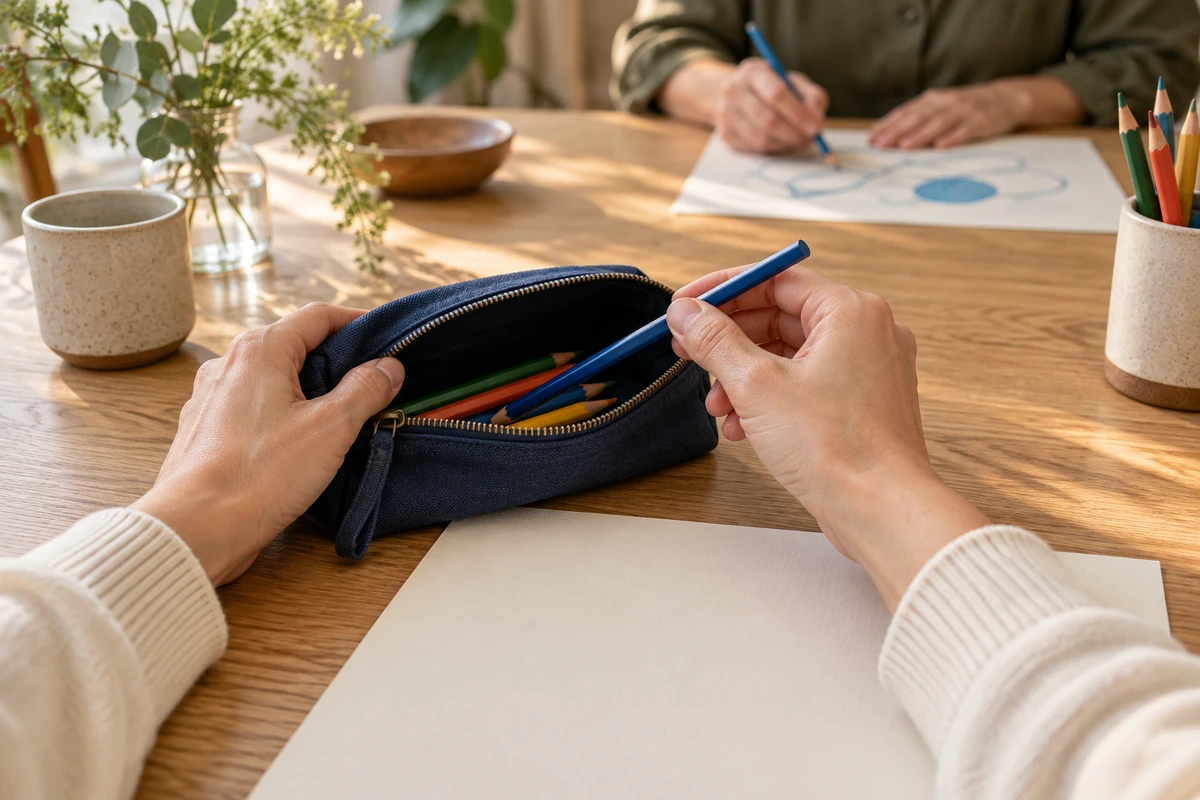
Imagine an original, fictional canvas pencil-case advertisement. An adult joins a communal drawing activity for the first time and takes a seat. The view turns first towards a neighbour’s already intricate lines, then down to the newcomer’s blank paper and familiar pencil case. A hand opens the zip, pauses among several pencils and selects a blue one to make a simple first line.
There is no need to label the person shy or lacking confidence. They have not started yet. Looking at a neighbour, returning to their own belongings and choosing a pencil provide actions to develop. The case supports taking something out; it does not cause courage or improve drawing ability.
Compare two information orders. An establishing view can first show the table and participants, before a POV brings us closer to this person’s choice. Alternatively, withholding that overview lets the audience discover the neighbour’s work and the blank paper through the character’s turns. Delaying discovery is not inherently better. The overview may be more useful when a short film needs to establish the activity quickly.
Give each turn a job. Looking towards the neighbour establishes how the activity has begun; looking at the case finds a personal starting point; looking at the paper prepares an action. If the camera suddenly circles in front of the person merely to display the case’s exterior branding, acknowledge a separate product shot. Do not invent an impossible eyeline to justify it.
Without a face, the hand need not perform the entire scene alone. A reach briefly delayed, another look at the paper after picking up a pencil or clearing space before drawing can all become performance material. They should belong to the immediate task rather than adding hesitation every time a product is touched. First contact and familiar use deserve different rhythms.
Sound can also motivate a turn. A neighbour says something relevant to the activity; the character looks up before returning to the paper. Or the sound of paper sliding closer precedes finding the person offering it. This explores sound and attention, not a rule to exaggerate every breath and fabric noise or a claim that designed sound objectively records an experience.
End the POV when we need to see the person
If the important moment is the expression after that first line, an external view is not a failure of the earlier form. Having followed the character’s attention, we can now watch them continue participating. Sustained and occasional POV are different arrangements, not different levels of professionalism.
The product may also need another position. Looking down to take a pencil can reveal the opening and interior without presenting the exterior shape well. A separate, accurate detail shot can explain material, zip or structure. Maintaining a “first-person throughout” label does not justify calling an inaccessible camera position the character’s view.
If the main task is explaining how the case opens or how its compartments work, a clear, steady demonstration may be preferable. There is no need to invent a psychological change and make a character perform every feature. Conversely, a brand film about beginning need not explain every compartment before the first mark.
Ask why the person looks, not merely where the camera goes
During rehearsal, let the performer complete the task and identify what needs attention before selecting the looks worth filming. Ordinary action is not automatically correct. It provides a starting point for discussing how an added presentation requirement changes a turn or pause.
Then compare rough storyboards: what does the audience already know, what has the character just discovered and does the next view still belong to the same position? This is a proposed creative comparison, not a shoot or audience test conducted for the article. It cannot guarantee identification, recall or conversion; it can make the intended relationship more concrete.
Preserve one final factual distinction. Looking through someone’s eyes does not establish a real customer’s experience. Performance, generated imagery and recorded use have different origins. First-person framing cannot turn an invented experience into a customer testimonial.
The valuable part of POV is not a fixed handheld appearance. It is whom the story needs us to look with. If a conventional product view preserves every choice and discovery, perhaps this film does not need to borrow the character’s eyes.
For a POV product ad, bring the real sample, the character’s immediate task and the discovery worth preserving. Discuss eyelines, performance and product imagery through ONCE’s brand film production service.
Source note: the terminology page of the historical Adobe Stock guide was read and its PDF page inspected on 20 October 2026. The remaining discussion is original creative analysis. The drawing activity, pencil case and original AI-generated cover are fictional concepts, not ONCE client work, real customer experiences or filming tests.