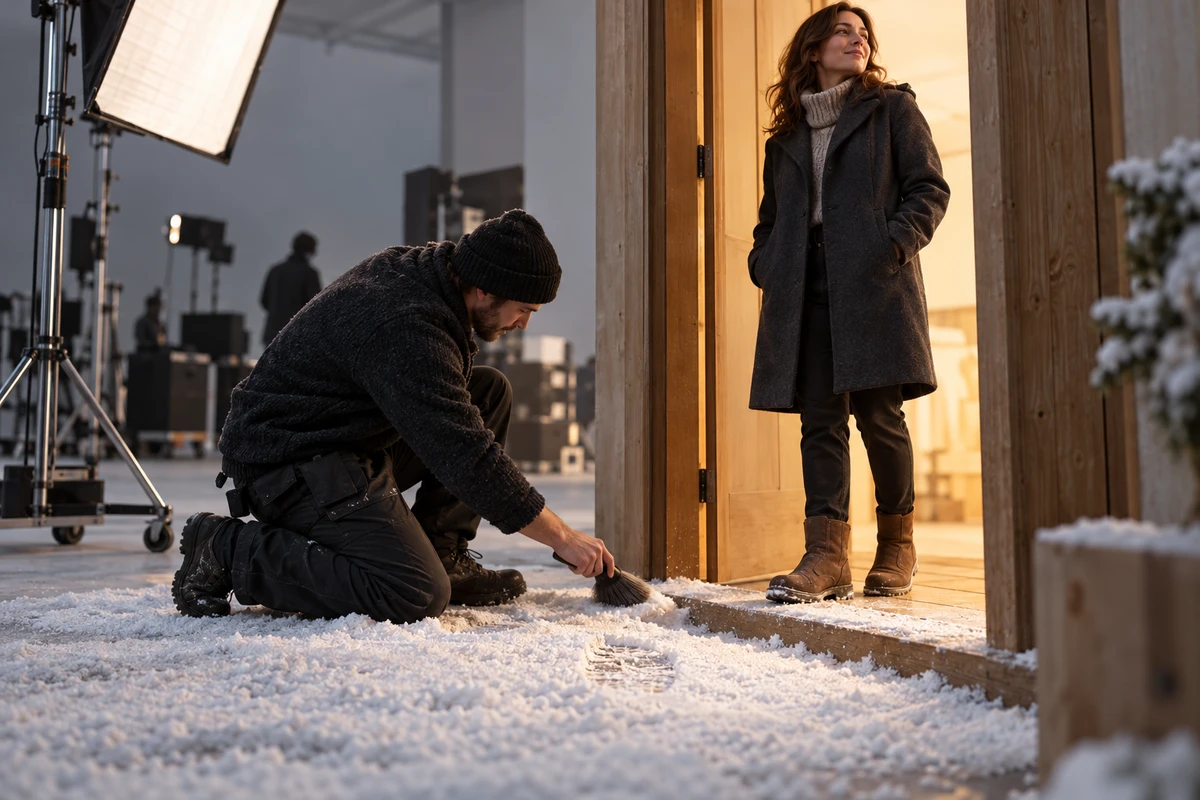
A winter background and a winter scene are different production tasks. A distant snowy street may establish the season. A hand brushing snow from a coat, or a boot leaving a mark at a doorway, adds a relationship that the shoot or post-production must actually deliver.
For an overseas brand commissioning seasonal content through a China-based partner, that distinction belongs in the brief before choosing a location, a physical set or a virtual stage. Start with what the cast and product need to do. Then commission the environment that supports it.
What out-of-season shoots can—and cannot—tell us
In its October 14, 2026 article, Behind The Scenes At MR PORTER’s AW26 Shoot In New York, MR PORTER describes filming an autumn/winter campaign in summer, with heavy outerwear in 30°C heat. That is the brand's account of one production, not a benchmark for conditions or costs elsewhere.
Garden Studios' November 28, 2025 account of Tropic Skincare's 2025 Christmas advert describes a digital winter street combined with physical props, a delivery truck and foreground snow effects. A separate Havas Digital Kyiv case, ADIDAS – “For every journey”, describes combining artificial snow, location choices and post-production for a winter campaign made in summer. We could not confirm a publication date for that page.
These written accounts were checked on October 20, 2026. We have not independently inspected the shoots or evaluated the films. Their useful contribution here is the division of work, not proof that virtual production, physical effects or location filming is universally cheaper or better.
ONCE's contact rehearsal
Imagine a fictional outerwear commercial: someone reaches a doorway, pauses and brushes a shoulder before going inside. This is a proposed scene, not an ONCE client case. The snow may establish arrival from outdoors—or it may be decoration that the story does not need.
We propose a contact rehearsal before dressing the set with snow. Walk the planned action without the effect, from the intended camera positions. Directing, art, wardrobe and post identify where contact occurs, what visible change it creates and the condition the next shot must begin with. This is a planning method to validate in a real project, not a completed effects test.
A wide shot might only need the character approaching a house. A tighter shot of the shoulder may require a visible relationship between hand, fabric and snow. Sharing the same background does not make those two foreground tasks identical.
If removing the snow from the shoulder changes nothing important, simplify the action or framing. If that gesture tells the audience the character has just arrived, keep it as a specific production requirement. The answer need not be more snow. It may be one clear interaction rather than several seasonal gestures competing with the product.
Rehearse the reset, not just the first take
Sketch three states: before the action, after it and at the start of the following shot. Is the shoulder clean or marked? When the wide shot is repeated, does wardrobe restore the starting condition or retain the previous take's result? What needs to change if the close-up is filmed first?
Ask what must be restored before asking how quickly another take can begin. The responsible departments should propose an executable approach, test the required interaction and check whether the footage will join. Keep references for the approved start and end states. Continuity does not mean every story moment must show identical snow; it means the changes should make sense.
Contact does not always require a physical effect. A compositing proposal should be tested with the necessary performance, foreground elements and correction scope. Not doing something on set is not the same as removing that task from the production.
Keep foreground work in the comparison
Once the action is defined, compare approaches to the same shots. Ask each team what the location, physical set or digital environment covers; what interaction remains on set; and what post must finish. A background-only proposal is not equivalent to one including garment preparation, visible contact and continuous action.
The scope should make background development, interactive foreground work, between-take restoration and post integration understandable. These are work categories, not four mandatory packages. A route that reduces physical dressing may introduce digital asset development or additional post. Keep both sides in the comparison rather than promising savings without project evidence.
Effects materials, site protection, clean-up, disposal and working arrangements need confirmation by the appropriate professionals for the actual materials, location and applicable requirements. A reference image does not establish that an effect is suitable for skin, a garment or a product. Real cold or discomfort should not substitute for performance and preparation. This article supplies neither a snow recipe nor safety thresholds.
Likewise, a staged winter interaction is not, on its own, evidence of warmth, waterproofing or grip. Any performance message needs the relevant product support and brand review.
Save the method as well as the scenery
With client authorization and an agreed usage scope, reusable production material can include approved camera positions, blocking, foreground implementation notes, continuity references and unresolved limitations—not just the digital street. A new coat length, product or gesture may change the contact even when the background is retained.
For ONCE, making that preparation understandable and adaptable is a possible direction for continuing content services. It is not a claim that ONCE already operates a particular virtual stage or snow-effects service, or has achieved margin improvements through it.
Bring one proposed product interaction to a production planning discussion: where is snow merely visible, where does it meet the cast or product, and what must be restored for another take? Those answers are a better starting point than choosing the largest winter landscape first.