A new editor joins a campaign after the music has been approved. The brand has a listening link and the prompt that produced the track. What the editor needs, however, is the exact sound used in the signed-off film—not a fresh interpretation of the same description.
For an overseas brand working with a production team in China, this is a practical handoff decision. Preserve the approved, properly obtained audio first. Then establish which future changes the delivered material can actually support. Sharing an account password or promising to generate something similar later is not a substitute.
The export condition belongs in the production brief
Suno’s “How many downloads come with my subscription?”, edited September 9, 2026, describes monthly download allowances that reset on the billing date without rollover. Repeat downloads, formats and stems of the same song count within that song’s download. It separately states that Suno Studio workflows are unaffected by those limits. Do not apply an ordinary download rule to Studio or count each stem as another composition.
Its August 10, 2026 changes FAQ distinguishes existing tracks from subsequent generation. Existing songs remain playable after an older model is retired; extensions, remixes and covers starting from them run on new models and may sound different.
This is not a notice that old songs disappear. The production implication is narrower: retaining an approved recording and generating a new version are different operations. A future generation should not be the recovery plan for a soundtrack already cut to picture.
The distinction also appears in another provider’s workflow. ElevenLabs’ Music overview, checked October 19, 2026, separately describes downloading an audio file and sharing a link. That is a documented workflow distinction, not evidence of comparative sound quality or a recommendation to buy either tool.
ONCE’s music reopen check
This proposed handoff method asks the receiving team to reopen the approved material against the relevant picture. It is not a test performed for an ONCE client.
Consider a fictional small-appliance campaign in which a compact desktop cleaner enters on a musical accent. The brand wants another language version while retaining that entrance. Nothing in this example asserts a product capability or an actual production result.
Identify the approval before moving the file
Keep the approved music reference with the picture version, track or asset identifier, and approval date. State whether approval covered the whole composition or its edited and mixed use in this film.
If the review film trimmed the track, moved its start or changed its level, retain those instructions. The original song and the soundtrack as heard in the film may have different durations and starting points without being different selections. The receiving editor should not have to infer that relationship from filenames alone.
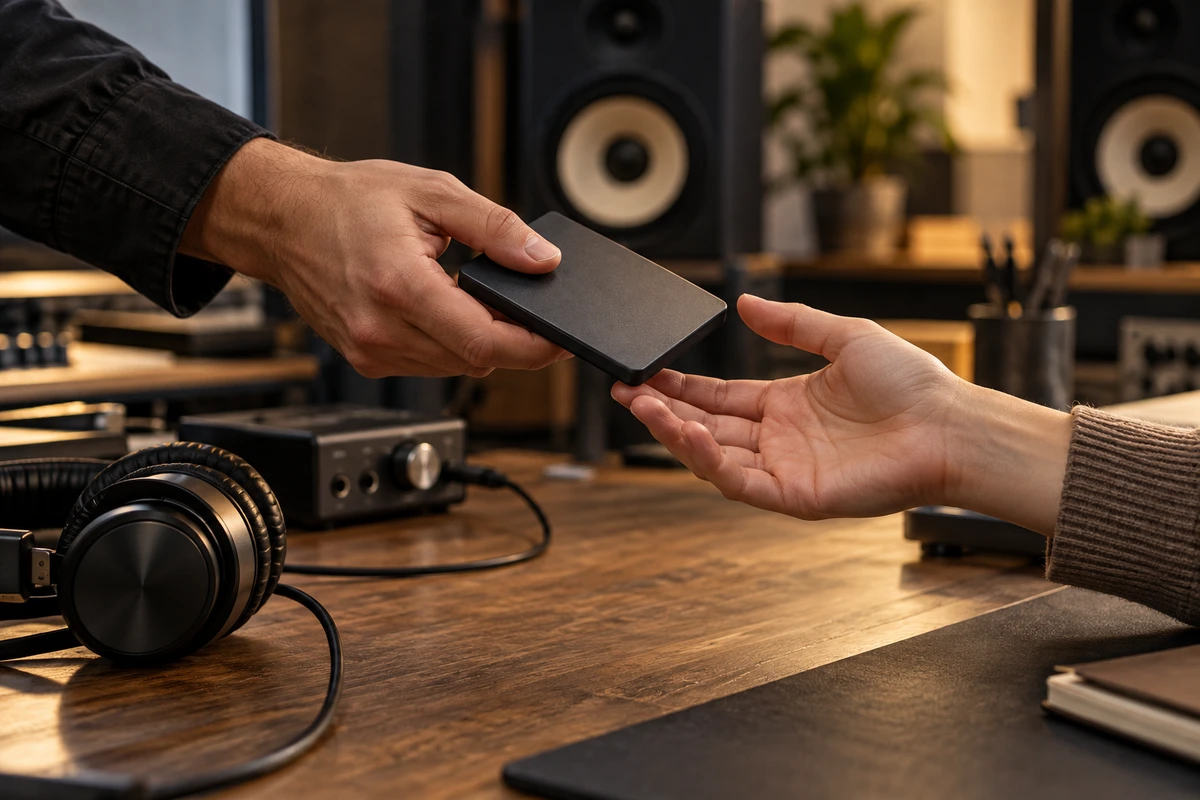
Obtain the file through an allowed download or export route. Do not substitute a recording of streamed playback. Preserve the original export and make separate working copies for permitted processing; do not strip source information to make the package look cleaner. Account credentials are not project deliverables.
Agree the audio format and quality that are needed and actually available. If the source is limited, disclose that limitation. Converting it into another format does not recreate information absent from the source. No universal sample rate, bit depth or delivery specification is prescribed here.
Reopen against picture, then test the intended change
Have the recipient open the file in their own working environment, import the approved picture and restore the documented timing. Listen through the product entrance and ending. Check for the wrong version, missing sections, misplaced cues or unexplained processing—not merely the presence of an audio file in a folder.
If something differs, compare identifiers, picture versions and edit notes before generating replacement music. A deliberate extension or replacement should receive a new version and review. It should not overwrite the approved recording while retaining its old approval status.
For a voice-over change, a separate music file may be sufficient. Lowering the drums while keeping the melody is a different request: establish whether suitable stems exist and can perform that job.
Ask whether the supplied tracks are original multitracks or stems separated from an audio recording. Import them using the stated start positions, lengths and processing instructions. Listen to the combination and to the element being changed. A file named “drums” does not demonstrate that its isolation is adequate for the proposed edit.
We have not tested stem separation here and promise no lossless result. Where the available material cannot support the request, retain the stereo version, reduce the change, commission additional sound work or make new music. A limited but usable handoff is preferable to unspecified future editability.
File control and use permission require separate acceptance
Suno’s Terms of Service, revised August 10 and effective September 3, 2026, condition permitted commercial use on requirements including a permitted download. They do not guarantee that copyright will vest in an output and contain separate restrictions for their defined category of Remix. A paid account or possession of a file should therefore not be described as unconditional commercial clearance, exclusivity or approval for every channel.
Record the provider, asset identifier, acquisition and download dates, applicable account or agreement, and the supplier’s basis for the intended use. Check any external reference audio, lyrics, voices or other material separately. This does not require passwords or unrelated personal account data.
The supplier, brand and legal adviser where needed should assess the actual material, agreement and intended territories. This article does not clear a particular track. Insufficient documentation is a reason to keep music in the candidate stage rather than mark it ready for release.
For the surrounding film package, ONCE’s guide to masters, audio elements and workable archives explains a broader delivery decision. The additional issue here is retaining a specific AI-generated recording without relying on the original operator’s account or a later generation.
Buy continuity in proportion to the next job
A one-off campaign may need the approved audio, its picture relationship and supporting use records—not a complete music-production session. A programme expecting changes to instrumentation, narration and duration should specify the required stems, dependencies and adaptation work in advance.
Download allowances are not a reason to collect every candidate. Distinguish tracks being considered, tracks approved for use and tracks intended for further development. Arrange permitted exports, custody and backup around those actual needs.
Production scope can distinguish musical exploration, approved-file preparation and reopening, and later adaptation or new creation. Generation counts do not measure the number of usable approved assets. Nor does this framework establish savings or a standard price.
For ONCE, the potential longer-term capability is continuity: an authorised record of what was chosen, the approved sound itself and the conditions for working with it again. That remains a direction to validate in real projects, not a claim about an existing music library or proven efficiency.
When the next editor arrives, the first task should be to recover the approved track from the agreed package and place it back against picture. New music can remain a creative choice. It should not become compulsory because the previous handoff retained only a link and a prompt.
Source and illustration note: the Suno help pages and terms, and ElevenLabs documentation, were checked October 19, 2026. Actual use remains subject to the applicable terms. The scenario is fictional; no music was generated, auditioned, exported or remixed for this article. The AI-generated cover is an unbranded concept, not a client session or software test record.