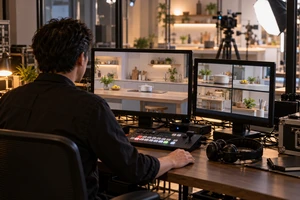
In a corporate interview, the interviewer is part of the image even when they never appear in it. Where they sit, whether they understand, and when they follow up all help organize the conversation. Seating an employee against an attractive background and asking them to be natural can miss the most concrete relationship on set: who is this sentence for?
“Look at me, not the camera” gives someone a place to direct their eyes. It does not necessarily give them a reason to explain. If that person keeps checking the question list or rushing to the next topic, the contributor may still feel as though they are waiting to be graded. The space beside the lens needs more than a pair of eyes. It needs someone who knows what this conversation is meant to make understandable.
An eye-level camera does not require a look into the lens
Adobe’s official guide, What is an eye level shot in film?, defines the setup through the camera’s height relative to the subject’s eyes. That describes a vertical relationship, not an instruction to keep looking into the lens. Separating the two makes an interview setup easier to discuss: a camera can be at eye level while the contributor looks toward an interviewer beside it.
BBC Academy’s Interviewing - Getting the shot right explicitly discusses how the off-camera questioner’s position changes the eyeline. Its guidance considers camera position, framing and gaze together, rather than reducing the setup to a prescribed angle. These are spatial principles from news-interview training, not a requirement that every corporate film adopt a news convention.
Let the two people sit down and talk, then look at that exchange from the camera position. Moving the interviewer sideways changes the contributor’s head turn and how their face appears. A standing interviewer speaking to a seated contributor introduces a different vertical relationship. Consider not only how comfortable the people feel in the room, but also what kind of exchange the image presents to a viewer.
A gaze direction is not a character judgment
Some people briefly look away while remembering; others organize their thoughts while looking at the listener. An interview can establish a clear main eyeline without correcting every natural departure. It should not turn a direction of gaze into a verdict about honesty, confidence or guilt. A film chooses a presentation, not a method for reading someone’s character from their eyes.
Nor does looking into the lens automatically create closeness, or looking away automatically create a documentary quality. Someone explaining a familiar subject directly to camera may be entirely at ease. Someone facing an interviewer may still be reciting a company introduction. Sometimes the question or preparation needs to change, not the angle by a few more degrees.
Give the listener a real need to understand
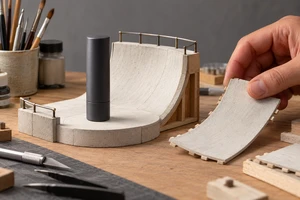
Imagine an entirely fictional interview with a packaging designer. Two unprinted cardboard mockups sit on the table. The interviewer wants to know why the opening moved from the top to the side. This is a writing exercise, not an account of a real product, a design outcome or an ONCE client project.
If the questioner took part in every design discussion, the answer might skip the background: “It was that issue from last time.” Both people understand, but a first-time viewer does not know what the issue was. The interviewer need not pretend to be ignorant. They can ask on behalf of someone who was not there: what happened, which occasion of use prompted reconsideration, and what alternatives were compared? A process that did not happen should not be invented to complete the story.
The opposite approach can be unhelpful too: continually interrupting technical explanations in the name of a beginner audience. Listen to a thought first, then identify the particular piece of background it needs. Where appropriate, ask the contributor to pick up an actual sample that can be shown publicly and point to the part they mean. An object can clarify a reference without being turned into a staged successful test.
Responses from the listener have different jobs. Attention can be expressed through gaze, expression or a small nod; it does not require a spoken agreement after every sentence. If that agreement overlaps an answer, preserving clean speech in the edit becomes harder. Give a thought time to finish before following up. When a fact is unclear, ask about it rather than smoothing it over with repeated approval.
A little waiting after an answer can also leave room for an addition. Silence should not become a device for extracting a moving story. A contributor can pause, correct themselves or decline to answer. Filming should help an explanation happen, not treat every hesitation as a performance obstacle to overcome.
A different shot need not create a different listener
A two-camera setup can become a discussion of a medium shot and a close-up while overlooking that both cameras observe the same exchange. The BBC Academy guide explains the relationship line formed by two people looking at each other and the need to consider it when placing additional cameras. That is a basis for spatial continuity, not a prescribed pair of positions for every corporate film.
Keep the interviewer in place while checking both images. Does one show an answer to an off-camera listener while the other seems to look past that person toward somewhere else? Do not ask a contributor to find each camera in turn within a sentence simply to give both angles a flattering face. If the intended addressee changes, explain that as a new passage rather than making the speaker guess when to turn.
Direct address is a separate, clear task
A welcome, a direct explanation to customers, or a statement the contributor wants to make personally to viewers can all be delivered toward the lens. It need not be called the more authentic version. Explain who this passage is for and what it should convey. Depending on the speaker’s preparation, consider key-point prompts, a teleprompter or recording in sections rather than requiring everyone to give the same kind of speech.
An interview that looks off camera can finish by turning toward viewers as a deliberate invitation. It can also feel like a switch to another film. Discuss why the relationship changes there, not simply the need for a final smile into the lens. Different versions may have different openings, but should preserve the speaker’s meaning. Do not turn an answer to an interviewer into a promise to a customer that the speaker never made.
Storyboards or concept images can help a team discuss positions and framing. Rehearsal can make the setting familiar. Neither replaces the listening that happens in an actual interview. The take worth keeping is not necessarily the one with the steadiest gaze or the most advertising-like sentences. It is one whose meaning is clear, whose facts hold up, and in which the person’s own way of speaking is still recognizable.
For a corporate interview or profile film, bring one question you want viewers to understand, the work the contributor actually participated in, and material that can be shown publicly to a discussion with ONCE about corporate video and interview production. Alongside the camera position, make room for the person who will be listening.
Source note: The Adobe guide and BBC Academy material were consulted on October 19, 2026. This original production analysis is not based on interviews, camera tests or audience research performed for the article. The cardboard-box scenario and original AI cover are fictional illustrations. No trust, sales or distribution outcome is promised.