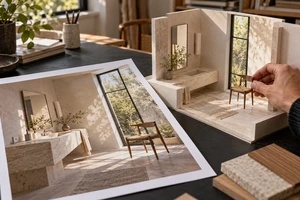
What exactly is a brand buying when a production proposal promises a miniature street? A beautifully dressed surface for a pack shot—or a working set that lets a product move, arrive on cue and do it again for another take?
For an overseas marketing team commissioning work around a China-made product, that distinction matters before the modelmaking begins. A reference image can establish the look without specifying the operation. Two quotes may therefore describe the same little city while pricing different jobs.
The useful procurement unit is an action that can be filmed and reset, not simply a count of miniature buildings.
A practical campaign makes the missing scope visible
In its October 8, 2026 article, “Building the Handmade World of Oura’s Latest Brand Campaign,” Oura describes a one-tenth-scale city with ring-wearing human hands as its characters. Its account includes working interior lights in subway models and pumped water in a miniature shower set.
These are the brand’s own production disclosures. We have not inspected the shoot or watched the complete campaign and making-of films for this article. The account supports those particular production choices, not a conclusion that miniatures cost less than CGI, outperform AI imagery or improve sales.
It does, however, expose a useful difference in a brief. “Subway” might mean a static background or a model with functioning interior light. “Bathroom” might mean visual dressing or a set through which water must actually run. The location label alone does not tell a producer what to build.
The ONCE action-unit brief
Our proposed method starts with one complete piece of action, including its return to a shootable starting condition. This is a planning framework, not a report of an ONCE client test or an established technical standard.
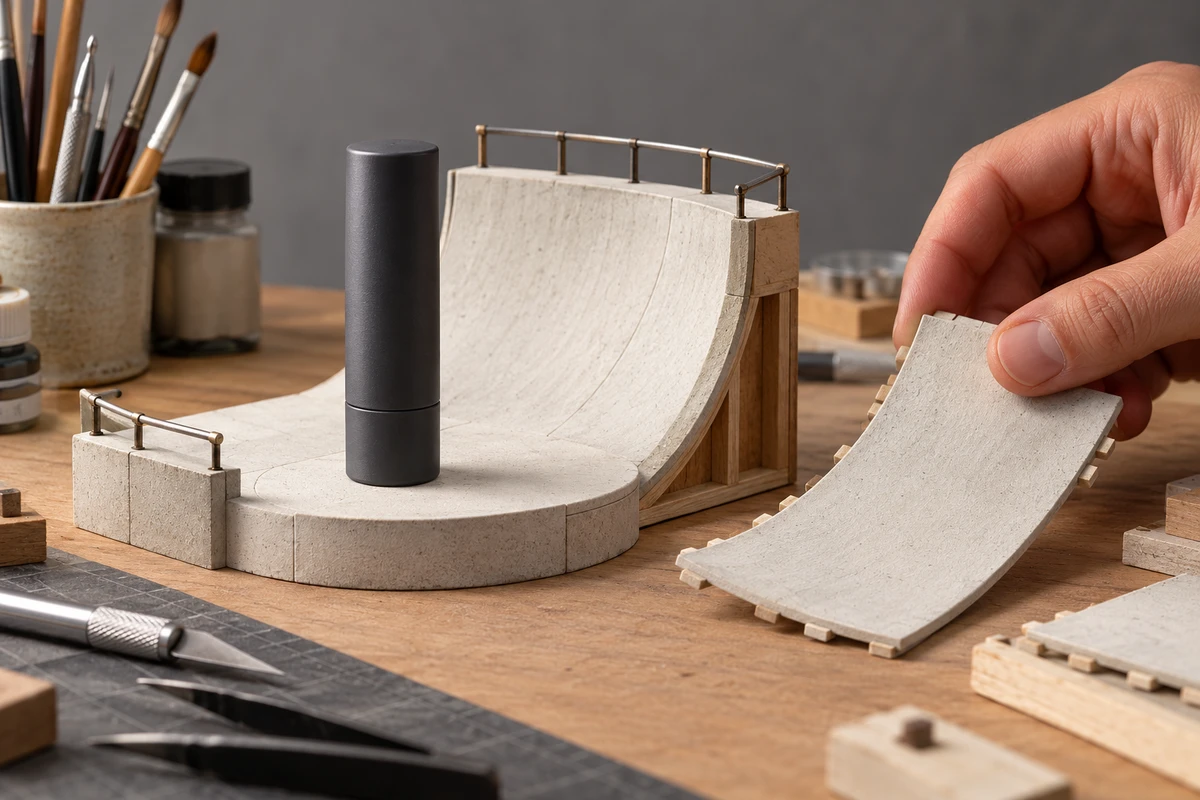
Consider a fictional lip-balm launch: the full-size product travels along a miniature ramp and arrives at a little stage. The scene expresses a lively entrance. It is not a demonstration of cosmetic efficacy, drop resistance or packaging strength. The actual sample would still need to be assessed for the proposed handling.
Instead of requesting “one miniature stage,” specify:
- Product and movement. Which sample is used, how it enters, its required orientation and where it finishes. Must it appear to move by itself, or may a hand enter the frame?
- Active surfaces. Which surfaces touch or support it, and which areas only need to read correctly from the agreed camera position?
- Operation and access. How motion is produced, where the operator or mechanism can work, and how the camera reaches its intended view. Identify any rig-removal work separately.
- Reset. What must return to its starting condition after a take, including surfaces and dressing—not just the product’s position. Identify replaceable or single-use components.
- Later use. Is this a single scene, or must the arrangement accommodate another product, camera angle or future shoot? Unspecified uses should not be assumed to work.
Reset is a creative requirement as well as a practical one. Returning the lip balm to the top of a ramp does not restore the original frame if the action has marked the surface. The team needs an agreed starting position, dressing arrangement and surface condition from which another take can begin.
Commission the difficult section first
For this hypothetical scene, a bounded piece of development could use the intended sample, a local section of ramp and the critical camera view. The questions are whether the movement, contact, arrival and reset can be achieved. No successful test, reliability rate or turnaround time is claimed here.
If the product repeatedly presents the wrong side, the next decision might be a different route, a different action or another implementation. If the story only needs the product to have arrived, beginning after the movement may be a better script choice. It removes a requirement rather than demanding a more elaborate mechanism. Whether it reduces cost depends on the actual revised scope.
Agree the development fee, deliverable and decision criteria first. A useful feasibility stage is a defined commission, not an open-ended request for free prototypes. Build the larger world once the necessary action is worth retaining and its execution has been resolved.
Four scope lines that make quotes comparable
ONCE’s proposed budget structure separates base scenery, action-unit construction, filming and resets, and any agreed future custody and restoration. These are scope categories, not industry cost percentages. Items already covered elsewhere in a supplier’s quote should not be counted twice.
Base scenery answers what the approved camera views must show. Action-unit construction answers what must move, make contact or produce a practical effect. That separation lets the buyer ask which faces of distant buildings need finishing, which nearby surfaces need replacement options, and which pieces are only decorative.
Filming and resets answer how the required footage will be obtained. Changing landing positions, movements and camera directions may change preparation, operation, repair and shooting arrangements. A static-display quote is not a like-for-like benchmark for a functioning action scene.
Future use needs its own decision. A one-off shoot can be commissioned for the film, agreed footage and essential records without buying long-term storage. Reuse requires an explicit arrangement for custody, packing, transport, vulnerable components and restoring the shooting setup. Ownership of a physical model is not the same as another studio being ready to film it.
For a brand planning to move a set out of China after production, transport assessment and responsibility for rebuilding the working arrangement belong in the procurement discussion. They should not be silently included in “the client owns the model.” Freight, customs and tax conditions require separate verification; this article makes no estimates or legal claims about them.
Keep what can genuinely work again
Two questions help decide the next investment: does the story need this physical action, and will later content use the same operating conditions?
A still image need not carry the scope of a complex working set. A local action need not require a complete street. Conversely, a new product size, motion path or camera position may make an existing set unsuitable. Its presence in storage is not proof that it is a reusable production asset.
Where the important future requirement is changing a digital environment, rather than operating a physical model, our separate article on approving virtual-set changes addresses that purchase. Here, the relevant question is what makes a practical action repeatable and recoverable.
For ONCE’s long-term development, a possible source of value is an authorised record of action concepts, local structures, shooting configurations and restoration requirements. That is a direction to validate through real projects, not a claim about an existing asset library or improved margins.
Before the next miniature production quote, prepare one complete action and one clear reset requirement. Then decide how much world needs to be built around it. The most useful model is not necessarily the largest or most detailed: it is the one whose work the agreed scene actually needs.
Source and illustration note: Oura’s article is dated October 8, 2026 and was checked October 19, 2026. The action-unit brief, scope model and lip-balm scenario are original analysis and a hypothetical example; no physical prototype was tested. The AI-generated cover is an unbranded concept illustration, not an Oura production image or an ONCE client shoot.