Before commissioning a video library for an AI support assistant, decide how the assistant will establish what the customer is looking at. A complete tutorial explains a sequence. It does not automatically tell a system which model is in the photo, which stage the user has reached, or whether the available information is sufficient to choose a clip.
For an overseas brand working with a Chinese manufacturer, a useful starting scope is a small set of common, distinguishable product states linked to approved explanations. Validate those relationships before expanding filming or integration. This article addresses content preparation and acceptance, rather than repair instructions.
A current example, with a clear limit
iFixit introduced its mobile app with FixBot in “The iFixit App Is Here” on December 9, 2025. It is an established development, not an announcement from this week.
As checked on October 18, 2026, its official FixBot Pro documentation describes assistance through chat, photos and voice, with Professional plans supporting an organisation’s own manuals and internal documentation. Voice remains an experimental capability. The official usage guide also says device selection helps tailor guides and answers; it lists image formats and PDF for attachments.
Those pages do not establish a general workflow for uploading arbitrary training videos. Nor do three pages from one provider constitute independent evidence of support outcomes. The production implication ONCE draws is more specific: visual material can help establish a product’s current state before an explanation is selected. That material deserves its own brief and acceptance criteria.
A tutorial and a state reference answer different questions
A tutorial explains order, prerequisites and an intended result. A state reference helps a person or system decide what is currently visible. They can be connected, but should not be approved as though they were interchangeable.
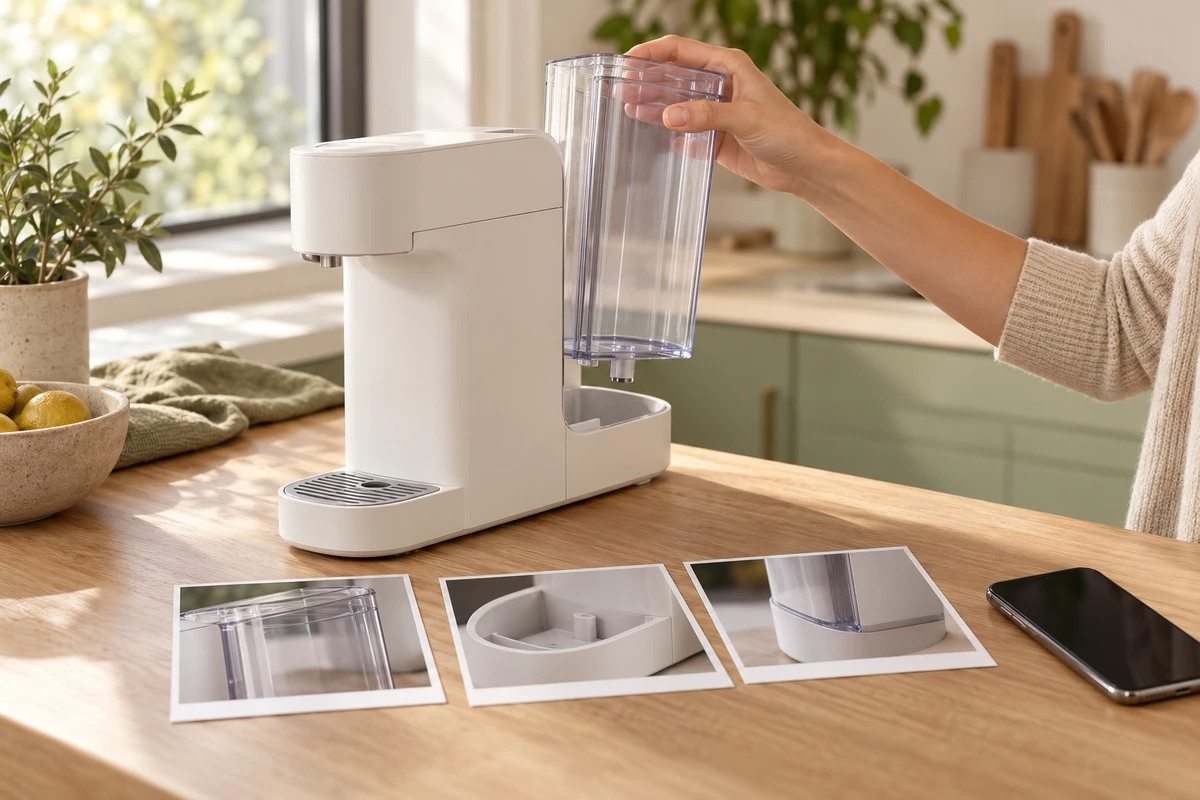
Consider a hypothetical appliance with a removable water tank. This is a planning example, not an ONCE project or test. A fully seated tank, a slightly displaced tank and a tank whose important edge is hidden by a hand are different inputs. One may match an approved explanation; another may need closer comparison; the obscured image may require a new view before any clip is selected.
Photography records observable details such as position, indicators and interface state. Product and support specialists decide whether those details justify a conclusion and what the user may do next. When they do not, the content needs an explicit route for further information or human assistance.
The ONCE State Reference Card
The following is an original content-planning method. No recognition test was performed for this article, and the card is not a FixBot import specification.
| Card field | What production should establish |
|---|---|
| Applicable product | Model, region and relevant hardware revision; combine only where supported |
| Observable state | A visible description and the nearby states most easily confused with it |
| Reference media | Overall orientation, distinguishing detail and relevant surroundings, including an unobstructed view |
| Approved explanation | Answer, manual location, standalone clip or timecode, and approver |
| Insufficient information | A clarification question, requested camera angle or appropriate human route |
Each card should explain why a particular clip is the right one. Similar housings do not justify sharing instructions if product versions require different procedures. Where the relationship has not been confirmed, the response can remain limited to identification or referral.
The clip must also make sense when retrieved alone. It should establish the applicable product, starting state and expected visible change without depending on a prerequisite buried in an earlier chapter. Authorised staff who need the complete procedure should still receive the full training material.
Capture a separate pass for recognition
Shallow focus, dramatic reflections and fast transitions can work well in advertising. They may hide the small difference that matters in a support image. For reference capture, prioritise a clear view of the relevant area, consistent scale and controlled obstruction.
Begin with enough of the product to locate the detail. Then record the distinguishing feature and, where useful, an adjacent state from the same camera position. If the distinction is in an interface, retain the relevant navigation context and version. Stable state IDs can connect regional wording, captions and voice-over without changing the underlying product reference.
Generated imagery can help plan angles before a shoot. Reference material used to support a real product judgment should come from confirmed physical samples. Filling an undocumented state with a plausible generated image would introduce an assumption into the knowledge library.
For cross-border work, ask the manufacturer to confirm the product state while the regional support team confirms the language and handoff. A technically accurate clip may still be unsuitable for a market if the local service route or permitted user action differs.
Test selection before automating the response
Start with one product family and one recurring identification question. Once the support owner approves the states and answers, prepare demonstration examples that were not used to build the library: clear matches, confusable cases, and cases with insufficient information or outside the supported range.
People can perform the first selection exercise offline. This exposes gaps in the material before software integration. After integration, check for the wrong model or revision, skipped clarification, and unsupported cases that still trigger an instruction.
Trace each error back to its source: an unclear image, inconsistent label, ambiguous approval scope, retrieval issue or application logic. This is a way to find defects, not a guarantee of recognition accuracy. Successful playback, correct content selection and the eventual service outcome are separate things to observe.
Buy a maintainable content set
Production can cover state inventory, sample capture, clip preparation, localisation and an index. Integration covers how a system retrieves, presents and records the material. The brand owns product facts, permitted actions and escalation arrangements. The exact division can vary, provided each responsibility has an owner.
Separate the initial capture and organisation work from integration and later changes to models, firmware or manuals. Comparing only finished minutes misses the effort required to distinguish and maintain states. When a card becomes obsolete, review its connected clip, captions and answer together so an old explanation does not remain available beside its replacement.
For ONCE, this is a service direction to validate: extending a shoot into product information that can be maintained over time. It could support future content management and workflow services, but recurring revenue or reduced support work must be demonstrated in real use. The next brief only needs a recurring question, an applicable model and an approved explanation to define a useful first set.