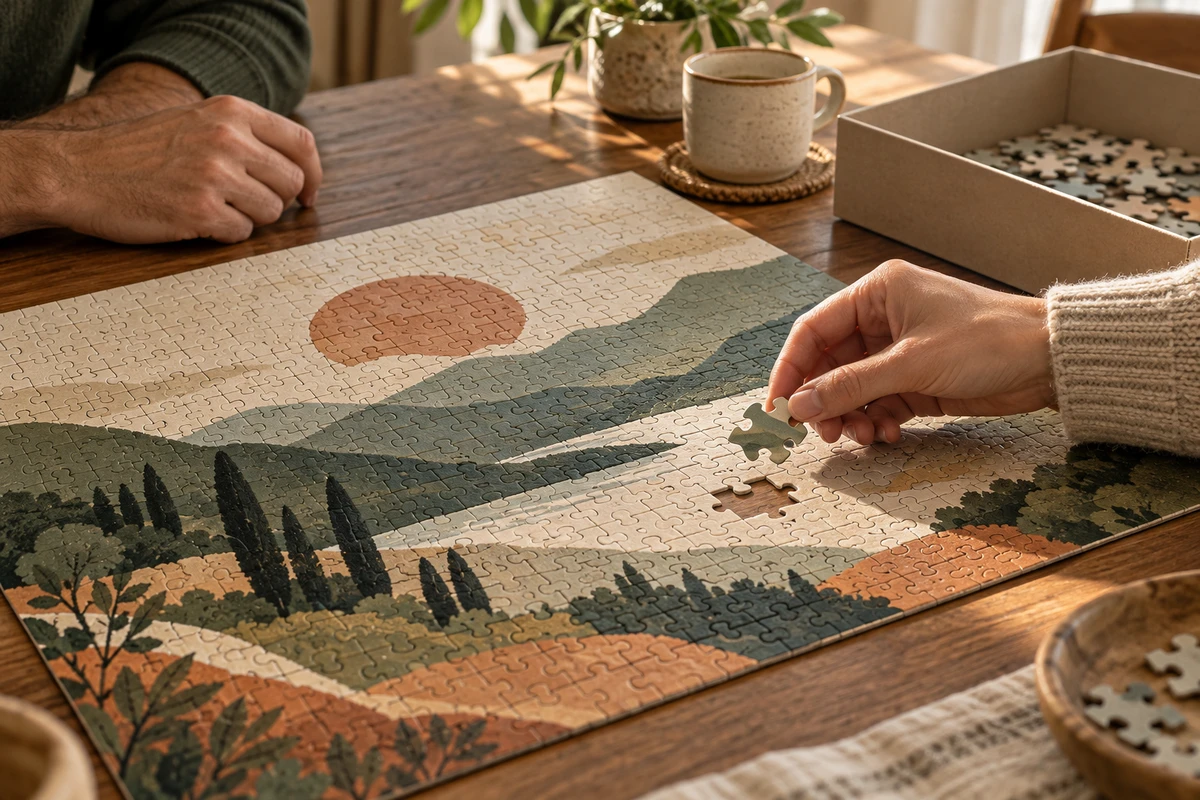
A finished jigsaw puzzle loses its final piece: it rises from the picture and returns to a hand. Other pieces separate and move back into the box. The reverse-motion product ad already has a noticeable visual effect. But where should it go next? Ending on a closed box may suggest that the tidying is done. Returning to two people about to open it together could shift the subject from completing a picture to choosing to spend time together.
The movement runs backward in both versions, but the destination changes how the product is understood. Reversing footage need not mean reversing an entire finished film. A more useful question is which beginning viewers should see differently at the end.
Backward movement is not the same as reverse chronology
These are separate decisions. Reverse playback changes the direction inside a shot: something falling rises, and a departing hand approaches again. Reverse chronology changes the order in which events are presented. We see an outcome before earlier events, while the action inside each shot can still run forward.
Adobe’s current Premiere guide, Change clip speed and duration using the Speed/Duration command, explains that Reverse speed plays a clip backward. That changes playback direction. It does not decide where an advertisement should start or finish, and a reverse button cannot supply a causal relationship.
Showing a completed puzzle and then cutting to two people opening its box moves from outcome to beginning. Whether pieces fly back into their hands is another choice. If the question is why they play together, a direct cut to the earlier moment may be clearer than continuous reverse spectacle. If the intention is to make a familiar process strange, literal reverse motion has its own expressive task.
A large-scale vision of time retreating need not consist of one recording played backward. Framestore’s Guinness production archive identifies noitulovE as a 2005 project combining live-action, stock imagery and CG, among other elements. We cite the maker’s written account, not a shot-by-shot viewing or an evaluation of campaign performance. The useful production question is whether every image needs to be made in the same way simply because the story moves backward.
A puzzle can return to two different beginnings
The following is an original fictional concept. It is not an ONCE client project, a completed film or an audience test, and it does not suggest that a real product assembles itself.
We start with the complete picture and move toward an unfinished state. More loose pieces return to the table; hands return to earlier positions. It is tempting to keep refining the backward mechanics: every piece returns to its box, the lid closes precisely and the table becomes spotless.
That may also erase what matters about the puzzle. Viewers have glimpsed time spent making something together, only for the ending to clear every trace away. The product becomes something to put away. This is not necessarily wrong: it could suit a storage proposition. But a film about shared time needs a different destination.
Return to packaging, or return to an invitation
Another ending stops the reversed passage before the puzzle begins, then cuts to a forward-playing shot. Someone pulls a second chair closer and asks, “Shall we do this together?” The box is on the table, the picture has not emerged, and the story rests on what is about to happen.
This is not a sentimental formula for every product. It gives this hypothetical film a proposition: the offering is not only a completed picture, but an activity people can choose to share. The film does not keep retreating into the past. A delivery parcel or a factory might take it further from the relationship it wants to explore.
If the actual product is positioned around solitary concentration, the two-person ending may be inappropriate. Stop instead at someone putting a phone aside and clearing space on the table. The destination should follow the relationship between a product and its user, not automatically return every film to a reunion, childhood or a manufacturing line.
Make one reversal matter, instead of making every second unusual
The whole film need not run backward. A short reversal of the completed picture can open it, followed by forward-playing scenes that establish its beginning. This differs from the question behind product ad match cuts. A match cut considers how shots connect; reverse motion also asks where a change of direction ultimately takes the viewer.
Playing an action backward and forward does not necessarily develop a story. Pieces gathering, separating and gathering again may create a visual loop. Without another insight, however, it remains an action going back and forth. Looping should depend on what another viewing adds, not merely on whether the software can join the ends.
Clarify the reversed action while other information moves forward
Before filming, write two short descriptions: what viewers should see, and what must actually happen on set to produce it. Opposite directions are easy enough to describe. The harder question is whether the purpose of an action remains legible when a hand contacts an object.
For the fictional puzzle shot, a first test could record a hand placing one piece, including the complete movement, and review it backward. If the reversed result looks as though a hesitant hand is attracting the piece, speeding it up may not be the answer. Consider the pause, grip or framing, then decide whether to keep the movement at all. This is a production suggestion, not a report of a test we performed.
Reversed pictures do not require reversed speech
Adobe’s How to reverse video footage in Adobe Premiere notes that the described reversal also reverses audio, which can be removed and replaced. A linked software operation need not dictate the creative choice.
In the puzzle concept, pieces can move backward while the final invitation is spoken normally; music can also continue forward. Sound gives viewers a foothold in the story instead of making dialogue, action sounds and music equally unfamiliar. A brief reversed sound might signal the temporal change without filling the entire film.
Decide which actions need to remain forward as well. If the film must explain how a product opens, how it operates or how long something takes, reverse spectacle alone cannot answer. Normal use and fantasy can sit beside one another, provided their different roles remain clear.
Editing can reverse time, not a product’s promises
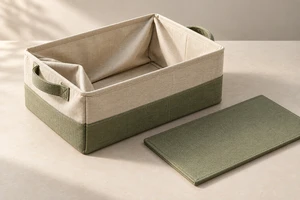
Imagine another fictional advertisement in which broken ceramic fragments gather into a whole cup. It could express a wish to take back a clumsy moment. The image alone cannot establish impact resistance or self-repair. Any explanation must agree with the visual intention. If the main message remains misleading, change the shot instead of expecting a small line in a corner to correct it.
The same applies to the puzzle. Pieces finding their own places can belong to an explicit fantasy. A film explaining the actual assembly experience needs to retain human decisions and actions. Reversal can propose an idea; it does not perform a product test.
When reviewing a rough cut, set aside how impressive the effect looks and watch the final shot on its own. Does it give the preceding outcome a new meaning? If the proposition survives intact without reverse movement, the effect is an optional tone. If returning to the beginning reveals why the product belongs in someone’s life, reversal is contributing to the idea.
To explore reverse motion in a product ad, bring the real product, the moment you want to reveal last and any use that must be shown normally to ONCE’s commercial and product video production solutions. What should moving backward help us see, beyond objects moving the other way?
Sources checked on October 16, 2026. The desktop Adobe help page read for this article displays January 7, 2026 as its update date; the separate reverse-video guide displays no clear publication date. The Framestore reference is a historical production account of a 2005 project. We conducted no software, filming or marketing-performance tests. The puzzle, cup and original AI-generated cover are conceptual illustrations. The Chinese edition names overseas sources and dates without URLs whose availability on mainland Chinese networks has not been tested; this edition links to the originals.