The weave, stitching and fibers look convincing. Then the product moves like rubber: its frame stretches, a seam slides across the surface, and a supported base bulges with everything else. Soft product CGI can lose its material character at exactly this point. The problem may not be insufficient detail, but detail attached to motion that does not belong to the object.
“Make it softer” is not a precise direction. The intended idea might be a fabric panel that folds, a filling that compresses, or a handle that feels less rigid in use. Those are different changes. The creative decision is where the object may change, what should retain its form, and what the movement should help people understand.
A convincing surface does not settle how an object moves
In its Panda London Bamboo Pillow project description, Chroma Studios describes scanning the pillow and materials for modeling and textures, alongside separate cloth simulation for the casing. This is the maker’s published account, not our assessment of model accuracy. We read the page on October 16, 2026; no confirmed full publication date was visible.
That division offers a useful starting point: appearance and deformation need separate consideration. A detailed weave describes a surface, but does not determine where a crease should begin. An attractive still has not yet answered what happens when the object is lifted, compressed or put down.
Set aside the broad question of realism for a moment. Does change begin at contact, or does the entire object melt at once? Do seams still connect the same parts, or do they travel like decoration across a surface? Can people recognize the original construction when the movement ends? These questions concern relationships in the image, not software settings.
Running a simulation does not establish a product’s physical performance either. We provide no material-testing method and have not calibrated a simulator. Fluid-looking animation still needs to be considered separately from the real product and the facts being communicated.
Why a fictional storage box should not become soft everywhere
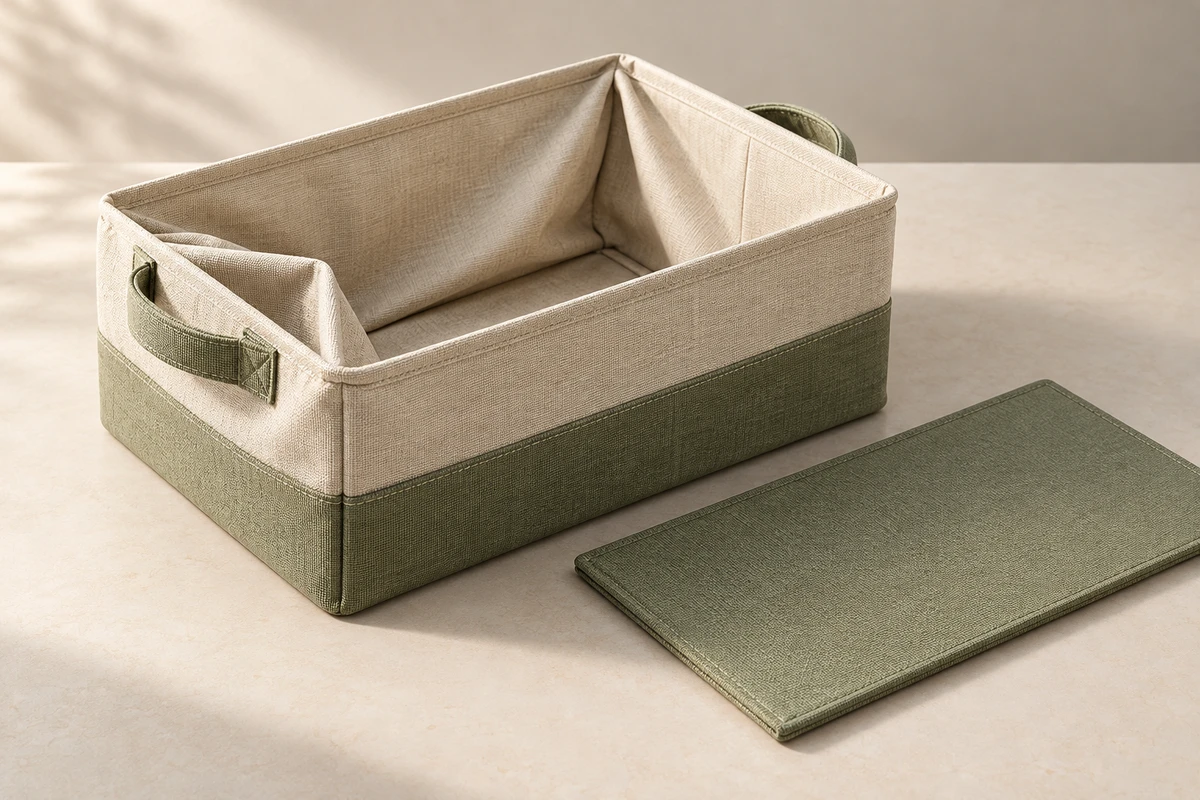
Imagine a fabric-covered storage box with folding sidewalls, a supporting base panel and handles sewn to its sides. The product specification and scenes below are original fiction, not an ONCE commission or a description of a product on sale.
To communicate convenient storage when empty, the story could begin with an empty box. The base panel is removed, the sides move together according to the proposed folding arrangement, and the fabric responds within that change. The flattened outline should let people understand where the original parts went, rather than suddenly replacing the box with a smaller object.
The most useful image may not be a spectacular soft indentation. Showing how the standing walls lose their support after the base is removed could explain more about the product. Soft and rigid elements do different jobs within one action. Softness becomes more than a style applied to the entire model.
A loaded box presents a different movement problem
Lifting a box containing objects is not the same as folding it empty. First examine how the actual sample carries its contents and which parts move. Then decide what the handles, attachment points and body should do in the image. A desire for lightness cannot make the contents, contact points and base support disappear from consideration.
In this fictional proposal, the handle could be grasped first, drawing attention to its attachment before the box leaves the table. This is not a prescribed movement sequence for every product. It is an alternative to replacing connected actions with one all-over stretch.
The ad need not become a construction lesson. If the theme is the ease of tidying a room, a clear local change may be enough while the rest remains quiet. Claims about load capacity, durability or recovery require suitable product evidence. None follows from this creative proposal.
A realistic product and a soft world can do different jobs
On its ASICS SUPERBLAST 2 project page, Wonder Vision describes a world inspired by inflated, pillow-like forms, using softness, compression and lift to express a sensation. We analyze that written creative account, not shoe performance, and do not claim to have watched the complete film. We read the page on October 16, 2026; no confirmed full publication date was visible.
That approach need not conflict with accurate product reconstruction, but they answer different questions. A realistic product shot can clarify construction and use. An imagined soft world can establish a mood, rhythm or association. Creative freedom in the latter does not authorize quietly changing product facts in the former.
For the fictional storage box, clutter could become soft colored forms and rearrange itself around the product in an unmistakable fantasy sequence. The box need not turn into jelly as well. Letting the environment carry the exaggeration may help the product retain a clear identity.
If the idea genuinely calls for the product to assume an impossible shape, it can be presented as imagination. The viewing context should not simultaneously treat that transformation as an ordinary operating demonstration. An abstract disclaimer at the end cannot do all of that communicative work for the image.
Timing and sound should not turn fabric back into rubber
Even with the same starting shape, different timing can suggest a different material character. Does the object fold quickly and stop, or change gradually after compression? Is there a small residual movement? Each choice should serve the particular object and idea, rather than assume that a bigger bounce means a better tactile impression.
Try removing the exaggerated rebound. Can folds, attachments and contact still express softness? A small release of fabric may be enough; the entire box need not jump. Less movement may make room for another material to remain present. This is a creative option, not an established advertising-effect rule.
Sound participates too. A spring-like effect accompanying a folding fabric surface may push it toward a toy-like character. Restrained friction and a soft landing may instead draw attention to its contact with the table. Foley can shape a style, but a designed sound should not be presented as evidence of the product’s actual acoustic behavior.
AI concept images may help explore shape and atmosphere. An attractive weave in one still does not establish the connections, folds or movement that follow. We have compared no generation models here. For accurate product depiction, return to the sample, construction information and the actual output. For fantasy, give the fantasy a clear expressive purpose.
The worthwhile quality in soft-product advertising is not a world where everything can be squeezed. It is the distinction between materials: a surface can relax, a base can remain firm, and a handle can have its own action. If you are developing such a product film, bring the sample, ordinary use actions and the feeling you want people to understand to ONCE’s product-image team to discuss live action, 3D and creative compositing. Find the part that deserves to change, then let it move.
This article combines published production descriptions with original creative analysis. It is not a software test, material-simulation report or review of client results. Both sources are production-company accounts, not independent effectiveness evidence. The storage-box specification and AI-generated cover are fictional concepts, without products or visual assets from the brands discussed.