An interactive product video earns its place when the viewer’s choice changes the explanation they need—not simply when a button makes the presentation look more advanced.
For an overseas brand working with a Chinese hardware supplier, the first question is editorial: are visitors trying to solve genuinely different tasks? If everyone needs the same sequence, a well-organized linear video may be enough. This article considers approved, prerecorded routes, not an AI system generating answers to unrestricted questions.
Buy the behavior, not the word “interactive”
Hocus Pocus Studio’s current Interactive Video Production page describes providing both film creative and programming. The page is undated; we reviewed it on 16 October 2026. That establishes the supplier’s stated scope, not independently verified engagement, pricing or production speed.
Vimeo’s official plan-feature guide, checked on the same date, distinguishes chapters from its Enterprise Interactive studio. Its hotspot settings guide describes different actions: opening an overlay, jumping to a point in the video or opening a webpage.
These are platform-specific capabilities and access conditions, not an industry standard. They illustrate a useful procurement distinction: a chapter menu, a detail panel, an outbound link and an alternative playback route do different jobs. Specify the intended behavior before choosing the tool.
ONCE’s Two-Answer Rehearsal
This is an original planning method proposed for this article, not a reported client test. Take one useful viewer choice and sketch two short answers before building a polished interface.
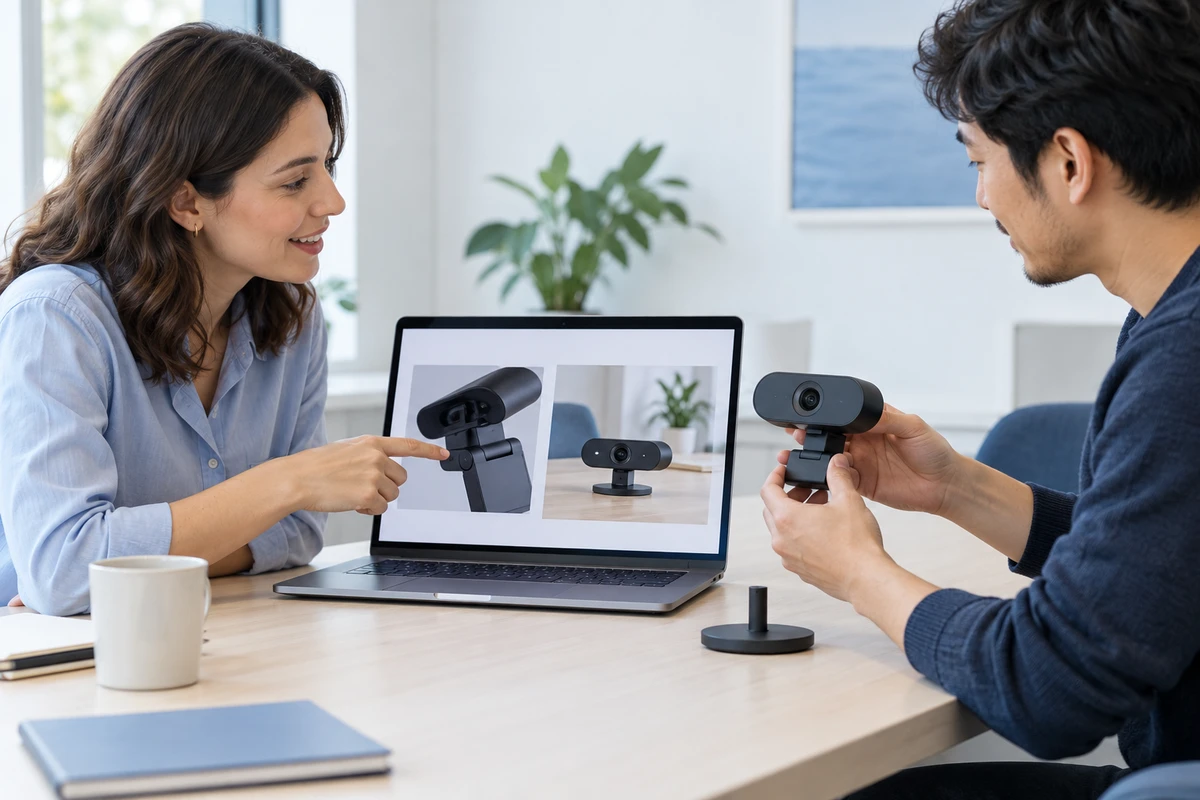
Imagine a fictional conference-camera product page serving both room-setup staff and everyday meeting users. One visitor wants to know what to prepare before installation; another wants to see ordinary meeting operation. The scenario makes no claim about a real product’s connections, compatibility or automatic setup.
The first route could show approved mounting and connection requirements, including what remains to be checked. The second could demonstrate the approved daily procedure for that model. Neither route should infer that the product fits a particular room merely because someone selected an option.
Write down the choice, the destination of each answer, the return or continuation point, and what happens when the viewer makes no selection. Existing footage or rough boards can reveal whether the routes have different purposes. A finished animation is not needed to discover that both buttons lead to the same sales pitch.
Keep a choice only when it serves a task
Changing a name or a color can be a legitimate creative effect. It is not, by itself, a different product explanation. If the useful difference is only where to start in an otherwise shared sequence, chapters may solve the problem without a more elaborate route structure.
If an answer depends on unknown site conditions or a custom engineering decision, end with an appropriate request for information or human handoff. Navigation helps people reach an answer; it cannot supply an approval the product team has not given.
Estimate distinct answers and route work—not just runtime
Do not assume every route needs a separate shoot. Product identification and introductory material may be shared, while task-specific demonstrations need their own footage. The tradeoff is dependency: replacing a shared segment means checking each route that uses it.
| Work package | What the proposal should identify |
|---|---|
| Shared and task-specific footage | Reused segments, separately filmed answers, applicable models and languages |
| Route configuration | Choice timing, destinations, return points and the no-selection experience |
| Player and page integration | Account, player and website responsibilities, with actual test environments |
| Updates and alternatives | Route/link maintenance, affected-path checks and non-interactive deliverables |
Two experiences with equal video runtime can therefore involve different work. A small set of timestamp jumps is not the same build as multilingual answers with return navigation and external pages. This is a model of work components, not an estimate of prices or guaranteed savings.
ONCE’s video production solutions offer a starting point for defining the footage. Name a suitably capable player and web-integration partner separately where needed; do not assume a film-production quote includes an operational interactive application.
Accept the experience by walking every route
A polished MP4 can establish picture and sound quality. It cannot, on its own, demonstrate that the configured interactions work.
On the intended page, device and player configuration, follow each option from entry to destination. Check that the right answer appears, the narration remains coherent and returning does not omit essential information. Also try making no choice, opening a permitted entry point directly and encountering an unavailable external destination.
Review captions and any other agreed viewing support along the routes, not only on a linear master. Capabilities must be confirmed with the selected implementation; this article does not certify any platform’s compatibility.
For social distribution, downloaded sales material or environments without the interactive player, commission a self-contained linear version or clearly separated clips. A button drawn into the pixels is not a working control. Specify what remains useful when the presentation leaves its original hosting environment.
Keep the question-to-footage map
Record each choice, destination segment, product version, language, return point and owner. A changed connection requirement can then be traced to the answer and routes that need review, rather than triggering a complete visual rebuild by default.
If selection events are collected, agree on what is captured, how it is counted and its permitted use. Clicking “setup” does not establish a visitor’s job title or purchase intent. Look for whether people can locate the information they need and which questions remain unanswered, not clicks alone.
ONCE’s business inference is that this map could support ongoing content maintenance. Whether that deserves a managed service depends on real update frequency and effort, not the presence of an interactive feature. Start with one useful choice and two answers. If the answers do not need to differ, invest in the clearer ordinary video instead.