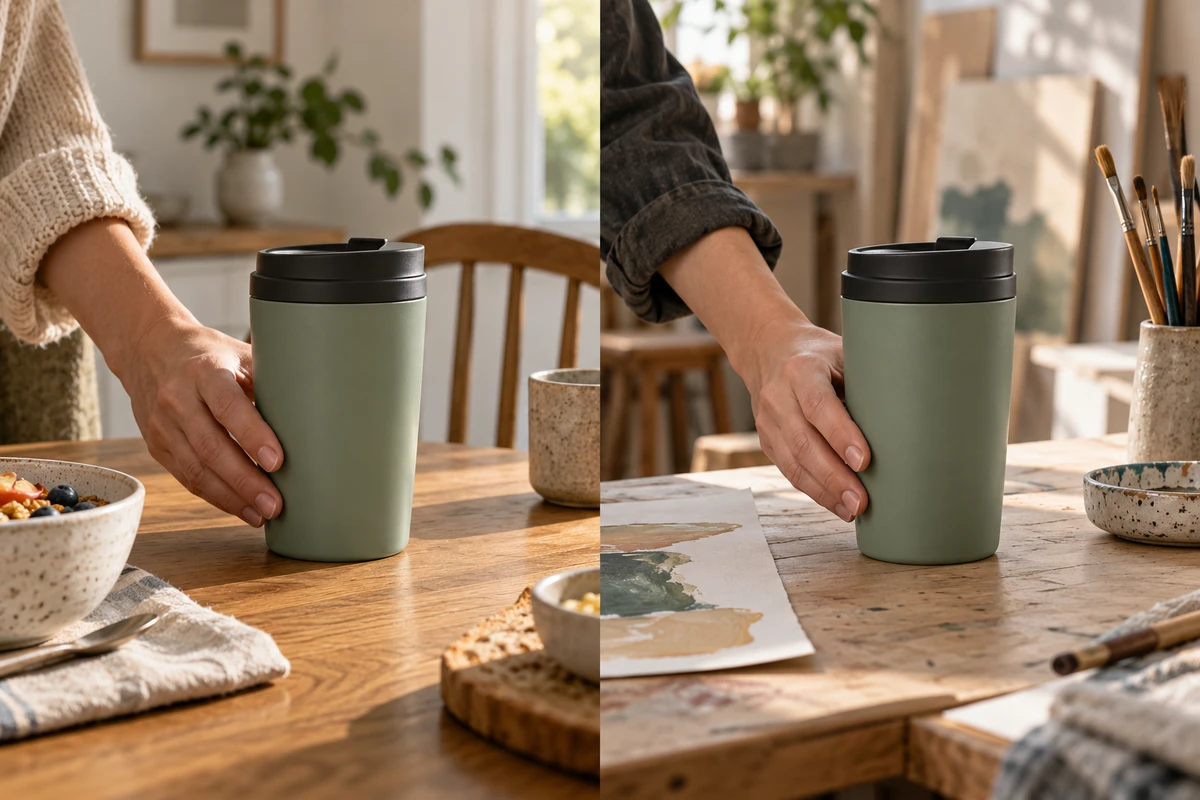
In one shot, a hand places a travel cup on a breakfast table. Cut to the next: a cup occupies a similar position, but brushes and an unfinished sketch now sit nearby. The images line up. That does not yet give this product ad an idea. What does the change help viewers understand about the life around it?
Match cuts can connect different places, times or people. Similarity carries the viewing experience forward; the change needs to contribute something. If the entire connection is that two objects are round, the transition may be clever while the product is merely there to supply a shape.
Similarity opens the connection; change gives it a purpose
Adobe’s Master the match cut for creative transitions describes connecting shots through similar visual or auditory elements, distinguishing graphic, action and audio matches. This is an editing concept, not an advertising-performance guarantee. Nor must every match appear to be one continuous action.
A graphic match might connect a cup’s rim to another circular object, emphasizing shape, color or composition. An action match might begin a hand’s movement in one shot and resume a similar phase of that movement in another. They can express different relationships: a visual analogy, a continuing action or a leap in time.
Consider a fictional travel-cup ad, not an ONCE client project. At breakfast, someone sets down the cup while checking what to take before leaving. On a different day in a studio, a similar gesture is followed by closing a laptop and drawing a sketch closer. The idea is neither a magically moving cup nor a statement about insulation. It is a familiar object accompanying different rhythms of daily life.
The idea still needs scrutiny. Are the table and studio simply attractive backgrounds, or has the person’s situation changed? Preparing to rush out and settling into concentrated creative work offer a difference worth exploring. Adding more cities does not automatically add that understanding.
One gesture can create several kinds of cut
The same material can suggest different relationships. Decide whether you want continuity, another day or an association before choosing the connection.
Cut during the movement for a handover
In the first shot, the cup is still descending. The next resumes from a similar height, direction and phase. Its position and size in the frame can be the visual anchor. Everything else need not freeze: a different sleeve, tabletop and background can establish the new situation.
But the audience must be able to recognize that change; it cannot exist only in the treatment. If the background is reduced to soft color and the sleeve remains identical, the shots may look like two angles on one placement. Retain a clear environmental cue or allow the new space to unfold after the cut.
Let the cup settle, then make repetition the rhythm
Alternatively, finish the first placement and let the hand withdraw before cutting to another placement in the studio. The connection is now a repeated habit rather than an apparently uninterrupted movement. Two unhurried gestures might establish stability; a hurried first scene and a relaxed second can foreground their difference.
Do not remove every pause merely to make the edit smoother. What happens after the cup lands may matter more than the seam. Cut away immediately and viewers may recognize the cup without understanding the life it has entered.
If shape is the link, make the analogy earn its place
A cut from the rim to a round patch of paint on a palette is closer to a graphic association than continuous use. It might suggest a move from daily preparation to creative work. Circular shapes alone, however, do not establish the product’s role in that transition.
If the analogy requires extensive narration to explain, consider dropping it. A direct cut to the person taking out a brush may communicate more clearly. A match cut is an option, not a demonstration every product film owes its viewers.
Plan a relationship between shots, not just attractive frames
In How to Plan Match Cuts for a Product Advert, published September 15 and updated October 6, 2026, The Camera Guys describes maintaining product placement while moving between working situations in its SMART Tools advert. This article draws on the production company’s written account, not a viewing of the embedded film or its claims about communication outcomes.
The account raises a practical issue: editing cannot supply every relationship missing from the shoot. For the hypothetical cup ad, compare the intended connecting frames before filming rather than judging each storyboard image separately.
If the cup’s outline is the main connection, consider the viewing angle, orientation and proportion of the frame it occupies. If the hand’s motion leads the cut, consider where it enters, when the shot changes and how the action continues. These are not parameters that must all remain fixed. They help decide what this particular transition preserves and what it changes.
Capture enough before and after the action to leave editorial choices. Recording only the instant the cup touches the table leaves no withdrawing hand if you later decide to cut after it settles. A complete action offers more room to compare approaches than repeatedly asking for only half a gesture.
In the edit, a temporary overlap can help compare positions. Then return to normal playback. Aligned still frames do not establish a convincing movement rhythm. If substantial scaling is needed, check whether it removes the surroundings that gave the new scene its meaning.
A transition can omit a journey, not perform a product operation
A match cut can compress the trip from home to studio. It should not turn an unshown function into an established fact. Cutting as a lid touches the cup, then showing the cup in a bag, does not by itself demonstrate that the lid was secured or that the cup will not leak.
If the ad explains the lid, retain a clear operation. If it presents moments of life, avoid implying unsupported capabilities. A change from a lidded to an open cup, or from full to empty, can suggest time passing. It should fit the scene, not silently substitute conditions within a performance demonstration.
Sound affects that relationship too. Music can connect the scenes without extending the first scene’s pouring sound into the second as though the same pour were continuing. Choose whether the soundtrack continues an event or links separate moments.
A vertical version also deserves another look. The cup may remain centered while the brushes identifying the studio disappear in the crop. Preserving the matched subject is not necessarily preserving the meaning. Rearrange the relationship for the new frame when necessary rather than defending the exact horizontal composition.
Give attention back to what follows the cut
Watch the early sequence at normal speed without a transition sound effect. Ask what the second scene adds, not only whether the cut is smooth. Scrubbing frame by frame to admire the join answers a different question.
If the answer is simply “a new background,” look again for a meaningful change in the person, action or use. If that change is already clear, a direct cut may work without another match. One important connection can be enough; every location change need not repeat the device. This is a creative judgment, not a finding from an audience or advertising-performance test.
The product can stay familiar while life changes around it. For a multi-situation product ad, bring the central proposition and two genuinely different moments of use to ONCE’s commercial and product video solutions. Beyond joining the images, what should this transition help viewers notice?
Sources checked on October 15, 2026. The Adobe page does not display a separate publication date. The production example is based only on its maker’s public written account, not a shot-by-shot film analysis. The travel-cup scenes and AI-generated cover are concepts, not evidence of a real product’s performance or an actual client shoot.