A remote team can agree on a camera move inside a beautifully scanned room and still arrive with an unworkable plan. Before commissioning a digital location model, decide what approval it must support—and what evidence makes that approval credible.
This matters when a brand's marketing team is overseas while the location, product samples and production crew are in China. A shared spatial model may improve the conversation. Its commercial value depends on whether it remains accurate enough for the agreed tasks, can be updated and can travel with the project after the initial presentation.
The signal: a scanned space is becoming a planning environment
The official IBC 2026 VooPla project account describes studio selection, 3D arrangement and recorded approvals in a digital-twin workflow. It explicitly identifies the exhibit as an R&D prototype rather than a live product. The demonstration belonged to the September 2026 event; the page supplies no separate publication date.
Meanwhile, District Cinema's Terra page lists browser-based annotation, measurement and camera planning, while stating waitlist access and marking some Production features as coming soon. These are examples of development direction, not proof of universal availability or independently established savings.
ONCE's inference is that the deliverable worth investigating is a maintainable spatial plan, with decisions attached to it. This article proposes an acceptance method for that deliverable. It does not review or endorse either platform.
Commission a decision before commissioning a whole building
Choosing the visual mood of a background may require only current photographs, a measured sketch and a call. A continuous camera move, repeated departmental layout changes or recurring shoots in a stable space may justify a richer model. Begin with the question that ordinary materials cannot answer.
Also distinguish the intended outputs. A visual scan for exploring a room, geometry for dimensional judgments and an editable scene for lighting or compositing are different requirements. Do not infer all three from the ability to rotate a scene in a browser. Ask the supplier to demonstrate the capabilities the project actually needs.
Imagine a hypothetical tabletop-speaker campaign: the camera moves around the product while a performer crosses behind it toward a window, and the final delivery includes a vertical composition. The useful scanning scope is the space needed to plan that shot—not automatically every room in the facility.
ONCE's shot-based acceptance record
Bind each critical approval to five fields. These are proposed project controls, not a surveying standard or safety certification.
| Field | What the supplier and production team should establish |
|---|---|
| Shot task | The movement, framing or access decision the model must support. |
| Reference check | Identifiable corresponding points in the model and location, with the on-site measurement method, person and date. |
| Accepted discrepancy | The task-specific difference the responsible specialist can accept, and any areas that remain unverified. |
| Valid version | The scan, layout and equipment dimensions on which the plan depends. |
| Decision owner | Who authorizes further design, requests measurement or changes the plan. |
There is no universal centimeter threshold for every production decision. A broad background placement and a tight equipment route tolerate different uncertainty. Set the acceptance requirement before reviewing the result, with the person who will rely on it.
Check the dimensions that can change the shot
Choose a small set of consequential distances for independent comparison: product table to wall, intended camera position to background, or a bottleneck along the access route. Record both the location measurement and the model reading. If the discrepancy exceeds the agreed allowance, correct the model or restrict its use. Checking one area does not validate the whole building.
Attach the intended imaging conditions to camera bookmarks: framing, focal length, height and the physical equipment envelope. A different lens or rig can change both the composition and the space needed to execute it. An attractive screenshot without those inputs is a weak handover.
Mark uncaptured or obstructed areas explicitly. A corner absent from the representation must not silently become usable floor space. Motion, rigging, loads, electrical capacity and sound conditions still require the appropriate location information and responsible specialist confirmation; visual approval does not supply those answers.
Accept the second version, not just the first tour
Include a change rehearsal in acceptance. In the speaker example, ask the supplier to move the table toward the window or add a background panel inside the existing project. Then ask which shots and approvals require another look.
The change may affect camera clearance, the window relationship and the performer's route. The software need not infer every consequence automatically. The workflow does need to identify affected work, preserve the previous decision and make the new unresolved items visible. Sending another link while everyone continues using an old approval is not a completed update.
Separate relatively stable structure—walls, doors and fixed windows—from project layout, such as furniture, sets, lights and equipment. Date and version both. A building alteration triggers structural checks; a new shot plan triggers layout checks. Neither a total rebuild for every change nor permanent trust in an old scan is a sensible default.
This is where the asset gains potential long-term value: the team can see what changed and which decisions still hold. It is more than preserving the appearance of a room.
Accept a transferable working package
A viewing link, an editable model and the right to hand material to another supplier are separate deliverables. Specify the permissions the brand needs, along with any restrictions on third-party content. Do not assume that access to a viewer includes source ownership.
Agree on the necessary model or source material, units and coordinate explanation, reference checks, camera settings, change log, uncaptured areas and exportable decision records. Every job need not receive every raw scan, but the team should understand which future work will be constrained by omissions.
Test the actual handover in the agreed receiving application or account. Check scale, orientation, correspondence of annotations and camera usability. A supported file extension is not proof that this project's entire working context transfers intact. For restricted premises or unreleased products, agree who can access the package, for how long and how access ends.
Buy a bounded pilot before a permanent system
Compare the model's construction, verification and maintenance effort with the conventional materials and meetings it could actually replace. Count only avoidable work. A necessary technical visit remains in the budget even if the digital tour is excellent.
For a first pilot, choose one stable space with a genuine reuse plan and one difficult shot. Record setup and checking time, update effort, repeated work actually avoided and misunderstandings that remained. An anticipated reduction in travel is a hypothesis until the project demonstrates it.
For production partners, reusable knowledge about a location could become a service asset: checked positions, dependencies between changes and shots, and a reliable account of what remains valid. This is a direction ONCE proposes exploring, not a claim that ONCE has deployed a scanning product or measured its returns.
Bring the hardest shot, the parts of the location likely to change, the people approving remotely and the expected reuse to the first discussion. ONCE's video production solutions offer a starting point for defining the planning and filming scope. Ask for one task that can be checked, revised and handed over before expanding the purchase into a full digital location library.
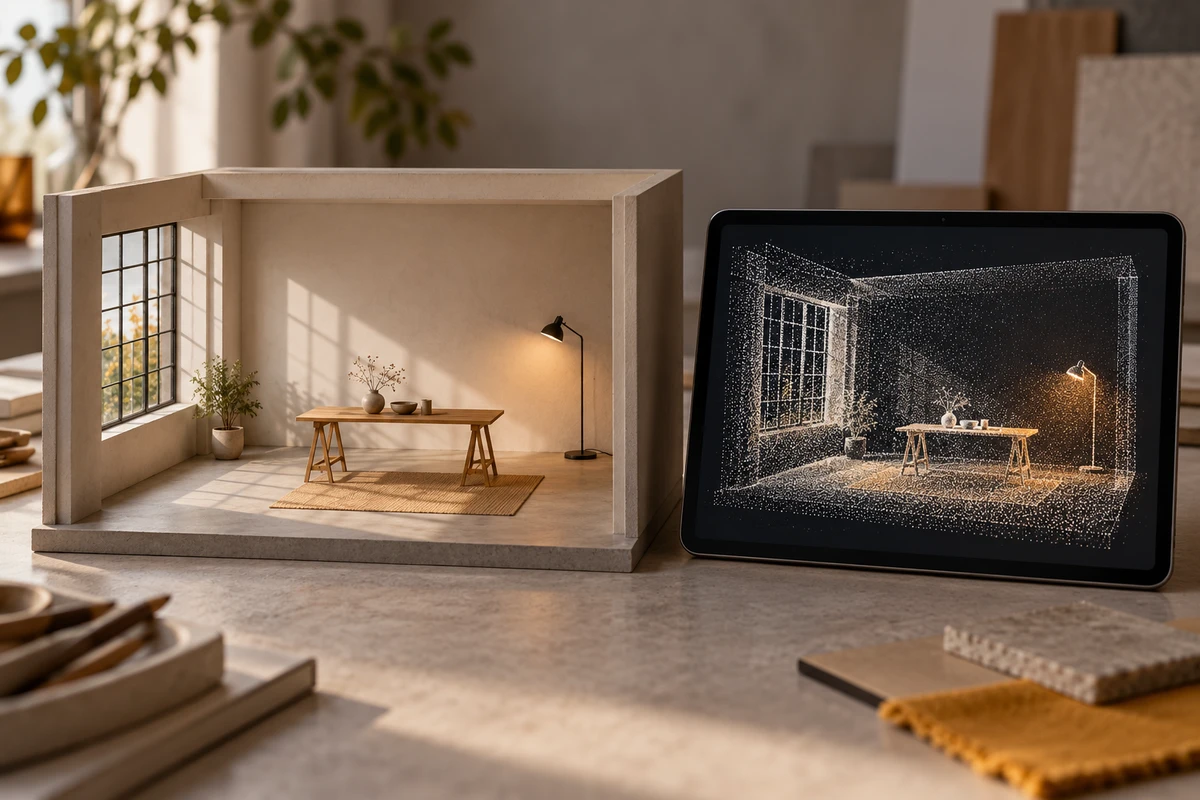
Sources checked October 15, 2026: IBC's VooPla 2026 project page and District Cinema's Terra page, neither stating a separate publication date. This analysis uses the written accounts; it does not claim software testing, demonstration viewing or independently verified performance. The speaker shoot is hypothetical. The original AI cover is a concept, not a measured facility or client production.