A split screen can show two events at once without making them happen at the same moment. That distinction opens up possibilities for brand advertising. Departure and homecoming can meet on screen; one product can accompany anticipation as well as relief. The challenge is not fitting two videos into a frame, but making their shared presence meaningful.
There are two kinds of timing to consider. Presentation timing determines when each panel moves or pauses and where sound comes from. Story time determines whether the events happen together, follow one another or connect only through an idea. Neat synchronization should not silently answer that second question.
Nike offers a starting point, not a synchronization rule
Nike Japan’s official news release of 31 July 2020 describes You Can’t Stop Us bringing together athletes’ bodily movements across different sports through 36 split-screen pairings. Wieden+Kennedy’s project page, dated July 2020, describes a dynamic split-screen film intended to encourage collective voices and change.
Those are the organizations’ published descriptions, not this article’s shot-by-shot observations. Nor are reach or awards used to establish effectiveness. The useful starting point is specific: separately occurring actions can be brought together and offered as an expression of shared strength. They need not become a single event taking place in one location.
Borrowing only the aligned appearance would miss the point. If the actions’ resemblance has no connection with the brand idea, a polished join may remain a technical flourish. Conversely, two actions need not form one seamless body to justify the split. Identify the experiences being connected before deciding whether the join should disappear.
One suitcase, two states of mind
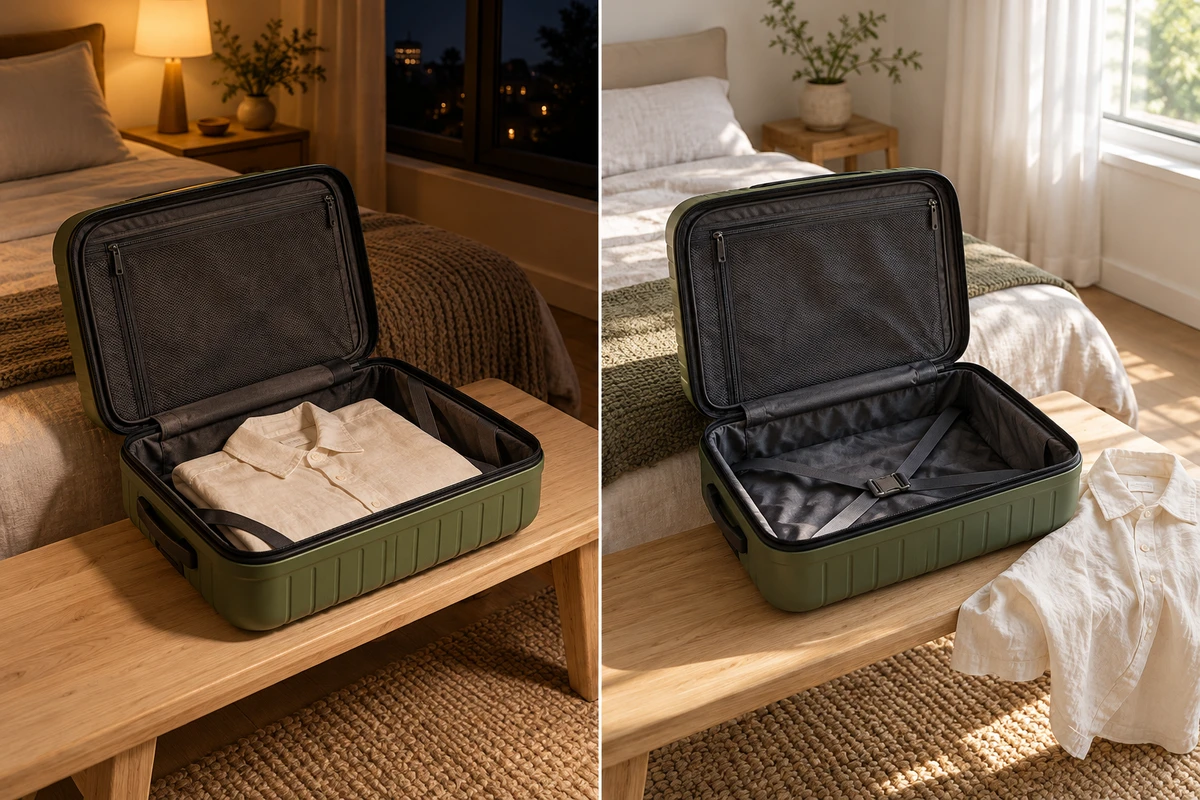
Consider an original fictional suitcase commercial. It is not an ONCE client project and has not been filmed or audience-tested.
On the left, it is the night before departure. Someone puts a folded shirt in the case and checks what still needs packing. On the right, it is daytime after the trip. The same person takes a shirt out and returns it to the wardrobe at home. The suitcase remains the same model; the condition of the clothes, what the person wears and the purpose of the action differ.
This is neither a packing race between two people nor two actions that literally happen together. The idea concerns the ends of a journey: deciding what to take away and what to return to everyday life. The product accompanies those moments. It does not automatically make tidying faster.
Light can distinguish night from day, but warm and cool tones alone may not explain enough. Putting clothes into the case and taking them out, opening the wardrobe and closing it again, also establish direction in time. Two close-ups of hands pulling zippers may produce symmetry without making departure and return clear.
Let each panel first establish its activity before developing the visual echo. Can the case still be recognized in half a frame? Are clothes entering or leaving it? Does the character read as the same person? Those questions deserve attention before every line is forced into alignment. A direct caption can help when necessary; chronology need not become a riddle.
There is room for an uneven beat. The departing version of the character picks up a shirt, hesitates and puts it back on the bed. The returning version is already setting travel clothes aside for sorting. Different degrees of hesitation give the case two lived contexts rather than one symmetrical gesture. Whether to retain that pause depends on the film’s tone, not a prescribed duration.
Sound can turn separate moments into an apparent exchange
Two visible panels offer two possible sources of sound. A phone ringing on the left followed by someone reaching for a phone on the right could suggest an answered call, even if the script places them on different days. The relationship has changed from two ends of a journey to people contacting each other. That is a story change, not a minor finishing detail.
In the suitcase concept, cloth moving against the case might first be heard on the departure side, with the wardrobe closing heard later on the return side. Music could connect the mood without every action sharing one zipper sound. Decide which event the sound is informing, rather than simply putting something in each audio channel.
If both panels contain dialogue, decide which line deserves to be heard in full. Letting one moment become quiet can give the other room to be understood. The quiet side need not stop living: a small, legible action can continue without starting another event that requires explanation.
Our discussion of POV shots in product ads asks whose attention the viewer shares. Here there is an additional choice: how two separate moments divide attention during one viewing interval. More visible footage does not automatically mean more understood information.
Which moment remains when the split ends?
The film need not retain two panels throughout. When the departure side closes the case, that panel could end, leaving the homecoming side to continue. The character puts the empty case away and the room becomes quiet. Homecoming supplies the final emphasis: a journey returning to everyday life.
Alternatively, keep the departure side as the character picks up the case and leaves. Let the returning action fall away. The emotional emphasis moves to the road ahead. Similar material can support different brand expressions. Choosing which panel survives also chooses between anticipation and reflection.
Simply erasing the centre line should not imply that two places have become one room. Creating a genuinely shared space needs a composition and action that support it. If the purpose is merely to end the juxtaposition, returning directly to a full-frame shot can be clear. Leaving the split should establish where the story goes, without always performing a compositing trick.
Keep emotional juxtaposition separate from product comparison. A departure sequence with omitted actions cannot be compared with a fully retained homecoming sequence to claim that one packing method is faster. Demonstrating actual operation time requires more than rearranged, accelerated or abbreviated clips presented as equivalent records. This concept establishes nothing about speed, capacity or durability.
For a commercial like this, write each moment’s action first. Bring those sequences and the real product to ONCE VISUAL to discuss what deserves simultaneous viewing and what should be revealed in order. Bringing two times together is not about filling the frame. It is a way to give an object different, connected meanings across a life.
Sources checked on 16 October 2026. Nike’s release was published on 31 July 2020; Wieden+Kennedy dates its project July 2020. Only published text is used, not a claimed shot-by-shot viewing or effectiveness study. The suitcase story and original AI cover are fictional concepts.