Your overseas support team flags a slow assembly step. The manufacturing team in China says the procedure is correct. The content supplier proposes a new 3D experience. Before choosing a production scope, the brand needs one shared question: what is the user actually struggling to understand?
Step-level feedback can make an instruction update more precise. It can also create false confidence when elapsed time is treated as a diagnosis. The next useful asset might be a close-up, a clearer label or a rotatable model—or no new content until a product question is resolved.
Establish what the supplier offers—and what the metric means
BILT’s current Frequently Asked Questions, checked on October 16, 2026 with no publication date displayed, describes brand-funded, brand-approved 3D instructions that users can advance or repeat at their own pace. Its analytics deliverables include download statistics, reviews and average assembly times per step. These are published service descriptions, not data ONCE has accessed or proof that a brand’s returns will fall.
The current Installation & Assembly page, checked on the same date, describes rotating, zooming and inspecting components. Those controls provide a different viewing experience from a fixed film. They do not establish that every interaction is logged or available to the brand. A zoom control is not evidence of an exportable zoom-event report.
Before using any step-time ranking, ask how time starts and stops. Does it run from entering a step to selecting the next one? What happens when someone returns, leaves the screen, resumes later or changes devices? Which records enter the average, and is any distribution or outlier explanation available? If the definition is unclear, call it an unresolved measurement question rather than assembly efficiency.
Elapsed time might reflect necessary physical work, a search for a part, uncertainty about orientation or a break away from the device. Those are hypotheses until checked, not interchangeable reasons to commission more animation.
The ONCE pause-and-compare method
This is a proposed collaboration method, not a reported client experiment. Start with one step and one specific uncertainty.
First, identify the product revision, instruction version, language and task. A step number is not a durable comparison key if an update has split one task into two. Record the starting state, intended completed state, approved instruction asset and the question under investigation. The manufacturer remains responsible for approved part names and procedures.
Next, compare the signal with relevant support questions and appropriately consented observation of the actual task. Ask the person to explain the mismatch between what they see on screen and what they have in hand. Collect only information needed for that purpose. “Is this a good tutorial?” is less useful than “What do you need to know before continuing?”
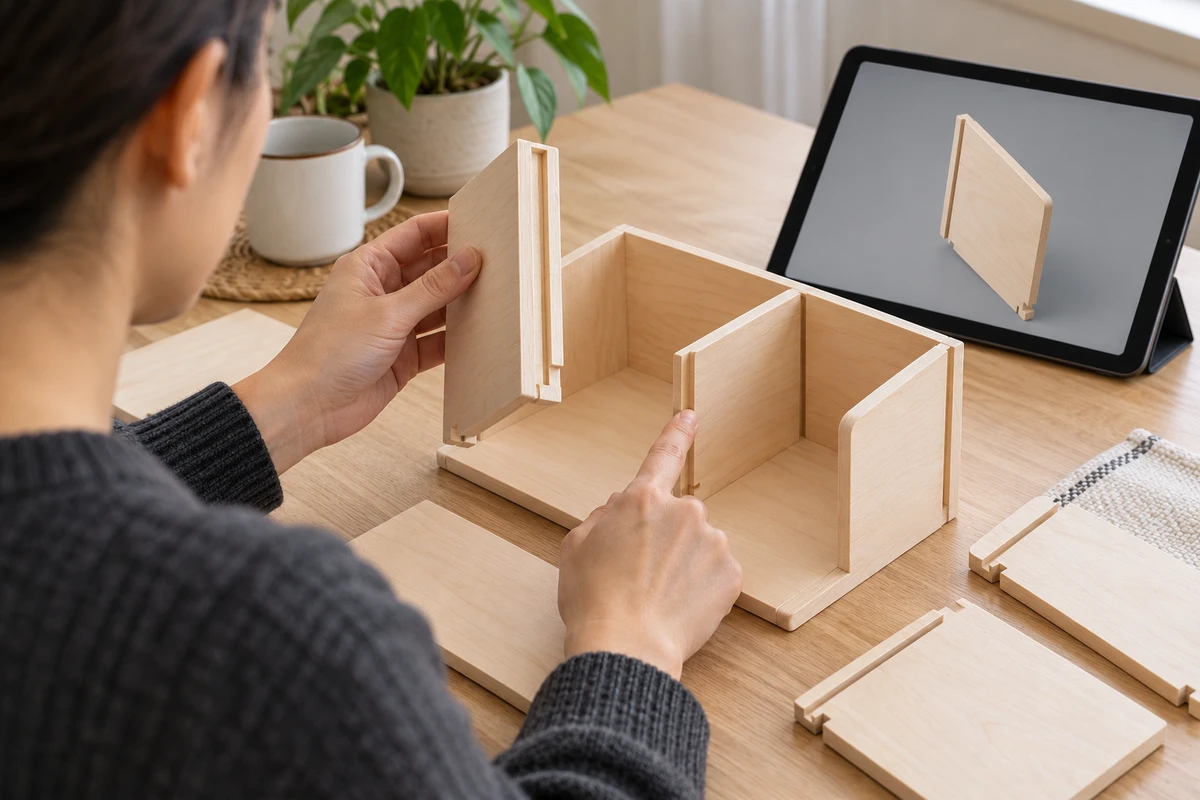
For a hypothetical flat-pack desktop organizer, imagine uncertainty over a shallow groove on a divider. If the missing information is simply which edge faces the user, a clear side view or a short fixed clip may answer it. A rotatable model has a more specific purpose when users need to inspect the relationship from several angles. This is an illustrative situation, not an ONCE case or a prediction that either format will reduce completion time.
For a team sourcing from China, keep the production-language issue separate from the product issue. The overseas user may be uncertain about a translated part name even though the factory’s assembly reference is accurate. Compare the approved terminology before rebuilding the visual sequence. If the physical part does not match the approved information, route it to product and support instead of making the animation look easier.
Then change only the information associated with the question: a viewing angle, part label or explanation order. Retain comparable product and task conditions where possible. Changing the hardware revision, language, procedure and visual format together makes it difficult to attribute any difference to the content.
Document the original uncertainty, what the revision added and what remains unresolved. This suggested local review can expose omissions. It is not a large-sample study, proof of sales impact or evidence of fewer returns. Stronger outcome claims require a separately designed evaluation.
Choose the smallest appropriate intervention
A fixed step video can explain an approved action and its visible result. A close-up is a focused addition when a hand blocks a feature or scale is unclear. Name the missing information in the scope instead of requesting a generally “more detailed” film.
Interactive 3D is worth evaluating when user-controlled inspection, component relationships or alternative paths have a real role. It also requires approved structural material and review, plus explicit decisions about models, steps, controls, devices and delivery environments. A rendered animation export is not automatically an interactive instruction system.
A product investigation belongs on a separate track. Content cannot correct mismatched parts, unconfirmed compatibility or an unresolved procedure. For safety-sensitive or professional installation, qualified product specialists must define what guidance is appropriate. Never shorten necessary actions or warnings to make a time metric look better.
The resulting update brief might contain just one new viewpoint, one terminology correction and one question for engineering. Minutes of new footage are a poor substitute for that clarity.
Keep the reason for the update, not just the updated file
For recurring content, the valuable record connects feedback to the product revision and the approved instruction—not merely to a dashboard screenshot. Ask what fields the brand can access or export, how measures are defined, how long records remain available and how approved materials can continue to be used if the service changes. Report access does not establish ownership of all raw data or unrestricted reuse rights.
Keeping the reason for each edit makes the next production decision easier to continue: which view answered a question, which wording was corrected, and which apparent content problem was actually elsewhere. This is ONCE’s analysis of a more useful ongoing service, not a demonstrated financial return.
Bring an existing instruction, one genuine user question, the relevant product revision and its approved terminology to an ONCE production discussion. Define the uncertainty before buying the format. That is how step feedback can guide a focused update rather than an unnecessary rebuild.