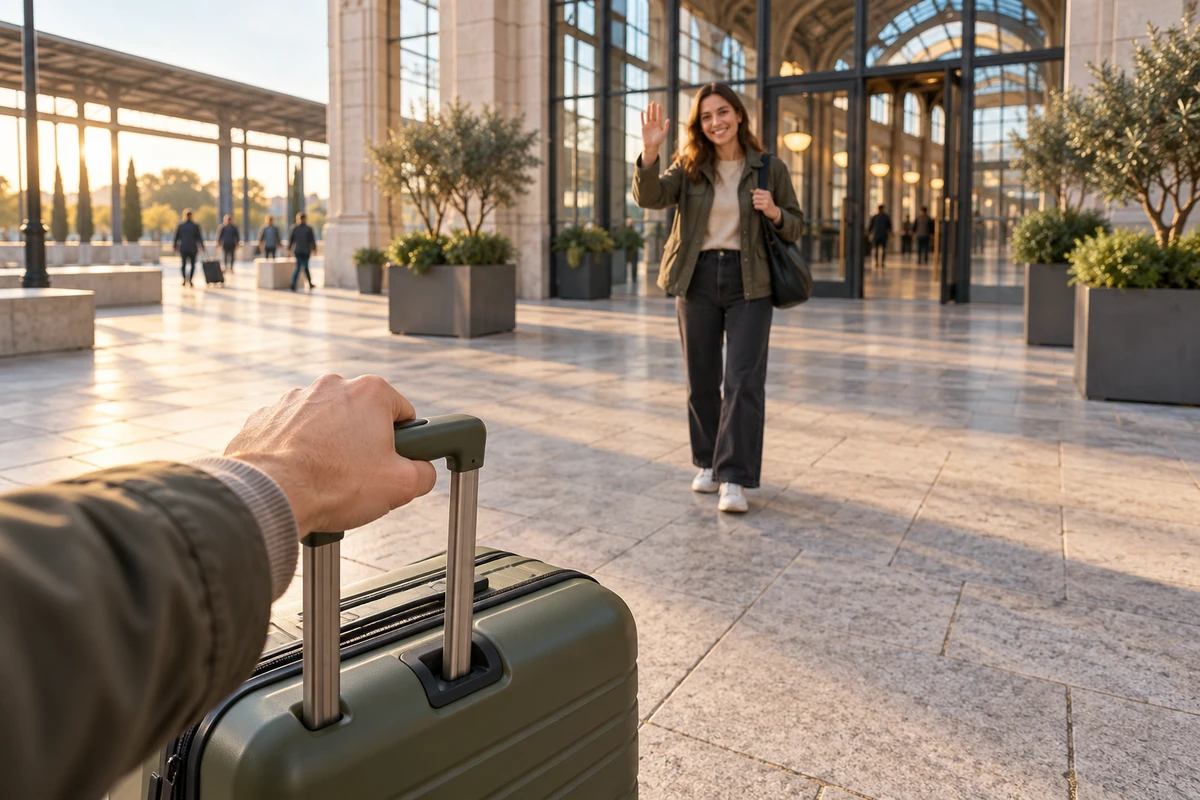
Imagine a fictional suitcase commercial. A traveler leaves a station, looking for the friend who has come to meet them. From the traveler’s position, we spot a familiar person waving, glance down at the suitcase beside us, then look up again. The product never fills the frame, but it enters the moment of arrival through someone’s attention.
Film from the other side of the forecourt and the story changes. We can see the traveler, suitcase and waiting friend together, but no longer discover the friend with the traveler. Either approach can work. A POV shot in a product ad is not inherently more truthful than an external view. It determines whose visible information the audience temporarily shares.
This scenario is a creative proposal, not a filmed or tested project. It makes no claim about a suitcase’s weight, dimensions or performance.
A visible hand does not automatically establish a viewpoint
Adobe’s official guide, Different types of shots and camera angles in film, describes POV as seeing through a character’s eyes. The useful part is whose eyes, not a mandatory piece of equipment. Its POV section also allows different focal lengths and handheld or stabilized movement according to the intended expression, rather than prescribing one appearance.
Hands can locate a body, but they are not the only cue. A frame without hands can be understood as someone’s view because of adjacent shots, direction and the object the person is seeking. Conversely, an overhead view of hands arranging a product may primarily offer a clear demonstration angle. It need not pretend to be the world directly before the character’s eyes.
An over-the-shoulder shot retains another distance. Adobe’s shot-reverse-shot guide distinguishes views that suggest looking through a character’s eyes from framing that includes part of the foreground character’s back and shoulder. The latter keeps us near the person while also leaving them visible as someone we observe. These are differences in information, not promises of better advertising results.
In the suitcase concept, seeing the friend from the traveler’s position shares a discovery. Looking over the traveler’s shoulder can also show where the traveler stands and how their body turns toward the friend. If both kinds of information matter, the shoulder view may be preferable. A shot’s name is not a quality ranking.
The two Adobe guides were consulted on 16 October 2026. Complete publication dates were not confirmed.
Choose what deserves this person’s attention
People on the same journey need different information. The arriving traveler seeks a familiar face. The waiting friend may be searching the people coming out. A passerby simply sees two people meet. Placing a camera near someone does not automatically give it their concerns.
In its published Sun Life: POV Campaign description, Canadian production company Oak + Rumble describes two POV-style videos, one from a client’s perspective and one from an advisor’s. Only the written project account was read for this article, not the films. The useful starting point is that different roles can experience the same service differently. We do not adopt its marketing metrics or infer that POV must improve conversion.
For a product film, make the question specific. What answer is the person waiting for? Where will it appear in the frame? Once attention shifts, how does the product still belong to the experience?
Give attention a reason before making the camera follow
In the fictional arrival, the friend could enter the traveler’s view before a brief downward glance confirms the suitcase they are about to take along. Looking down then becomes a character’s check before moving, not merely an inserted product close-up.
Another version keeps the traveler looking down at the case until the friend suddenly appears above it. That could work as a product presentation followed by a person’s arrival. It may no longer tell the story of finding a friend in a crowd. The images need not be unattractive; the order of attention has simply rewritten the scene.
A POV shot need not imitate every head movement. If the person is searching, the movement should help us understand what they seek. Once they find it, the camera can stop. Aimless wobble does not become a credible user experience merely because it resembles casual footage.
Nor must every look happen in one uninterrupted take. Establish the traveler, cut to what they see, then return to a reaction. Adobe’s shot-reverse-shot guide describes that character, observed object and reaction relationship. Decide separately whether each view needs a strict eye position, a nearby character-aligned angle or an external observation. Not every shot of what a person is looking at is a strict optical POV.
Feeling like use is not the same as explaining the product
The subjective suitcase passage can express arrival, searching and readiness to move while leaving much of the case unseen. If the brand also needs to explain its opening, internal layout or wheel construction, choose another position that shows those things clearly. Narration should not have to repair every omission.
Likewise, an action appearing effortless from eye level does not establish a product’s weight. A narrative shot can convey one person’s experience. A performance claim still needs appropriate product information and truthful presentation; a visual impression cannot become a physical conclusion.
Return outside to supply different information
Keeping one viewpoint throughout a film can create a strong style at a cost. The user’s face, posture, the complete product and other people’s reactions may remain absent. If those are central to the intended brand story, stepping outside is not a failure of immersion. It lets another kind of information speak.
After the fictional subjective passage, a side view could show the traveler meeting the friend, with the case between them. It need not repeat the entire search. It answers what the POV did not: whose attention we followed, and how the people and product now relate.
The space also needs to connect. If the friend is distant in one shot and immediately beside the traveler in the next, without a cue for elapsed time or movement, the sequence may read as different moments. A film can omit a journey, provided the creator understands what was omitted and whether the remaining cues support understanding.
Background clarity is a related but separate choice. Our discussion of depth of field in product ads asks how much environmental information to retain. Viewpoint asks whose act of looking that information belongs to. A blurred background does not substitute for motivated attention, and showing everything does not replace a narrative choice.
At the storyboard stage, sketch subjective, shoulder and external versions of the same scene. Read them without explanation: what does each reveal first, and what does it temporarily withhold? This does not predict advertising performance. It checks whether the intended idea has entered the frame. If the camera change alters no meaningful information, a POV label may not justify extra complexity.
For a new commercial, bring the real product, the user’s immediate task and the discovery you want viewers to share to ONCE VISUAL. A good subjective shot need not show the product more often. It gives the product a reason to appear within an experience worth sharing.
Sources and links checked on 16 October 2026. The travel scenario and original AI cover are fictional concepts, not client work, a user record or a product test.