Approving a dimensionally correct model is not the last check on how large a product will appear. A brand commissioning a launch film from a production partner in China should also review what happens when that model starts bouncing, turning or floating. The engineering team may have approved the geometry while marketing is still approving a misleading impression.
This does not mean every product film should slow down. It means expressive movement deserves its own approval question: does the audience understand the physical product, or just enjoy the animation?
What the research actually supports
A paper by He (Michael) Jia, B. Kyu Kim and Lin Ge, first published online in the Journal of Marketing on May 22, 2020, reports six studies of otherwise immobile products animated to move spontaneously. Faster movement could lead people to estimate a smaller product; highlighting explicit size information mitigated the effect. See Speed Up, Size Down.
In their June 4, 2020 American Marketing Association explanation, the authors also identify category unfamiliarity and perceived similarity to the movement of living things as relevant conditions.
Those findings are a reason to check an execution, not a universal speed setting. They do not establish that every camera move, rapid edit or mechanical demonstration changes perceived size in the same way. This is an evergreen production question, not a new 2026 platform requirement.
Separate character from operating performance
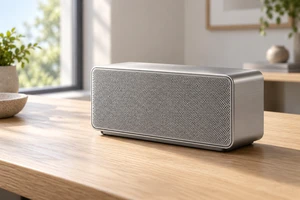
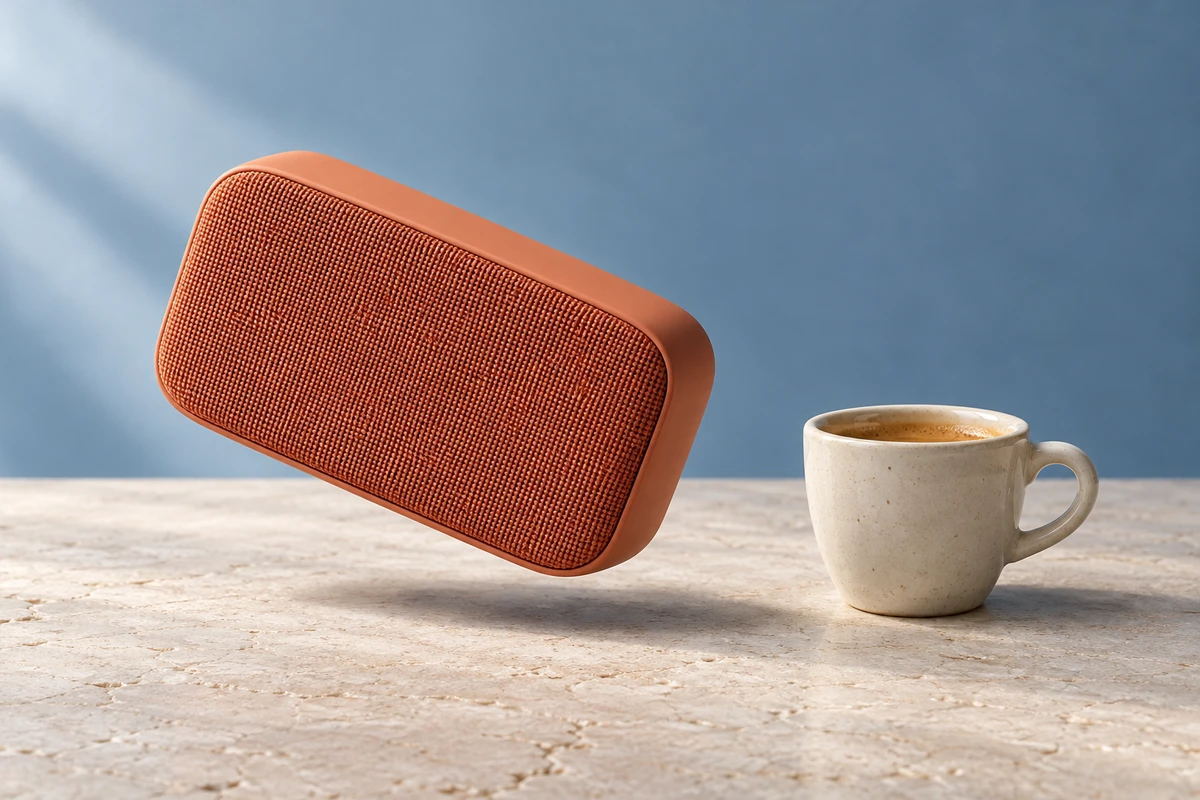
Consider a fictional portable-speaker launch. A lively animation makes the speaker hop and pivot; a restrained alternative presents it resting on a bedside surface. Either could suit the brand. The problem begins if one communicates a bedside device and the other suggests something small enough to clip to a key ring. This is an illustrative brief, not an ONCE client result.
Before giving notes, identify the job of the movement:
| Movement | What the team is approving | What it does not prove |
|---|---|---|
| Expressive hops, floats or spins | Character, rhythm and a credible size impression | Autonomous movement or real-world performance |
| A viewing rotation | Visibility of surfaces and enough time to inspect them | Operating speed |
| A functional opening, lift or rotation | Behavior supported by the product information | Permission to accelerate a demonstration for visual effect |
When a shot explains performance, use technical confirmation and real operation as the reference. If it is time-compressed or schematic, make that distinction clear. Perception research is not a justification for misrepresenting a mechanism.
The ONCE Motion–Scale Review Sheet
The following is our proposed production method, not a validated effectiveness model. It turns a vague concern about a product looking “toy-like” into a specific review before final rendering.
Establish the still reference
Ask the supplier or product owner to confirm the SKU, dimensions and state being shown: closed, open or ready for use. Then define the relationship the viewer must understand—bedside footprint, one-handed carrying or fit within a particular space.
Build a still reference with approved geometry, camera position and an honestly scaled familiar object. A cup resized to suit the composition is not reliable evidence of scale. If the still is confusing, correct that first. Motion cannot repair an undefined baseline.
Compare two timings without redesigning the shot
Request slower and faster rough-animation versions using the same path, amplitude, camera, product scale and start/end poses. Show one complete movement cycle in each, with matching stationary holds before and after. Do not make the faster version repeat the action just to match total duration.
The movement duration will differ, so this is a practical diagnostic comparison, not a perfectly isolated experiment. Record the difference. Review without music or impact sounds initially, then check the chosen direction again in the complete audiovisual cut. Changing camera, lighting, music and movement together makes feedback difficult to act on.
Ask about the object before asking about taste
Use viewers outside the production team who broadly resemble the intended audience. Before revealing the actual dimensions or showing a sample, ask where the product belongs, how someone would carry it and how large it seems relative to the reference.
Different viewers can see different versions. If the same people must compare both, vary the order and acknowledge comparison and learning effects. Only after collecting their initial descriptions should you reveal the approved dimensions and ask what surprised them. Small exploratory sessions can expose misunderstandings; they do not establish conversion gains or return-rate reductions.
| Feedback pattern | Production response |
|---|---|
| Both still and animated views confuse size | Revisit geometry state, framing and reference objects |
| The still reads clearly; one timing creates confusion | Adjust timing, easing or amplitude locally and review again |
| Size understanding is similar; style preferences differ | Make a brand-character decision, not a size claim |
| Confusion appears only after sound or cropping changes | Inspect that version’s soundtrack and retained scale cues |
Buy a reviewable decision, not an unlimited revision promise
For an overseas team working with a Chinese manufacturer and studio, the handoff should name who approves specifications and who approves the communication. A factory’s model approval should not silently become marketing’s motion approval.
Replace “make it more premium” with an intended understanding: “This should read as a bedside device, not a pocket accessory.” The animator can then propose an observable change—a shorter hop, a longer settling hold or a reference object kept within the shot. Slower motion alone is not evidence of weight, durability or engineering quality.
Ask the quote to distinguish rough timing comparisons, final rendering after approval and later animation changes. Request the affected shots, rendering work, sound synchronization and format adaptations rather than relying on a generic allowance for “revisions.” No universal price or saving is implied here.
For future launches, retain the approved model version, camera settings, motion curves, reference frame and review notes. Editable projects and third-party assets require a separate handover agreement. A new SKU can inherit a motion direction, but not an untested assumption about perceived size.
For ONCE, the strategic opportunity is to build reusable knowledge around these decisions, not merely accumulate finished renders. That is a proposed capability to develop, not a claim about an existing proprietary dataset or measured margin improvement.
Bring the product version, intended size relationship and planned placements into the 3D product animation brief. Before buying the polished render, make sure the rough movement introduces the right physical object.
Source note: the paper abstract and authors’ explanation were checked on October 15, 2026. They describe the same research, not independent replications. The AI-generated cover is conceptual and is neither a product specification nor a research stimulus.