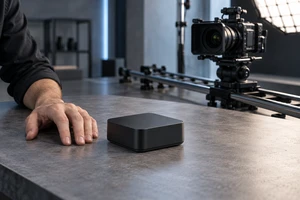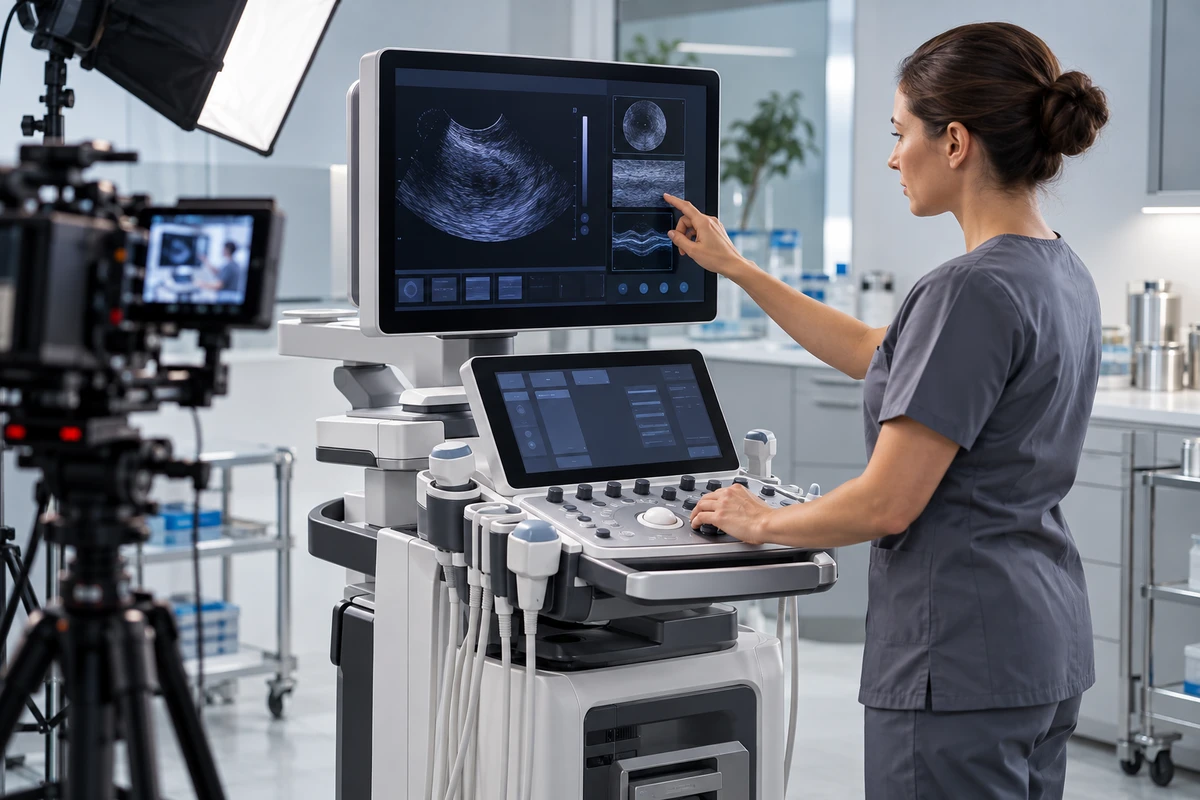
A device can look advanced, the operation can appear effortless, and the clinician character can seem completely confident. Cut those images together and the viewer may infer something the script never says: that the device diagnoses more accurately, improves treatment, or removes risk.
The hard part of medical-device video production is not making technology look complicated. It is making sure each image communicates only what the product is authorized and supported to communicate. Before a China-based production team writes the script, the brand should separate device identity, professional workflow, interface output, and clinical outcome. Product, medical and regulatory owners then decide what can be filmed, what needs qualification, and what must stay out of the public version.
Pictures make claims, too
In China, Article 60 of the Regulations for the Supervision and Administration of Medical Devices requires medical-device advertising to be truthful and lawful, based on the registered or filed instructions for use, and free from false, exaggerated or misleading content. Advertising that requires review cannot be published before that review.
The EU Medical Device Regulation is equally relevant to the image plan. Article 7 of Regulation (EU) 2017/745 prohibits misleading text, names, trademarks, pictures and other signs concerning intended purpose, safety and performance. In the United States, FDA materials on intended use and indications for use show why advertising, context and the purposes suggested around a device matter.
These regimes are not interchangeable, and qualified regulatory and legal owners must decide what applies. Their practical overlap is still useful for production: compliance cannot be reduced to removing two adjectives from the voice-over. The room, operator, interface, patient reaction and edit sequence can all create an implied claim.
The ONCE four-layer picture permission model
1. Device identity
This layer answers, “Which exact device is on screen?” Model, hardware revision, probe or accessory, software build, packaging, labels and target market should match the source documents approved for the version being filmed.
Hero shots, ports, installation, mobility, cleaning and maintenance can usually be planned here. A prototype must not visually promote an unshipped structure or feature as though it were the commercial product. Give every shoot sample a stable ID and place its labeling version, firmware, interface build and permitted market on one sample card.
2. Professional workflow
This layer answers, “Who uses it, where, and in what sequence?” Setup, connection, calibration, positioning, operation, cleaning and servicing are often the most valuable B2B content for hospital procurement, distributors and biomedical engineering teams.
The performance cannot be improvised for cinematic smoothness. User qualification, protective equipment, hand position, consumables, sterile zones, room type and critical steps need product and professional review. Showing a professional-only device as an easy home-use product can change the apparent intended use even when the narration remains cautious.
3. Interface and output
This layer answers, “What information does the device produce?” A film may show an authentic screen, report, measurement or operating status, but the production record should distinguish live output, training data, a simulated case and a post-production illustration.
Imaging and software devices need particularly clear version and data provenance. A phantom, test dataset or synthetic case may be appropriate to demonstrate workflow and display behavior; it should not be edited into a real patient's clinical result. FDA's 2025 guidance for early orientation meetings for medical-device software highlights the value of explaining intended users, use environment, general workflow, inputs, outputs and risk mitigations. Those same fields make a strong production brief, even though a marketing film is not an FDA orientation meeting.
4. Clinical outcome
This layer carries the highest review load. Diagnostic accuracy, treatment improvement, safety, speed, complication reduction, patient benefit and comparisons with another approach should never be invented by the production team to complete the story.
If an outcome belongs in the film, tie it to the exact device, population, conditions of use, evidence source, market and approved wording. A clinician, hospital environment or before-and-after edit does not automatically substantiate a claim; it can create an even stronger implication than the copy. When the support is incomplete, stop at the identity, workflow or interface layer instead of asking performance to stand in for evidence.
Turn the storyboard into a visual-claims register
A conventional storyboard records framing, action and dialogue. A regulated-device project needs four additional columns:
- what a reasonable viewer may believe because of the shot;
- which approved source supports that interpretation;
- the markets and device versions for which it is valid;
- the named reviewer who releases it.
Consider a shot described as “the operator clicks and the system highlights a suspicious region.” The visual claim is not merely that a highlight appears. The viewer may believe the device autonomously identifies a finding. If the authorized position is decision support, the interface, narration and edit must preserve that role rather than turning assistance into diagnosis.
Review should occur at three production gates. Before scripts and boards, lock intended purpose, IFU/labeling, approved claims, prohibited expressions and market status. After rehearsal or test capture, confirm device state, professional steps, environment and interface. Before release, inspect picture, performance, captions, voice-over, data displays, qualifications and market versions frame by frame.
Every cutdown needs its own review. Removing one condition, warning or context shot from a compliant master can create a different claim. ONCE's existing guide to filming medical-device product video in Shenzhen covers the operational preparation; the visual-claims register adds a decision layer for what each shot is allowed to mean.
A credible professional scene does not require a fictional patient success
Brands do not need to manufacture a recovery story to make a film feel medical. Valuable and defensible subjects include installation, calibration, accessory connection, role handoffs, interoperability, data flow, cleaning, maintenance and training.
These details may be less dramatic than a treatment outcome, but they answer real questions from procurement, engineering, distributors and clinical users. Where people appear, use approved professional demonstrations, training contexts or clearly identified simulations. Do not use an actor's relief, a fabricated report or an unsupported expert endorsement as a shortcut to trust.
For overseas brands producing near a China supply chain, this also changes who must be available around the shoot. The factory or R&D team confirms the physical product. The target-market regulatory owner confirms claims and status. A medical or clinical reviewer confirms professional behavior. The production company turns those approvals into pictures and versions; it should not silently inherit responsibility for deciding clinical truth.
Price the review load, not only the runtime
Two 90-second films can require radically different production systems. A device beauty film and installation sequence mainly consume sample preparation, location, camera and post-production. Authentic UI, professional operation, multiple market claims, patients or clinical outcomes add source control, specialist time, privacy and rights management, regulatory review, version separation and revision loops.
A more useful procurement denominator is:
Landed cost per releasable evidence-shot package = product preparation + professional rehearsal + live action/animation + medical and regulatory review + market versions + revision and archive, divided by the number of shot packages cleared by product, medical and regulatory owners for the intended market.
This is not an industry benchmark. A shot package means the picture, interface, caption, source record and approval trail that express one reusable product fact. The model reveals work that a day rate hides: who owns each public conclusion, what changes between territories, and which shots expire when labeling, software or indication changes.
Use generative production where it cannot rewrite clinical truth
Generative tools can accelerate mood boards, previs, non-evidentiary environments, layout exploration and early animation tests. They should not be treated as the source for device geometry, professional technique, anatomy, patient response or clinical outcome.
When generated material is used, send it through the same visual-claims register. Record what was generated, what viewers may infer, what supports that inference, where it may be used and whether it must later be replaced with controlled live action or approved medical animation. Generation creates production capacity; it does not create regulatory authorization.
Start the project with a four-layer review
Mark every proposed shot as device identity, professional workflow, interface/output or clinical outcome. The first two layers can often be solved with an accurate sample and expert rehearsal. The third needs controlled software and data provenance. The fourth should not proceed without approved evidence and market-specific review.
For medical imaging, medical robotics and other professional-device projects, the most productive first conversation is not about cameras. Bring the target markets, regulatory status, IFU/labeling, sample and software versions, approved claims, use environment and delivery channels. ONCE can then turn the medical-device and professional-equipment video brief into filmable layers, review gates and market versions.
This article is a production and procurement method, not legal, medical or regulatory advice. Final release must be approved by qualified owners for each device and market.
Core sources verified 14 October 2026: China's Regulations for the Supervision and Administration of Medical Devices, Article 60; China's Interim Measures for the Administration of Review of Advertisements for Drugs, Medical Devices, Health Foods and Formula Foods for Special Medical Purposes; Regulation (EU) 2017/745, Article 7; and FDA guidance on intended use, indications for use and device labeling.