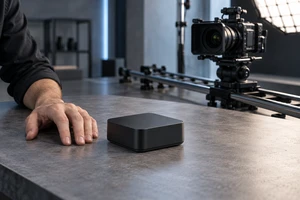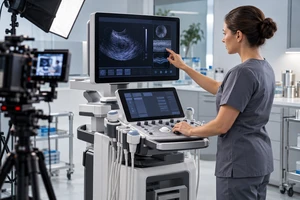
Imagine the same performer sitting at a table with a product in front of them. In the first version, they keep looking at the product. In the second, they occasionally look toward someone off-camera. In the third, they raise their eyes and address the viewer. The lighting, dialogue, and physical action remain unchanged, yet the social meaning of the image has shifted. The product can be an object under inspection, part of an exchange between two people, or a statement offered directly to the audience.
Gaze is often left for the shoot day, when direction collapses into phrases such as “make it feel natural” or “give it more emotion.” But gaze is not decoration added to a facial expression. It decides whom the audience follows, whom they trust, and where they stand in relation to the character. Only then does it decide how the product enters the story.
Gaze allocates relationships before it allocates attention
People tend to follow another person’s gaze. A 2021 meta-analysis in Psychological Bulletin integrated 423 gaze-cueing effects and found that observed gaze reliably directs attention, although the size of the effect changes with the task, timing, and facial expression. That does not predict the performance of any particular ad. It does establish a useful creative principle: where a performer looks is part of the composition.
Direct and averted gaze also do different jobs. Five field and laboratory studies published in the Journal of Consumer Research found that, in the tested materials, averted gaze supported narrative transportation and emotional appeals, while direct gaze supported spokesperson credibility and informational appeals. Direct eye contact is not automatically “more connecting,” and looking away is not automatically more cinematic. Each invites the viewer into a different relationship.
That is why gaze should be designed before asking whether the performer smiles. A smile sets the emotional temperature; gaze decides who receives that emotion.
Looking at the product, off-camera, and into the lens are different grammars
Looking at the product transfers attention to the object
When a performer looks at a product, viewers can read that object as the cause or result of the current action. In a 2017 eye-tracking experiment with 137 participants, people viewed fictional shopping pages with banner ads. When the depicted face looked toward the product region, participants were more likely to look at the product. The study used web banners, not brand films, so its findings should not be translated into a video conversion promise. It does show how gaze can act as a compositional pointer.
The risk is that a performer who constantly watches the product begins to resemble a demonstrator. A more believable approach is to give each look a reason: a sound interrupts the character, so they check the product; two people exchange a glance before looking at it together; an operation finishes, and the character reads the result before returning their attention to another person.
Looking off-camera makes someone exist beyond the frame
Off-camera gaze is especially good at creating relationships because viewers instinctively search for the unseen target. Even if the second person never appears, a stable eyeline can imply distance, height, intimacy, and status. A brief upward glance may feel like a request for permission. A look held at equal height, with the mouth reacting first, can suggest that two familiar people already understand each other.
Emotional brand films often need this unfinished relationship. If a character keeps addressing the lens, viewers can feel that they are being told something. If the character looks toward someone within the story, viewers are more likely to observe a piece of life from nearby. The Journal of Consumer Research studies distinguish narrative transportation from spokesperson credibility in much the same way. Neither gaze direction is universally better; each must serve the appeal.
Looking into the lens turns the viewer into the person being addressed
Direct gaze shortens social distance, but it also changes the grammar of the film. It works naturally in product explanations, founder messages, creator-led content, and brand statements that require a clear promise because the performer is no longer living only inside the story. They are accountable to the viewer.
Direct gaze still needs restraint. Held too long, it can feel like scrutiny. Paired with language and expression that do not agree, it can feel recited. If a character suddenly summarizes to camera after an intense emotional beat, the address can break the life the scene has just created. Direct gaze is often strongest when it has a visible origin: a character acts within the story, reaches a realization, and only then turns to the audience. That moment is not merely “looking at camera.” It hands over the conclusion.
Eyeline matching turns separate shots into one space
Brand films frequently photograph the performer, product, and environment separately. What makes those images feel simultaneous is not just matching color and shot size. Their eyelines must be able to meet.
If a performer looks slightly down and screen right in a close-up, but the next shot places the product above and to the left, viewers may not name the error. They will still feel that the character and product occupy different spaces. When direction, height, and implied distance agree, a character close-up and a product close-up validate each other: the first shot poses a look, and the second answers it.
The useful on-set record is not “look right.” It is a defined target:
- which side of the lens the target occupies, how far it is from the camera, and whether it is above or below the performer’s eyes;
- whether the eyes or head initiate the turn, and how long the transition takes;
- whether the performer looks at the other person’s eyes, hand, product, or a specific detail;
- where the gaze returns and how that return connects to the next action.
These choices preserve editorial options. One generic side glance cannot easily become expectation, suspicion, or confirmation in post. A fast scan, a full head turn, and a return after a held look give the relationship distinct rhythms to edit.
Give the performer a gaze action, not an emotion word
“Look at them lovingly” is not much more executable than “make it natural.” A performer needs to know why the gaze moves and what information the character expects to receive.
A gaze action can be written with four elements: target, reason, timing, and return.
The target is not merely “off-camera,” but a precise point on the unseen person. The reason is not “to show affection,” but to check whether the other person heard. The timing is not “somewhere after the line,” but the instant a product sound ends. The return determines whether the eyes go back to the product, the other person, or the lens.
Consider a hypothetical home scene in which a character switches on a lamp. “Look surprised” is weak direction. A filmable instruction would be: “When the light comes on, look first at the color change on the table. Hear the off-camera person laugh. Raise your eyes to find them, confirm that they saw it too, then let your gaze return to the lamp.” The product function, an unseen person, and the character’s emotion now share one gaze sequence. This is a creative example, not an ONCE client project.
A product should enter a relationship, not interrupt it
Having everyone look at the product is not a complete solution. Relationships need direction and change.
When a gift is offered, the giver may look at the recipient before knowing whether it has been accepted. When a product changes the situation, the user may look at the result and then find someone nearby to share it. Once the problem is solved, two people may finally stop looking at the product. The object is not the endpoint of the relationship; it is what changes that relationship.
This gives editing a clear priority. A functional shot answers, “What happened?” A reaction shot answers, “Why does it matter to this person?” Keep only the function and the film becomes a demonstration. Keep only the reaction and the product becomes a prop. The gaze shift between them is often the bridge that carries physical performance into human meaning.
AI can generate a face, but critical gaze still needs shot-by-shot review
Generative video is making character shots more usable, but “eyes pointing somewhere” is not a complete performance. A 2025 paper on natural gaze-head coordination specifically modeled the temporal relationship between gaze and head motion, noting that this aspect had not been emphasized in earlier gaze-controlled facial video generation. CVPR 2024 research on controllable character animation likewise described temporal consistency of detailed character appearance as a major image-to-video challenge.
Those papers do not prove that any particular model will fail. They do explain why eyes, head turns, blinks, facial detail, and the target in the following shot must be reviewed together. A correct product frame and stable character identity do not guarantee that a relationship reads clearly.
AI is useful for testing gaze direction, off-screen space, and composition in preproduction, as well as for transitions that do not depend on precise eye performance. If a look decides whether two people trust each other, whether a character believes the product, or whether the performer is speaking to the audience, treat it as a hero performance shot. Check pupil direction, the order in which eyes and head move, target height, and continuity across the cut. When these elements cannot be controlled reliably, live action remains the more direct choice.
Draw the gaze relationship before drawing the storyboard
Before storyboarding the next brand film, describe each important moment as a relationship change: who looks first, why they look, whether the other person responds, and what the product changes in that exchange. This is not another production form. It forces the creative idea to answer a more fundamental question: who is the person in the frame trying to connect with?
Return to the performer at the table. If they keep looking at the product, the viewer reads observation. If they look toward someone off-camera, the viewer reads sharing. If they finally raise their eyes into the lens, the viewer reads an invitation. The tone of a brand film may depend less on a bigger location or a more expensive camera than on where a pair of eyes sends our attention.
For more on how performance, cinematography, and editing work together, explore ONCE's video production insights. If you are developing a brand film in which human relationships carry product value, visit our video production solutions to discuss gaze design, performance tests, and the division of work between live action and AI.
Sources checked on October 13, 2026. The cited studies use meta-analysis, controlled advertising materials, and laboratory or field designs; they do not replace audience testing for a specific brand, performer, platform, or final edit.