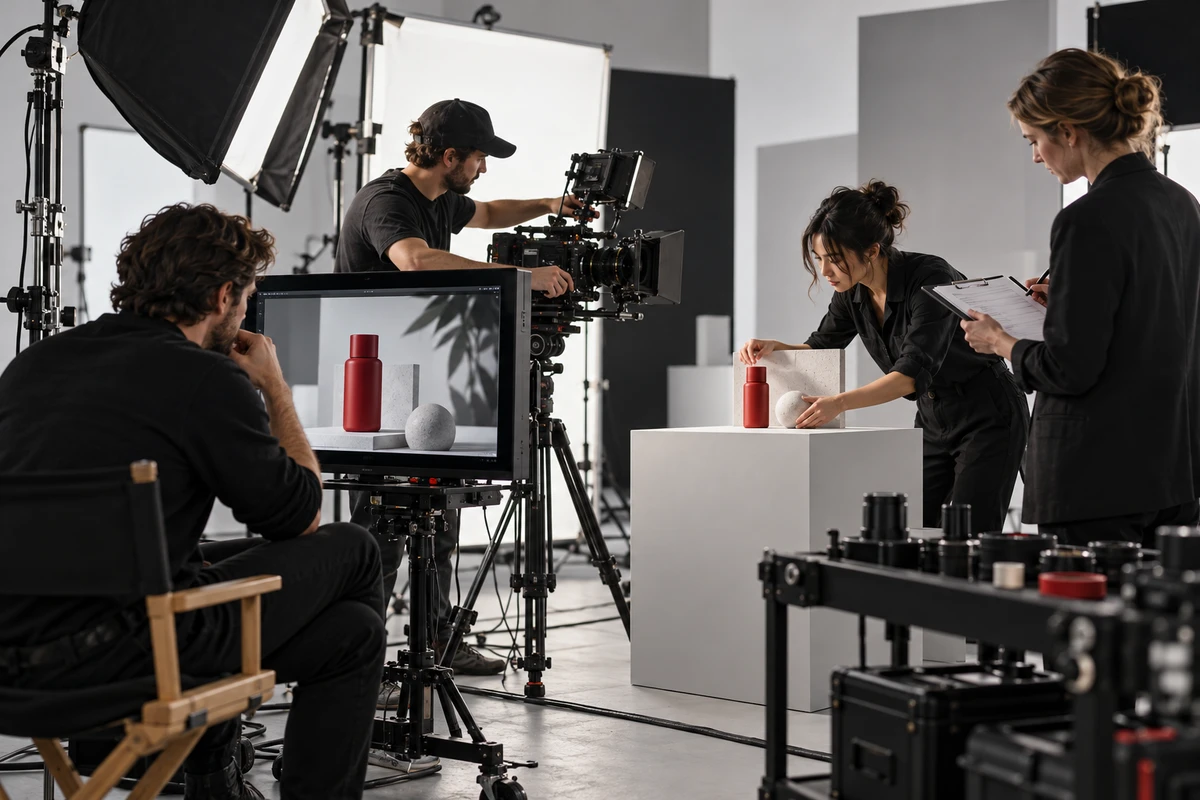
Four people can stand around a monitor and still leave the most important question unanswered: is the take failing because of the performance, the lighting, or the way the product has been arranged? Headcount does not create accountability. A useful brand film crew plan begins by identifying how many kinds of decisions must be made independently, then deciding which roles can be combined and which must remain separate.
For a buyer, the real test is not “How many people will be on set?” It is whether creative direction, image-making, production design, and execution each have a clear owner—and who makes the final call when those priorities conflict.
Start with three kinds of workload
Crew size should follow the work. First is creative-decision load: performance, blocking, story turns, and choices that must be made during the shoot. Second is visual-execution load: controlled lighting, specialist camera movement, product surfaces, set dressing, or material that must connect cleanly with VFX. Third is production-coordination load: locations, cast, prototypes, factory access, rights, transport, and approvals moving at the same time.
When two of those loads are high, compressing every responsibility into one lead creator usually creates a bottleneck. Combining roles is not inherently unprofessional. The practical question is whether two critical decisions must be made at the same moment.
ScreenSkills describes the director as the creative lead from pre-production through the edit, the director of photography as the owner of the photographic approach, the production designer as the person shaping the visual world, and production management as the function responsible for schedule, resources, and practical delivery. A commercial brand film may be much smaller than a feature, but the responsibility map still holds.
What the four core roles actually own
Director: expression and trade-offs
The director translates the brand objective into actions, performance, and shot relationships. When time runs short, the director decides which information and emotional beat must survive. Before a contract is signed, the scope should state who owns the script interpretation, storyboard, performance direction, and editorial intent.
Director of photography: usable images
The cinematography lead owns camera, lighting, composition, movement, and the technical route to a usable image. On a small shoot, the DoP may also operate the camera. Once controlled lighting, moving rigs, and multiple cameras run in parallel, operating and decision-making need more separation.
Production designer or art lead: everything visible in frame
Sets, props, product placement, surfaces, wardrobe color, and screen graphics all contribute to the brand impression. Art is not just “making the location look nice.” It means identifying what must be designed, sourced, cleared, transported, and reset before the camera rolls. The more product close-ups and controlled surfaces a film requires, the less suitable art becomes as an improvised assistant task.
Producer or production manager: a plan that can happen
Production turns the script into dates, locations, people, equipment, prototypes, approvals, and contingency options. ScreenSkills’ production-manager checklist covers scheduling, resources, permissions, and fallback planning. Those are exactly the details that determine whether a brand-film concept can fit a real factory window or launch date.
Three crew levels without fixed budget labels
Lean: one task, low concurrency
This suits a single-location interview, a limited amount of workplace coverage, or straightforward product documentation. One experienced lead may combine directing and cinematography, while art focuses on organizing an existing environment. Production coordination and sound still need named owners. The configuration works only when tasks can be completed in sequence rather than all at once.
Standard: brand expression and execution carry equal weight
If the film includes several locations, performance, controlled lighting, product shots, or parallel preparation, appoint separate owners for direction, cinematography, art, and production. Lighting, sound, camera assistance, styling, and floor support are then added according to the shot plan. The goal is not to fill a template; it is to let department leads approve the look references, set plan, call sheet, and product status before the shoot.
Complex: multiple systems must run in parallel
Set builds, night work, vehicles, crowds, specialist photography, multi-camera coverage, heavy VFX, or cross-city logistics cause each core department to expand. Direction may need an assistant director to run set rhythm; cinematography may need dedicated lighting and grip teams; art may need build and prop management; production may need location and transport support. More people are justified by parallel dependencies, not by the desire to call the project “cinematic.”
Generative tools do not erase these responsibilities. They may help with concept exploration, previsualization, or selected image elements. But whenever the finished film represents the brand, someone still has to approve the visual direction, confirm product accuracy, and own the deliverable.
Four interfaces where projects usually lose control
Director and cinematography: define the shot task
For each important shot, state its information goal, action, camera movement, lighting requirement, and downstream use. Direction explains why the shot exists; cinematography explains how to capture material that works. A reference film and the phrase “make it premium” are not enough.
Direction and art: freeze purchases after framing is known
A prop may be a color block in a wide shot but a quality issue in a close-up. Confirm framing, screen time, and product placement before materials and quantities are locked. This prevents the art budget from being spent on details the audience will never see.
Art and production: turn a design into a resource list
Every set idea should map to sourcing, fabrication, transport, access, build time, reset, and clearance. A visual idea without an owner and a deadline is not yet an executable plan.
Production and the brand team: put approval windows on the schedule
Scripts, storyboards, sets, prototypes, wardrobe, and selects all need named approvers. If marketing, product, and legal must review the work, their response time belongs in the schedule. Start with a multi-platform delivery matrix if the shoot must generate several versions; for industrial subjects, complete a shootable-evidence inventory before the script is locked.
Put these five items in the quote and contract
- Name the core role owners and state which roles are combined at each phase.
- List the outputs each role must provide, such as a director’s treatment, visual references, set plan, call sheet, and shot records.
- Define which conditions trigger extra crew: night work, sync sound, complex art, multiple performers, or multi-camera coverage.
- Name the brand-side approvers for the script, storyboard, prototype status, and delivery versions.
- State how lead-crew changes, location changes, or added requirements reopen scope and scheduling.
Headcount, equipment lists, and reels can help compare suppliers, but they do not replace clear ownership. A smaller team can work well when every source of complexity has an owner, an input, and a completion standard.
If you are preparing a brand film, explore ONCE brand and commercial production and the video production knowledge hub, then send a brief for a creative diagnostic so crew structure and approval points can be aligned before pricing.