An AI phone film often shows a simple promise: tap once, the phone understands the request, and the task is complete. But did the feature run on the device, depend on a cloud connection, or switch paths according to the handset and operating-system version? If the script never answers that question, a polished interface can turn one successful demonstration into a promise the product cannot reproduce consistently.
The first job in an AI phone product film is therefore not adding more “futuristic” styling. It is making every feature claim reviewable by product, marketing, and legal teams. A practical workflow starts with a feature claim card and then builds a shot-verification matrix. Establish the facts first; only then choose live action, screen recording, UI compositing, CGI, or generative imagery.
Define the proof before writing the feature scene
Many hardware claims are directly visible: the profile of the chassis, button response, hinge movement, camera module, or material finish. AI features introduce more variables. The same result may depend on the device model, OS version, model version, network, account, language, permissions, and prompt.
Before storyboarding, create one claim card for every AI feature. At minimum, record:
- the user input, whether voice, text, image, or a cross-app task;
- whether execution is on-device, cloud-based, or hybrid;
- the test handset, OS, app, and model or service version;
- network, sign-in, permissions, language, and regional requirements;
- the expected output, waiting states, and known failure conditions;
- whether the shot is a continuous capture, edited screen recording, UI composite, or conceptual visualization;
- the product owner who approves the behavior and the legal or compliance owner who approves the external claim.
This card is not an excuse to fill the end frame with disclaimers. It helps the creative team see where visual exaggeration is harmless and where the camera needs to remain documentary in its honesty.
Three kinds of truth need three visual treatments
Hardware truth: let light prove the material
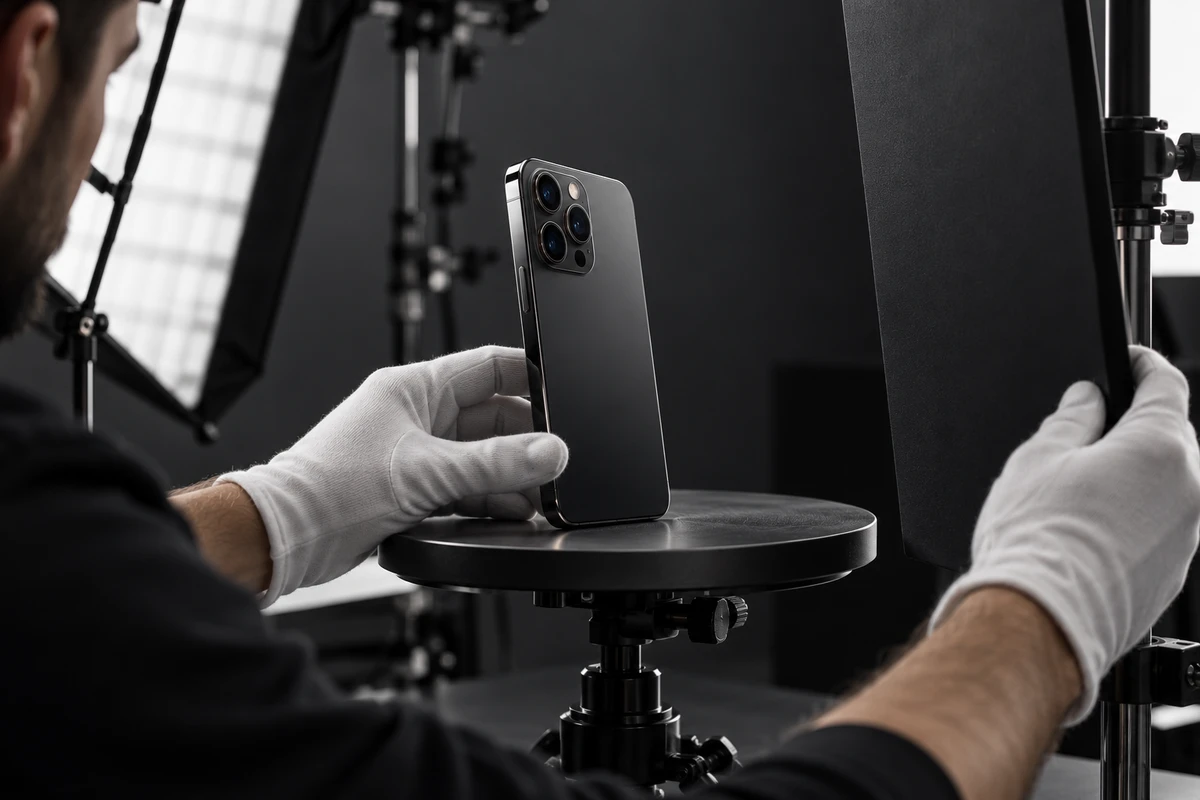
Frames, camera bumps, display creases, button travel, protective structures, and accessory connections are physical facts. Film them with a production-representative or approved appearance sample, and record whether color, finish, openings, and proportions match the launch product.
Macro work magnifies dust, fingerprints, and edge defects, so the production needs graded samples, a cleaning procedure, and backups. If a 3D turntable or a generated environment extends the live plate, constrain the silhouette, cutouts, material, and scale with real photography, CAD, or an approved 3D asset. The same principle appears in our guide to deciding what AI can create and what needs live action.
Interaction truth: the hand, interface, and outcome need one causal chain
Feature films often keep the moment before input and the polished outcome, then skip waiting, permission, or confirmation states. The pace improves, but viewers can infer that the feature has no conditions, no latency, and no alternate path.
A more credible scene preserves three visible beats: user trigger, system response, and completed result. Live-action hands establish the physical action. Native screen capture preserves actual states. Compositing corrects flicker, reflections, legibility, and localization without removing required steps. If editorial pacing compresses latency, log that treatment in the approval record rather than letting the edit imply a fixed response time.
Mechanism visualization: explain the invisible without presenting it as a test
Model orchestration, privacy isolation, chip computation, and cross-app calls are not directly photographable. CGI, motion graphics, and generative imagery can make these systems easier to understand, but explanatory visuals and functional proof should remain distinct layers.
For distribution in China, generative assets also need a compliance review. The national Measures for Labeling AI-Generated and Synthetic Content took effect on September 1, 2025, covering generated or synthetic text, images, audio, video, and virtual scenes and defining explicit and implicit labels. Applicability depends on the parties and publishing context, so brands should have legal teams map the rule to their actual channel and role rather than add labels at the last minute. Read the official measure.
On-device, cloud, and hybrid features require different proof
“AI phone” does not describe one execution model. Google’s Android documentation, updated October 8, 2026, says Gemini Nano can run without a network connection, while inference speed still depends on device hardware. It also describes hybrid inference that can fall back to cloud models when on-device capability is unavailable or insufficient. Apple’s Foundation Models documentation likewise distinguishes on-device models, Private Cloud Compute, and third-party server models.
That distinction creates a straightforward production rule: do not verify only that a feature worked once. Verify the conditions under which it worked.
On-device features
Test with mobile data and Wi-Fi disabled, and record whether model downloads, resource preparation, or permissions were already completed. An offline scenario may be a valid creative premise, but a preloaded test state should not be presented as an out-of-box experience.
Cloud features
Record network type, account state, regional availability, and service status. If network conditions affect the result, avoid an unexplained cut that manufactures a fixed response time. Preserve the real timing separately from the accelerated edit.
Hybrid features
Confirm when the device switches paths, whether users can perceive the transition, and whether the outputs differ. The final film may not need to explain the entire architecture, but the production record should. Otherwise, a later change in device, market, or OS can invalidate a shot without anyone knowing why.
Schedule a technical test day before the shoot
The variability of AI features makes “we will test it on set” an expensive plan. Run a dedicated technical test before principal photography with the product manager, interaction designer, writer, director, screen-capture operator, and post-production lead.
The goal is not a beautiful teaser. It is a shot-verification matrix. Give each shot a row that includes the approved claim, device ID, OS and app version, model or service version, network state, account and permissions, test input, continuous successful runs, representative failure, capture method, post treatment, disclaimer, and approval status.
For nondeterministic outputs, do not present a count of successful takes as statistical reliability. Use it only to estimate execution risk. Public copy should describe the real capability and its conditions, not turn the best output into a guaranteed result.
Preserve an unpolished chain of facts on set
An AI phone film may combine premium product cinematography, human use, and perfectly legible UI. The final result can be seamless while the production archive remains layered:
- Interaction reference camera: shows gestures, phone orientation, and the environment so post-production can reconstruct what actually happened.
- Native screen recording: keeps the full action, prompts, waiting, permission, and error states rather than only the winning take.
- Clean product plate: allows screen replacement while preserving realistic reflections, occlusion, and hand contact.
- Approved UI package: comes from or is approved by the product team; buttons, status bars, and results are not redrawn from visual habit.
- Final composite log: states what was removed, what was accelerated, and which text layers were created for distribution.
This discipline does not reduce creative freedom. It lets the director compress a complex interaction into a clear rhythm while giving production and approval teams a route back to the original facts.
Accept a verification package, not only a launch-style master
Google Ads’ current Misrepresentation policy prohibits misleading product information, manipulated media intended to mislead, and inaccurate or improbable claims presented as likely outcomes. The safest production response is not timid creative; it is a traceable relationship between each public claim and its source material.
A useful delivery and acceptance package includes:
- Chinese and English masters plus the agreed horizontal and vertical cutdowns;
- clean versions, separated music and voice tracks, and subtitle files;
- complete screen captures and interaction reference footage for key features;
- feature claim cards, the shot-verification matrix, and final approval records;
- handset IDs, OS, app and model versions, and filming dates;
- source and treatment notes for UI composites, CGI, AIGC, and live-action footage;
- known conditions and a list of shots that must be retested after future product updates.
If the campaign will later be adapted for Amazon, Shopify, TikTok, and the brand site, build a multi-platform delivery matrix before the shoot instead of relying on crops after the master is locked.
AI phone advertising should be imaginative, but that imagination has to rest on reviewable product facts. When preparing a brief, bring the feature list, sample versions, target markets, and delivery channels to ONCE. We can use them to frame the claim cards, shot-verification matrix, and bilingual asset plan for the project.