When teams search for a Shenzhen product studio rental, the first instinct is often to browse location photos and ask which set looks best. The set matters, but the expensive problems usually come from something else: a schedule that combines clean product close-ups, talent demonstrations, and recorded dialogue without checking whether lighting positions, sound, and set changes can coexist.
A more reliable method is to divide the shot list into three groups before the studio visit: controlled-light shots, contextual shots, and environmental shots. Then decide which belong in a white cyclorama, which need a practical set, and which genuinely require a location. The result is not a vague “one-day studio rental,” but an executable location plan.
Group one: controlled-light shots
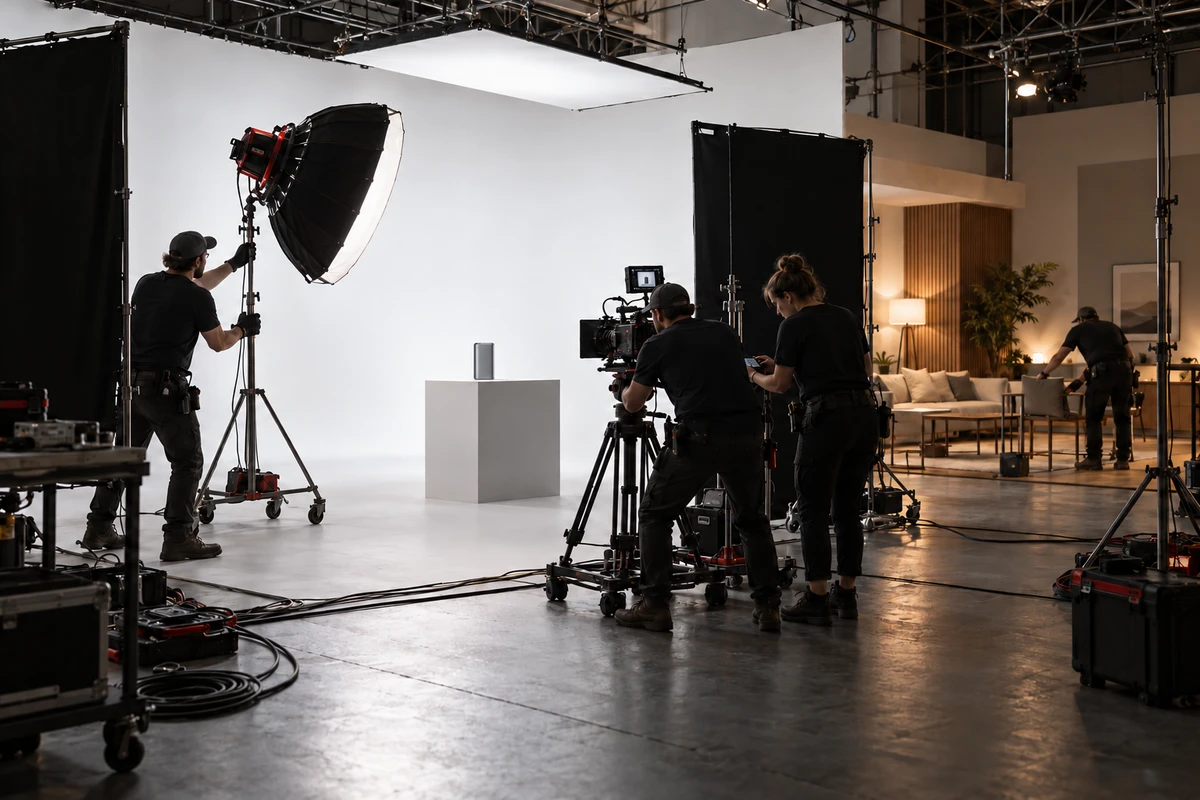
Turntables, material close-ups, compositing plates, motion-control moves, and full-body demonstrations often need a clean background, stable light, and enough camera distance. A white cyclorama is useful not merely because it is white. It gives camera, lighting, art, and post-production teams greater control over silhouette, reflections, shadows, and background extension.
Do not evaluate a cyc with one wide phone photo. Test at least four things with a priority shot:
- Place the product at its intended mark and confirm that camera, lighting, and crew still have working depth.
- Frame with the actual widest or longest lens planned for the scene and check whether the ceiling, floor seam, or edge of the cyc enters the image.
- Turn on a hard source and inspect the sweep for marks, uneven reflections, and unwanted texture.
- Walk the planned push, slide, orbit, or robotic-camera path and confirm that stands, cables, and safety zones do not conflict.
ARRI's official lighting handbook separates product lighting, dramatic lighting, and studio applications into different tasks. Its background-lighting guidance also shows why an evenly lit cyc needs deliberate beam control. Floor area is only the starting point; where fixtures can be placed determines whether the shot works.
The ONCE Shenzhen production base supports product commercials, brand content, and studio production. For shots that need clean contours, repeatable movement, or compositing, send the product dimensions, camera height, and movement path before deciding that a white studio is suitable.
Group two: contextual shots
A home interior, technology set, or office environment is not simply decoration. It helps viewers understand the relationship among the product, the user, furniture, light, and a real action.
A small appliance on a table may require power, cable routing, steam or water control, talent blocking, and depth behind the product. A smart lock requires the correct door thickness, swing direction, hand movement, and reverse angle. An interview requires enough separation between talent and background as well as control over HVAC noise and room reflections. A set can look right and still make the scene difficult to shoot.
A practical-set scout should include three tests.
Walk the action
Have the director or producer perform the open, sit, pick up, use, and exit actions. Any move that forces talent around furniture, turns the product away from camera, or blocks a key interaction should be fixed before the shot list is locked.
Test the frame
Use a phone or viewfinder to create the planned wide, medium, and close shots. Check whether reverse angles have usable backgrounds, whether a vertical crop removes critical set information, and where lights can remain outside frame.
Record one minute of room tone
Shure's audio guide for video and film production recommends spaces with low ambient noise and limited reverberation from hard surfaces. Fans, HVAC, and mechanical noise can become more obvious to a microphone than to a person standing in the room. Record quiet room tone during the scout and review it on headphones.
If the film combines product action with dialogue, protect the shots whose sound is hardest to replace, not the beauty shots that can be picked up later.
Group three: environmental shots
Driving, outdoor sport, city commuting, factory logistics, and real retail environments require the location itself to participate in the story. Recreating everything in a studio can remove scale, changing daylight, and authentic spatial relationships.
Locations also introduce weather, traffic, bystanders, permissions, power, transport, and sound risk. YouTube's current filming guidance recommends scouting in advance, checking light and sound, planning equipment and power, allowing setup time, and obtaining the necessary permissions. A commercial production must also address releases, visible trademarks, property authorization, and safety responsibility.
A common mistake is to place every talent shot on location in the name of realism. If the story only needs a hand action and a product response, a controlled practical corner may give better continuity. A location becomes essential when environmental scale, travel path, or natural conditions are part of the claim.
Build a shot-to-location table before comparing quotes
Before requesting a studio quote, assign six fields to every shot:
- What the shot must communicate or prove;
- How much working area the product, talent, and props require;
- Whether the background must be a real space, a partial build, or a neutral surface for compositing;
- Whether the shot records dialogue, product sound, or environment;
- Which lighting, track, motion control, and power requirements apply;
- How long set change, reset, and clearance will take.
The completed table may reveal a mixed plan. The morning can handle turntables, material close-ups, and repeatable motion in the white studio. The afternoon can move to a practical set for demonstrations, unboxing, and interviews. Only the shots that depend on the city or natural conditions remain for the location day.
This is not just a way to rent fewer spaces. It puts consistency-critical images in the most controllable environment, human-scale actions in a practical set, and irreplaceable environmental relationships on location. Fewer changes also let lighting and art departments prepare work in batches.
For a closer look at one part of the problem, the ONCE video production archive includes guidance on controlling materials, demonstrations, and reusable assets. The method here focuses on combining multiple locations across one production.
Confirm four production questions before leaving the scout
Is changeover time on the schedule?
Moving from a cyc to a practical set involves more than carrying the camera. Product resets, fixture moves, background cleanup, wardrobe, and new blocking all take time. Two adjacent sets that require opposite lighting directions can be slower than a longer physical move.
Does the equipment list match the shots?
“Equipment included” does not mean every item suits the work. Macro product shots need stable support and precise control. Wide talent movement needs larger lighting positions and safe working zones. Motion-control shots require early confirmation of payload, path, floor conditions, and an operator.
Is production sound usable?
Test HVAC, traffic outside the building, neighboring spaces, and practical appliances. If clean sound is not reliable, choose in advance among lavaliers, boom microphones, temporary treatment, ADR, or a quieter time window.
Does the booking include build and strike?
Painting, set construction, rigging, and complex product preparation can require access before the shoot day. A useful quote should include build, test, principal photography, backup date, and strike requirements—not only a low daily rental number.
Final decision: lock the least replaceable shots first
A Shenzhen product studio does not need to solve every image in one room. Lock the least replaceable shots first: precisely controlled product action, human use that needs believable scale, location work that depends on real spatial relationships, and dialogue that must sound clean. Then build the studio, equipment, crew, and schedule around those requirements.
If you already have a script, storyboard, or product list, use the U-STUDIO production base page to request a scout or check availability. Bring three priority shots and test space, lighting positions, sound, and changeover time in person; the result will be more accurate than choosing from photos alone.