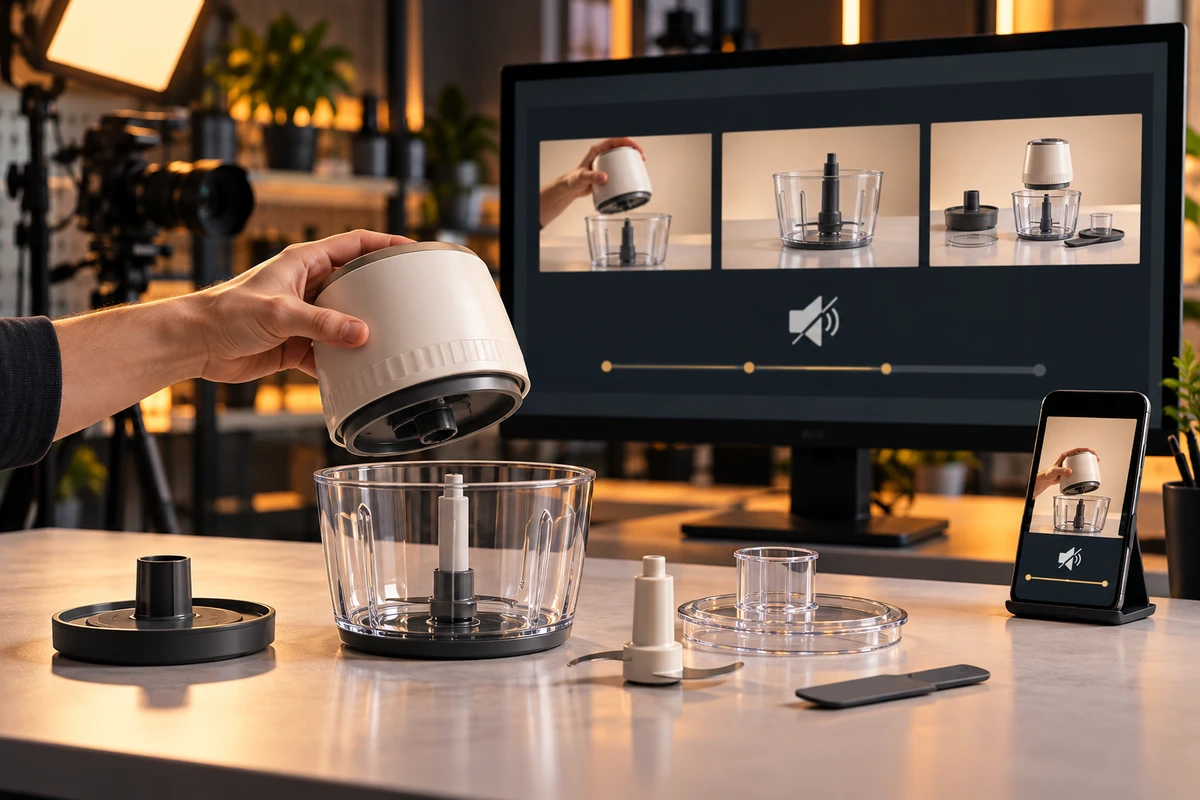
A kitchen-appliance video says, “disassembles with one hand,” and repeats the promise in captions. Yet the image only shows a hand passing the machine; in the next shot, the parts are already arranged on a table. With sound on, the team feels that the message is complete. Remove narration and text, and the shopper cannot see the latch, the number of steps, or whether one hand was actually sufficient. The feature was described, not demonstrated.
That is the failure a silent review should expose. The process does not begin by adding more captions. It temporarily removes music, voiceover, sound effects, and text so the image must answer four questions on its own: what is the product, where does the action start, how does the product respond, and how does the result appear? If a core benefit disappears without verbal support, fix the shot first. Use concise text only for names, values, conditions, and facts that cannot be directly observed.
Treat mute as an information-dependency test
Amazon's May 12, 2025 seller article, “When customers can't touch, let Amazon product videos convince them”, recommends simple, focused videos that surface important features quickly. It also notes that some shoppers watch without sound and suggests basic text overlays for important information. Amazon Ads' moderation guide similarly explains that some video units start silently and recommends visuals, on-screen text, or captions that preserve the message.
That guidance is easy to misread as “caption everything.” Text can name a feature but cannot replace its action. It can say “easy installation,” but it cannot show whether the connector aligns, the latch engages, or unusual force is required. It can say “easy to clean,” but it cannot reveal which parts contact residue, how they detach, or whether a tool is needed.
A silent review is therefore an audit of dependencies, not an audio setting. Every buying judgment should be tied to its source: product appearance, continuous action, before-and-after state, a textual condition, or evidence that belongs in supporting documentation rather than in the image.
Pass one: verify product identity on the opening screen
Mute the audio, hide captions and animated titles, and play only the opening. A reviewer should be able to answer three questions: What is the product? Who is using it in what context? Which structure or action deserves continued attention?
If the answers come only from small packaging copy, a narrated category name, or a later explanation, the opening has not established identity. The fix is rarely another label. Change subject size, scale reference, accessory relationship, or the representative action. An unfamiliar form needs a more complete silhouette; a familiar category can move into action sooner, but the environment and talent should not hide the product.
There is no need to invent a universal three-second rule. Time is simply a useful production window. The actual standard is whether the first group of shots gives a phone-screen shopper enough information to understand the action that follows.
Pass two: freeze each action and inspect causality
A functional demonstration needs four visible nodes: starting state, user action, product response, and end state. They do not require four separate shots, but narration should not be asked to bridge a missing node.
Consider a magnetic lamp. If the edit jumps from a lamp in the user's hand to one already mounted on the wall, the shopper cannot see alignment, attachment, or whether the position can be adjusted. A caption saying “fast installation” only enlarges the gap. A stronger version preserves the approach to the base, structural alignment, the moment of attachment, and a small adjustment, then uses short text only for a surface or accessory condition.
Or consider a vacuum storage bag. The bag looks smaller in the result shot, but if the extraction tool, seal, and stopping condition disappear in the edit, the viewer cannot attribute the change to the product. Pause beside every benefit and ask: What was the previous state? Who triggered the change? What did the product do? Did the result occur under the same conditions? If two or more answers are missing, the team probably needs another shot rather than another line of copy.
Result images also define the boundary of a claim. The FTC Policy Statement Regarding Advertising Substantiation says objective claims need a reasonable basis before dissemination and includes reasonable interpretations of implied messages. Legal requirements vary by market and claim, but the production lesson is useful: when an image implies faster, stronger, or more durable performance, record the sample, comparison basis, and shooting condition. On mute, check whether a beautiful outcome encourages a conclusion the production has not actually supported.
Pass three: reduce the review to phone width
Details that are clear on a grading monitor can collapse into hand movement at listing size. Reduce the player to a typical phone width and inspect whether:
- the product remains larger and clearer than the set, talent, or props;
- ports, buttons, latches, indicators, and scales are legible;
- a hand hides the critical point of contact;
- the difference between starting and ending states remains obvious;
- vertical or square crops remove the action start or result;
- subtitle safe areas collide with interface controls or the product.
If an action works only on a large screen, change focal length, composition, or action direction. A post-production crop may sacrifice clarity or remove the scale reference. A useful close-up shows how the action happens; it does more than make the object larger.
Pass four: restore text one line at a time
After the first three passes succeed, bring text back one line at a time. Each line should perform one of four jobs: naming, quantifying, limiting a condition, or identifying a version.
“Two speed settings” names a visible action. “500 ml” quantifies capacity. “Use with the included base” defines a condition. “Fits model X2” binds the shot to a version. By contrast, words such as effortless, powerful, or professional-grade may simply enlarge a claim unless the image and supporting evidence give them a precise meaning.
Use a five-column silent-review table:
| Claim | Visible fact | Current dependency | Correction | Applicable version |
|---|---|---|---|---|
| One-hand cleaning | Hand unlocks, removes, and separates parts | Voiceover explains the steps | Capture continuous action | ASIN A and B |
| Installation complete | Connector aligns, latch responds, end state holds | Small text says “installed” | Re-edit to preserve feedback | ASIN A |
| 500 ml capacity | Liquid reaches the marked level | Exact value is hard to read | Keep shot, add short text | Large model only |
| Smaller in storage | Same camera and scale before and after folding | None | Pass | All colors |
The dependency column matters. It reveals whether a benefit relies on the image, voiceover, captions, sound design, or the viewer's prior product knowledge. The objective is not minimal text at all costs. Text simply should not perform the evidentiary work that belongs to the product action.
Repeat the review whenever the version changes
Silent approval belongs to a version, not only to a language master. A color change with identical structure may preserve the action footage. A new capacity, accessory set, connector, or operating sequence requires another image-and-text review. German, French, or Japanese copy can also change line length, safe areas, and timing; a translation that once cleared the product may cover a control or action.
Review Amazon listing and off-Amazon ad versions separately. Autoplay, crop, and interaction differ by placement. An action that appears clearly in the second half of a listing video may never enter a six-second cutdown. When many variations are involved, combine the silent-review table with ONCE's variation-to-shot-to-ASIN mapping method so shared footage and version-bound captions remain explicit.
A video passes silent review when the opening identifies the product, the core action retains its start, response, and result, essential detail remains legible at phone size, and text is limited to names, values, conditions, and versions. If voiceover is rescuing the image, return to the shot list and choose whether to capture, re-edit, or remove the claim.
For an Amazon launch, place target ASINs, the current listing screen, priority benefits, existing footage, and language versions in one silent-review table. ONCE can then turn the gaps into a focused cross-border product-video plan, so post-production is not asked to solve missing visual information with more captions.