Imagine a smart-lock brand preparing a product-page video for an international launch. A location sends over photographs of a polished entryway with good walls, cabinetry and lighting. It can even hold the lock. During the scout, however, the “door” turns out to be a decorative panel. The bolt cannot enter a strike plate, and the panel was not built to the door dimensions supported by the product.
That set can communicate the feeling of arriving home. It cannot prove that the lock installs correctly, closes properly or operates on a compatible door.
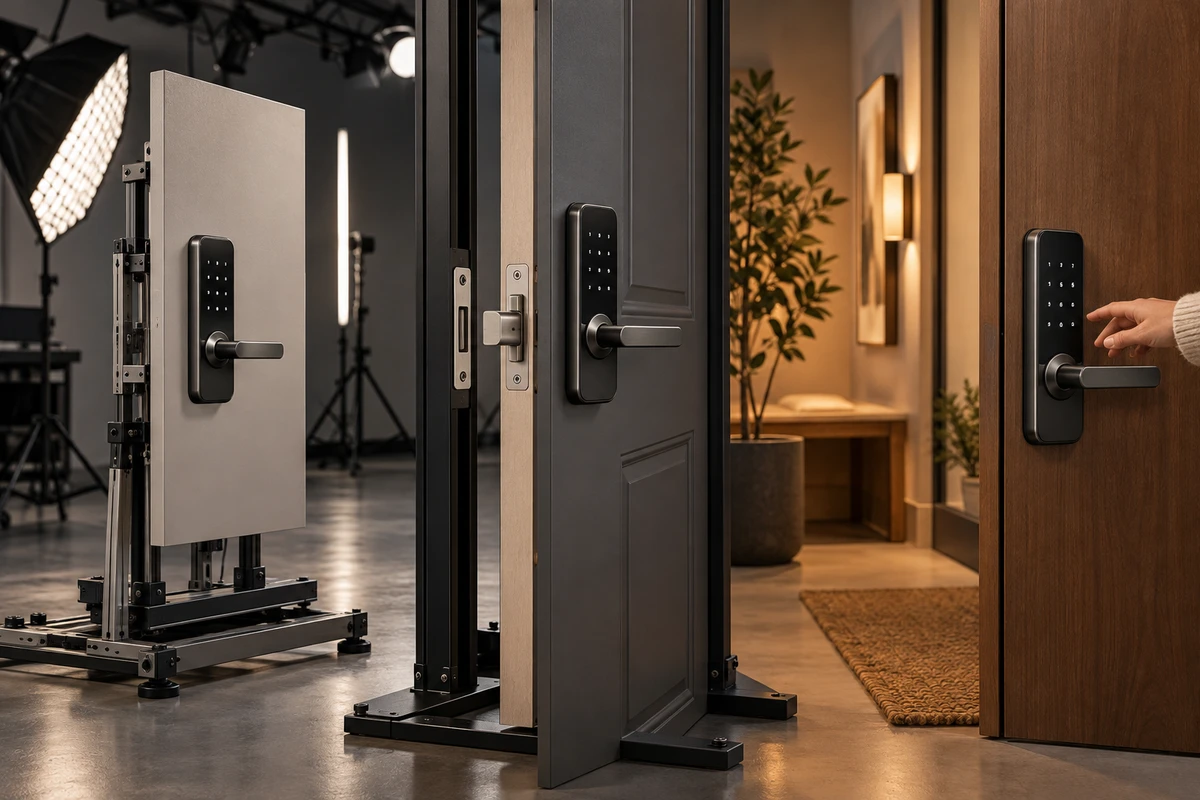
The purchasing question is therefore not which set looks best. It is what each shot must establish. In a smart lock product video, a mock door, a working door and a complete entryway are not three levels of decoration. They are different production tools: the mock door controls product visibility, the working door validates mechanical action, and the entryway establishes human use.
They may be combined in one build or filmed separately. What matters is that one type of set is not presented as evidence supplied by another.
Start with three different buyer questions
A smart lock shown on a product page, brand website or sales screen usually needs to answer three groups of questions.
The first group concerns the product itself. What are the size, finish and colour of the exterior and interior assemblies? Where are the fingerprint reader, keypad, keyway, battery compartment and handle? These details need controlled, repeatable product coverage.
The second group concerns the relationship between the lock and the door. Can this SKU be fitted to the intended door preparation? Does the latch or deadbolt travel correctly? Does it align with the strike when the door closes? What visible or audible feedback follows a fingerprint, code, app command, key or interior turn? These claims require a door that actually works.
The third group concerns the person and the entrance. How does the user approach the door? Are their hands occupied? Can the control area be read at night? How do a guest, family member or delivery scenario unfold? These questions require a person, a credible route through the space and a target-market context.
Amazon's current guidance says product videos can demonstrate size, features, functionality and real-life use. Google Merchant Center's video-link guidance similarly encourages product-specific videos from different angles and in use. Neither platform decides whether a decorative set is a valid functional rig. That judgment still depends on the real SKU, the door specification and the task assigned to the shot.
A mock door controls the image, but does not automatically prove fit
A mock door may be a simple panel built for filming, or a more developed rig with a frame, removable rear cover or cutaway. Its main advantage is control. The camera can approach the hardware closely, light can be placed behind the panel, internal parts remain accessible, and the lock can be removed and reset without dismantling a finished location.
It is often the right place to film:
- standard views of the exterior and interior assemblies, handle, keypad and fingerprint reader;
- the scale relationship between the hardware, door thickness, handle height and an adult hand;
- the battery compartment, mechanical keyway, emergency power point and removable accessories;
- installation or cutaway details that do not require the door to close;
- colour, finish and beauty coverage that requires repeated product changes.
The limitation is straightforward: attaching a lock to a panel does not prove compatibility with a real door. Current Yale compatibility guidance lists door thickness, face bore, edge bore and backset by model. Schlage installation documents likewise ask installers to verify door thickness, bore preparation and backset. Those figures belong to specific products; they are not universal dimensions for every lock.
Before a mock door is built, the brand should supply or approve:
- the exact SKU and interior/exterior assembly;
- supported door thickness, face bore, edge bore, backset and strike dimensions;
- handing, swing direction and latch or handle orientation;
- the correct screws, adapters, lock body, cable, batteries and emergency accessories;
- differences between the filmed prototype and the production product;
- which shots are explanatory and which are expected to support an installation claim.
If the rig was not made to those conditions, it can still support beauty coverage. The production record should identify it as a set, and the edit should not turn it into a broad compatibility conclusion.
The working door owns closure, alignment and real feedback
A working door needs more than hinges. It needs a stable frame, the correct preparation, an aligned strike and a gap that allows the door to close repeatedly. Once installed, the latch or deadbolt should complete its travel with the door both open and closed.
This is where the production should capture the functional material that is hardest to recreate later:
- whether an exterior input and interior mechanical response belong to the same operation;
- whether the bolt moves freely with the door open and enters the strike when the door is closed;
- what visible or audible response follows each approved unlock method;
- whether unlock, opening, closing and relocking remain in their true order;
- how planned low-battery, incorrect-entry or retry states are reset.
Before lighting the polished angles, record one plain continuous reference take. Keep the hand, lock, door and relevant feedback on one timeline. Close-ups of the keypad, reader, handle and app can then be filmed separately. Post-production can tighten the sequence without joining different installations or unrelated operations into one apparent success.
The working door still has boundaries. A successful close proves the action only for this installation under the recorded conditions. It does not prove that the lock fits every door, and it does not establish resistance to forced entry, weather, endurance or a security grade. Certification and security claims must return to the applicable test evidence and approved brand documentation. A commercial set is not a laboratory.
The entryway proves a human relationship, not universal compatibility
A complete entryway lets the lock move out of an installation diagram and into life. A performer may arrive carrying bags, admit a guest, enter a code at night or check the door from inside. The audience can read the height, reach, sightline and pace of the interaction without a dimension graphic taking over the frame.
This is also where a polished video can become misleading. The lock may be fixed to a non-working facade. A wide lens may exaggerate the exterior assembly. A finger may cover the status light. Exterior and interior actions may have been recorded on rigs that cannot possibly be the same door.
Give each entryway shot an explicit job:
- If it carries atmosphere and movement, an approved set can work, but it should not be edited into a false bolt or installation result.
- If it carries functional proof, the door inside the entryway must meet the working-door standard and complete the action for real.
- If it represents a target market, check the door type, handle/deadbolt arrangement, swing, measurement units, phone interface and any outlet or bridge placement. “Western style” is not a production specification.
- If CGI or generative imagery extends the environment, it must not change product size, mounting position, included accessories or compatibility with the door.
TikTok Shop's US policy for AI-assisted product listing images, updated in September 2026, specifically warns against using perspective, reference objects or generated environments to exaggerate scale or imply an unsupported installation. The page applies to US listing images rather than every product video, but the production lesson is useful: a generated entryway must preserve the relationship between the real product and the physical space.
Shoot by proof dependency, not by edit order
The final film may open with someone arriving home, cut to a beauty shot, then end with a lock action. The production day does not need to follow that order.
Start by establishing a product reference. Record the correct SKU, assemblies, finish, accessories, interface and mounting direction. Capture front, side and on-door scale views that later sets can be checked against. Complete the clean beauty coverage before repeated handling marks the surface.
Next, qualify the working door. Before talent and complex lighting occupy the set, an authorised product specialist should run through installation, closure, locking, unlocking and reset. A misaligned strike, sagging door, compressed cable or unstable firmware is a rig problem to solve—not a performance issue to hide with more takes.
Only then move into the entryway performance. The director can concentrate on timing, sightline, hand position and space because the lock path is already known. If the entryway door does not work, keep the functional proof on the working rig and treat the entryway as lifestyle coverage. Do not use an edit to make two doors appear to be one continuous operation.
A single location may provide a removable working door inside a complete entryway and reduce company moves. The buyer should still approve the three capabilities separately. A finished room does not guarantee that the mechanical rig is correct.
Add a door passport to the production attachment
Give every door entering the film a one-page “door passport.” It is a production control record, not an engineering certification. At minimum, record:
- door ID, set location and reference photographs;
- material, thickness, bore preparation, backset, swing and handing;
- frame gap, strike position and whether the door closes under real operation;
- lock body, panels, adapters, screws and accessory IDs;
- app build, firmware, phone OS, network and account state;
- the shots this door is approved to carry and the claims it cannot support;
- reset method, on-set owner and brand approver;
- access codes, test accounts, location details or credentials that must never appear publicly.
The shot list should reference that ID. Beauty coverage may use mock door D-01, bolt closure may use working door D-02, and the arrival scene may use entryway D-03. If D-03 is non-functional, its fingerprint action should not cut directly to D-02 opening unless the team has confirmed that the sequence remains an honest illustration rather than a false demonstration.
For the wider app, network and maintenance brief, see ONCE's guide to producing smart-hardware product video in Shenzhen. For examples of how products are presented across controlled and lifestyle settings, review ONCE's e-commerce product video work.
Wrap with three independently reviewable results
“The lock appeared on camera” is not a completion standard. A resilient smart-lock shoot should leave three results that can be reviewed without pretending they are interchangeable.
The appearance and scale package allows the buyer to verify the model, finish, assemblies, relevant details and true relationship to the door, hand and space.
The functional reference package preserves the path from input and feedback to mechanical action and door result on the recorded SKU and door. It includes the installation conditions, firmware and relevant limitations.
The lifestyle package shows how the intended user approaches, operates and leaves the entrance. The performer, props and set support believable use; they do not add a capability the product has not established.
If all three packages meet inside the hero film, the result can have polish, credibility and life at the same time. If the project only needs one or two, the estimate and shot list should say which proof task has been removed.
If you are preparing a smart lock, doorbell, access-control device or another entrance product, send ONCE the exact SKU, target market, door-compatibility information, sample status, intended channels and production timing. We can decide which shots belong on a mock door, which require a working door and which deserve a complete entryway before defining the product video production scope. ONCE's Amazon product video production solution provides a useful next step for organising those inputs.
Research note: sources were checked on 8 October 2026. They include current Amazon product-video guidance, Google Merchant Center's video-link documentation, Yale and Schlage door-compatibility and installation materials, August product compatibility information, and TikTok Shop US guidance for AI-assisted listing images published in September 2026. Installation conditions vary by brand and model. This article does not provide universal door dimensions or replace product engineering, certification, safety or legal review.