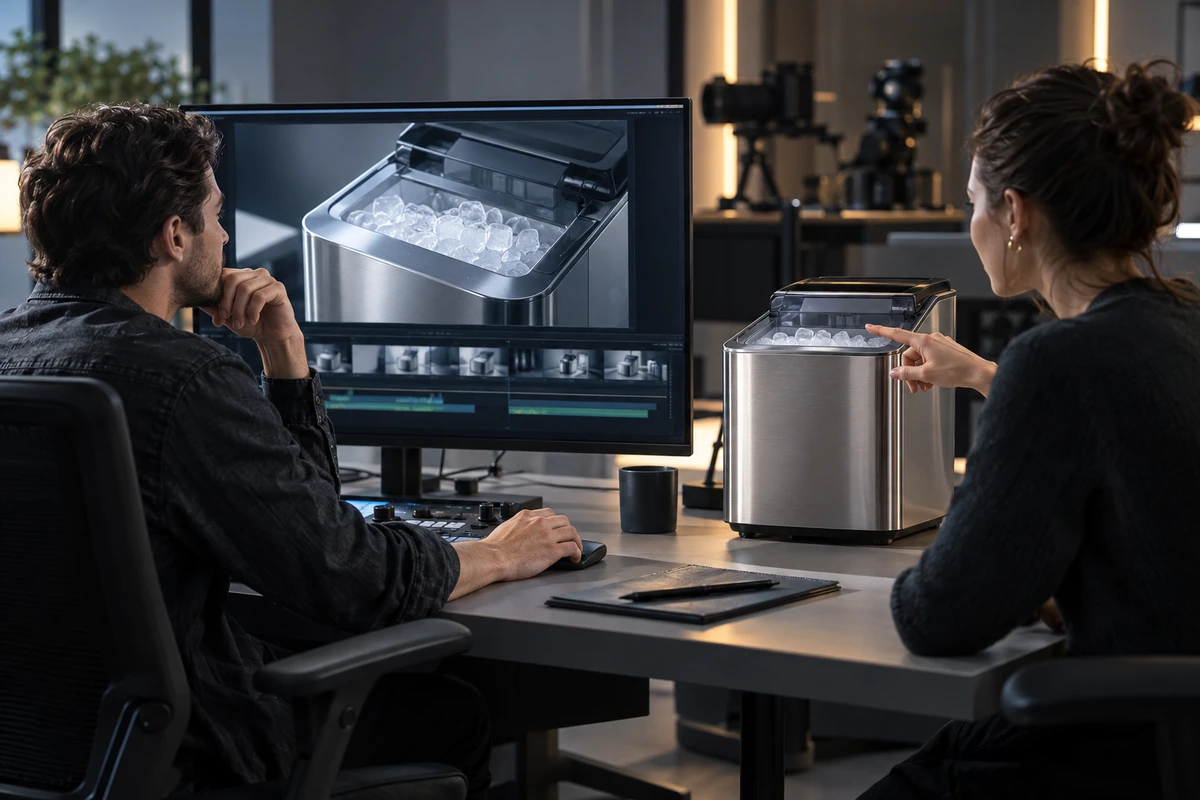
The first cut of a countertop ice maker looks polished. The stainless-steel housing carries a clean highlight, falling ice has been captured in slow motion, and the transitions land on the music. In the review, marketing asks for more pace while the product team asks for more specifications. Neither comment tells the editor whether a shopper can follow the sequence from filling the tank and starting the machine to collecting ice and cleaning it.
A more useful review temporarily removes the script and director's explanation. Someone who was not involved in production watches the intended aspect ratio under realistic conditions, then answers a set of buyer tasks: What is this? Who is it for? What action is required? What result is visible? Under what conditions? Each failure is logged by timecode and routed to one of four owners: the edit, a pickup shoot, the product page, or product and compliance review. The conversation moves from taste to an executable production decision.
Freeze Three Things Before the Review
Freeze the product facts
The brand should confirm the model, included accessories, operating sequence, sample state, approved performance language, and any necessary qualifications. The US Federal Trade Commission's business guidance says advertisers need a reasonable basis for express and implied claims, and that words, sound, and pictures are assessed in context. This is US guidance rather than a substitute for review in every target market, but it makes one production point especially clear: images can make claims too.
If the ice maker only completes a demonstration under defined settings or room conditions, a faster edit should not make those conditions disappear. A number that the product owner has not approved should not be built into motion graphics in the hope that it can be justified later.
Freeze the job of each version
A product-detail-page film helps a shopper understand operation and conditions. A social ad establishes relevance quickly. A deeper page module can carry a longer procedure. They may share production footage, but they should not inherit the same timeline, captions, or acceptance questions by default.
Amazon's current seller guidance describes product videos as a way to show function, dimensions, and use. Shopify currently treats video as product media alongside images and 3D models, while noting that storefront presentation depends on theme support. Platform documentation changes, so the live account and theme still need a pre-release check. The production implication is not that every channel needs an identical film; it is that the team must state which step of the buying decision this version owns.
Freeze the viewing condition
Review the actual horizontal, vertical, or square deliverable at something close to phone width. TikTok's current business guidance emphasizes mobile-first vertical composition, safe zones, and an early hook. Google Ads currently specifies separate horizontal, vertical, and square video assets. A landscape master on a grading monitor cannot approve the legibility of its vertical crop.
Replace an Open Feedback Round with Four Replays
Replay one: muted recognition, with no script
Ask a colleague who did not attend the script meeting to watch the target version without product notes. They answer three questions: What category is the product? Who would use it and in what situation? What is the most important action?
If the answer depends on voiceover, inspect the first useful image for category, scale, and action. Reordering footage, holding a shot longer, or enlarging a detail may solve the problem. If no hand, room, or familiar object ever establishes scale, stop asking the editor to search indefinitely and mark the issue as a pickup candidate.
Replay two: follow the core action as cause and effect
An ice-maker demonstration should not collapse into a button close-up followed by a beautiful shot of ice in a glass. A reviewer should be able to name the starting state, user action, product response, and observable result. The edit can compress the links, but a transition, speed ramp, or change of angle should not hide the essential step.
The note should not say, "This section does not flow." It should say, "From 00:12 to 00:16, it is not clear that filling the tank happens before the start command." An editor can correct order and duration. Missing initial state, operating gesture, or result shot is a production gap.
Replay three: restore sound and find repetition or conflict
With voice, music, and effects enabled, check whether the voice merely narrates the image, whether captions cover controls or feedback, whether sound design makes an ordinary movement imply unapproved performance, and whether music masks a sound the viewer needs to assess.
Words such as quieter, faster, or easier should not survive simply because they make a forceful line. If the product owner approved only a qualified statement, the qualification should sit close to the claim rather than being buried at the end. A number the current footage cannot honestly support may belong in approved specifications or test material on the page instead.
Replay four: put the video back on the real page
Review the cut in the position where it will appear, alongside the title, images, bullets, price, variants, and next page module. If the video already demonstrates filling and ice production clearly, it does not also need to recite every item in the box. If dimensions and warranty terms are maintained accurately in page copy, the film can spend its limited time on action, scale, and result.
Conversely, if an ad opens on clear ice but the landing page sells another model or offers no corresponding explanation, more pace cannot repair the broken promise. The issue belongs with media and page owners, not only with post-production.
Four Problems Require Four Responses
Each review note should contain one issue, with a timecode, the buyer question, the observed misunderstanding, the response type, an owner, and the version in which it will be checked again.
The edit can fix it
The material exists, but sequence, duration, crop, caption placement, or sound hierarchy obstructs understanding. A control response may be present but too brief. An interface that reads clearly in landscape may fall beneath a vertical safe zone. Post-production can fix these issues, but approval must happen in the target format.
A pickup is required
The existing material omits a state the buyer needs: an empty tank before filling, a removable cleaning component, a human scale reference, or a continuous action that was fragmented beyond verification. A pickup brief should name the missing state, action, or result. "More lifestyle footage" is not a usable request.
The product page should carry it
Exact dimensions, compatibility lists, warranty terms, regional differences, and frequently changing specifications are often better maintained as searchable, editable page copy. Video can establish the reason to care without burning every detail into every version. Returning information to the page is not a lower production standard; it assigns the information to the medium best able to keep it accurate.
Product or compliance must decide
Questions about performance numbers, comparisons, safety, efficacy, interface state, or required disclosure cannot be approved by the production company. The production team can explain how a shot may be understood, but the responsible brand specialist must approve the claim.
AI may assist with storyboards, background exploration, or version work. If generated material enters the final film, the team should record the tool, rights basis, edits, and applicable disclosure. Adobe's Firefly documentation, updated in August 2026, explains that it automatically applies Content Credentials to fully generated assets. Such metadata can add context about creation and editing; it does not substantiate a product claim.
Build a Review Record That Can Close Issues
An actionable record includes the version and its job, target platform and aspect ratio, timecode, buyer task, observed misunderstanding, issue class, owner, required footage or decision, due date, and the result of the next replay.
Pickup work must also enter a real production schedule. ScreenSkills' public description of first-assistant-director responsibilities connects script breakdown, technical recce, scheduling, and delay contingencies. Ecommerce crews may be smaller, but the logic holds: a pickup is a new sample, space, light, person, and time requirement, not a casual edit note.
The cut is ready when a target viewer can identify the product and core action in the real format; continuous footage supports the approved result; necessary conditions have not been visually removed; sound, captions, and image do not conflict; every open issue has an owner; and the product-page, advertising, and social versions each pass their own task rather than being forced to behave like the same master.
Know When to Stop Editing
If the underlying problem is an unapproved fact, a mismatched page model, a missing action, or an undefined placement, changing music, adding captions, and tightening pace creates only the appearance of progress. Pause the affected sequence, obtain the missing decision or footage, and then resume. If the buyer task is already complete and a new request is only a preference, the project owner should decide whether it falls inside the agreed revision scope.
This method does not promise conversion. Price, reviews, stock, fulfilment, media, and the product itself all influence purchase. Its value is narrower and practical: the buyer can see what each revision is meant to repair, and the production team can concentrate effort on footage that genuinely changes understanding.
For a wider plan covering product pages, ad cutdowns, and language versions, see ONCE's ecommerce product video production service. Amazon's official product-video guide, Shopify's product-media guidance, and the FTC's advertising guide for small businesses should be rechecked for the target account and market before release. To plan a review, send ONCE the product page, target market, placement, sample state, approved claims, current cut, and delivery list. We can first identify whether each issue belongs to the edit, a pickup, the page, or brand approval.