Hiring Video Production in China 04/10
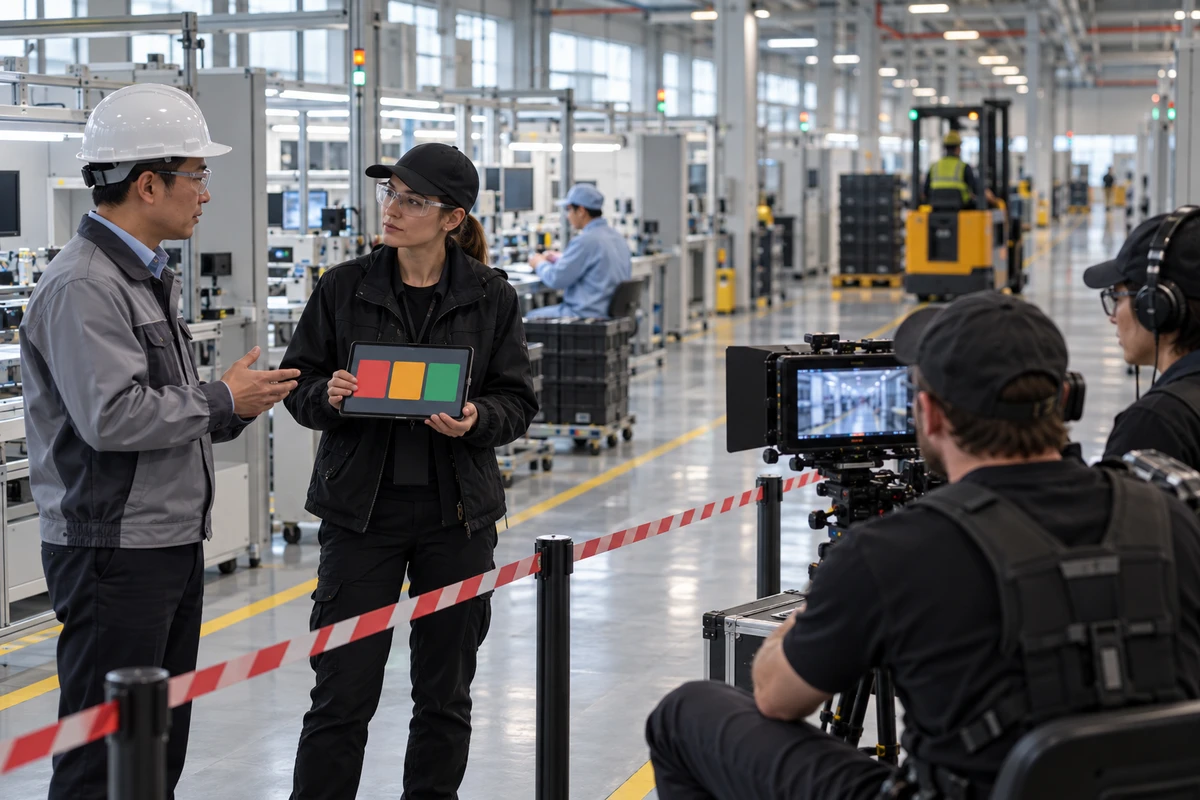
Imagine that a factory-wide shot has already been captured. A live machine line fills the right side of frame. In the left background, an order board is legible. An employee badge can be identified. Cartons carry another customer’s brand. One leg of the lighting stand extends into a forklift route. The director likes the composition, the marketing lead says the sensitive details can be blurred, and the factory safety representative asks for the entire take to be deleted.
The problem is not that one party is being overcautious. The project treated four different questions as one: may the camera record the scene, may the captured material be retained and transferred, may it be published for the intended use, and may the shot be executed safely under the current production conditions? If any answer is missing, the footage should not yet be treated as a deliverable asset.
A universal no-film list will not solve this. Drawings, screens, workers, order labels, access controls, PPE and equipment routes are governed by different things: law, customer or third-party obligations, factory policy, and production judgement. A more workable approach is a red-amber-green shot list in which every row identifies the approval owner, conditions, stop authority and fallback shot.
Separate four permissions before approving the camera
Each planned shot should pass four gates.
1. Permission to capture
This is the on-site recording decision. The factory confirms which area, process and time window may be entered with which equipment. The brand confirms which product, order and claim may be recorded. The production team identifies what else the angle may bring into frame or sound: reflections, conversations, labels, passers-by and adjacent lines.
Permission for a crew to enter a facility is not permission to record everything visible from that facility. First establish the appointment, access and three-party authority described in episode 01, Hiring a Video Crew for a China Factory Shoot: Who Owns What?. Then approve the actual shots.
2. Permission to retain and transfer
Raw footage contains more than the finished film. It may hold unmasked displays, conversations, badges, serial numbers, Wi-Fi names, visitors and other orders. Whether those files can be copied to portable storage, uploaded to a review platform, shared with post-production or sent to an overseas client is a separate question from whether a final edit will be public.
China’s Personal Information Protection Law defines personal information around an identified or identifiable individual and treats collection, storage, use, processing, transmission, provision, disclosure and deletion as processing activities. It provides several possible legal bases rather than consent alone, while Articles 38 and 39 address cross-border provision of personal information. In a factory-video project, the parties therefore need to identify who determines the purpose and method, who receives identifiable material, how long it is kept and whether it will leave China. A production supplier can implement releases, access controls and file handling. It cannot decide the legal basis for every party.
3. Permission to publish for a defined use
Approval to capture internal reference material does not automatically authorize a website film, YouTube upload, trade-show loop, sales email or paid ad. Employee portraits, third-party marks, customer orders, unreleased products and process detail may have different answers for different media, territories and audiences.
China’s Civil Code addresses the making, use and disclosure of an identifiable person’s portrait. The 2025 revision of the Anti-Unfair Competition Law, effective October 15, 2025, defines a trade secret around non-public technical or business information with commercial value for which corresponding confidentiality measures have been taken. These statutes do not produce a universal factory no-film list. They do show why a generic NDA cannot be treated as unlimited permission for every person, file, process and distribution use.
4. Permission to execute safely now
The same approved shot may be safe during a controlled demonstration and unsafe while the line is operating. Camera position, stands, cables, tracks, drones, atmospheric effects, bright light, performer movement and repeated actions can all change the real working condition.
China’s current Work Safety Law places primary responsibility on production and business entities and addresses risk controls, hazardous work, clear evacuation routes, PPE and the right of workers to refuse unsafe commands. That does not mean every visiting crew in every industry follows one identical induction or PPE list. The crew’s status, training and access depend on the facility, work and applicable rules. The practical production rule is narrower: the brand and director define the communication task; the factory’s authorized people decide whether the operating area and equipment can accommodate it; anyone observing an immediate risk can first stop the filming action.
Apply colours to individual shots, not permanent rooms
Labeling one workshop green and another red is still too crude. A generally approved area may suddenly contain another customer’s order. A normally restricted machine may be captured from an approved angle after its screen is cleared and a demonstration sample is installed. Status should attach to the shot and its conditions, not permanently to the room.
| Status | Operational meaning | On-set action | Condition for post-production |
|---|---|---|---|
| Green | All four permissions are confirmed for the current date, process state and intended use | Film only the approved angle, action and window | Back up, review and deliver through the agreed route |
| Amber | Capture is conditional, or material may be recorded only under controlled handling | Escort present; clear a display, replace a sample, cover a label, limit the frame or wait for a safe window | Do not place it in a public cut until the named reviewer clears it |
| Red | Recording is not permitted, or current execution is unsafe | Stop the camera and use an approved alternative | Do not justify capture by promising that post-production will fix it |
Amber does not mean “film now and decide later.” Red is not a task for the editor. The colour matters only when the row also states the condition and decision owner.
A procurement-ready shot list should include at least these fields:
- Shot ID and communication task: what a viewer should understand, not simply “production-line B-roll.”
- Area, process and time window: the line, shift and operating state.
- Expected visible or audible elements: product, people, visitors, screens, drawings, labels, equipment IDs, access controls and background sound.
- Capture approval: who allows the camera to record, including angle, equipment and duration.
- Retention and transfer approval: who stores the originals, who may access them and whether cloud or overseas transfer is in scope.
- Publication approval: internal review, website, sales material, trade show, social or paid media; territory and term are confirmed separately for the project.
- Safety conditions: induction, PPE, escort, equipment footprint, cables, vehicle routes, noise, light, power and any allowed production interruption.
- Status and expiry trigger: green, amber or red, plus the change—new order, shift, product, visitor or resumed operation—that invalidates the approval.
- Approvers and stop roles: separate owners for brand facts, factory confidentiality, site safety and production execution.
- Fallback shot: the already approved alternative if the condition fails.
Treat six common amber-shot categories differently
Employees, visitors and temporary personnel
An employee smiling at the lens does not establish that they understand the use of the film. The contributor list should identify the person or degree of identifiability, their task, media, territory, term, paid use and raw-footage route. Visitors, drivers, temporary staff and workers passing through should not be assumed to have joined that authorization.
If a person is not cleared, change scheduling, distance and camera position first, or use an approved hand detail, back view or genuinely non-identifiable image. Facial blur alone may be insufficient because clothing, badge, workstation, voice and action can still identify someone. Never remove required PPE to make a group shot look tidier.
Third-party brands, orders and shipping labels
Customer names, SKUs, quantities, destinations, barcodes, courier labels and carton marks may reveal both a commercial relationship and delivery information. The factory can arrange a demonstration batch, substitute packaging or a cleared sample area before filming. The on-site contact should check the live order again on the day. If backgrounds change continuously, the shot should remain amber even if the recce frame was clean.
Screens, drawings, whiteboards and machine interfaces
Displays refresh. Drawings are turned. Glass and metal reflect information outside the planned frame. It is usually safer to prepare an approved demonstration interface, a blank or sanitized document, a held screen or a cleared sample than to promise frame-by-frame repair. The shot list should say whether the image represents live operation, a controlled demonstration or a post-production composite. The edit must not collapse those three into the same factual claim.
Unreleased products and core processes
Recording only a few seconds does not reduce sensitivity. If a process can be shown only through a highly restricted angle, ask whether it genuinely performs a communication job. An approved output, handoff, non-sensitive control point, animation or reenactment may explain the logic, but simulated material should not be presented as the actual production state observed that day.
Access controls, security and spatial relationships
Entrances, cameras, visitor passes, keys, PIN pads, fire equipment and evacuation routes serve different purposes. The crew may need to understand emergency information without publishing the full facility layout. Wide angles, aerial views and reflective surfaces need their own review; concentrating only on the intended subject is not enough.
Line pace, equipment routes and noise
The most easily missed risk is the crew changing the factory condition: a stand occupies a route, a camera operator walks backward, a performer repeats an action, an interview masks an alarm, or the director asks the machine to run once more. Record the equipment footprint, headcount, whether a line slowdown is required, who may authorize it and what fallback activates after the waiting limit.
Separate two stop decisions: stop filming and stop production
People often say “stop for a moment” on set, but that can mean two different things.
Stop filming means stopping the crew’s action. The line producer, camera lead or any person observing an immediate risk should be able to stop movement, power down or withdraw. The factory’s safety, confidentiality or area contact may also revoke the current filming permission. This pause does not wait for a creative debate.
Stop production concerns factory equipment, processes and workers. A director, remote client approver or cinematographer must not tell an operator to stop a line, remove a guard, repeat a hazardous action or change a process for the shot. Shutdown, slowdown, maintenance state or a controlled demonstration can be authorized only by the factory personnel who hold that authority under the site’s system. The client and producer then handle any delay, reschedule or added scope under the project agreement.
This distinction protects all three parties. The production supplier must reject an unsafe setup. The factory controls its operation and site. The brand can reject footage that fails the approved communication or rights conditions. None should cross another party’s professional authority.
Replace one blanket approval with three checks on the day
The first check happens before equipment is placed. The factory contact walks the route and confirms whether orders, people, screens and operating conditions have changed. The crew marks stands, cables, monitoring, staging and people on the floor plan. An amber condition that has not been met means the equipment is not placed.
The second check happens immediately before recording. Freeze the monitor and scan the background, reflections, labels, badges, drawings, displays and PPE. Monitor sound for customer names, internal codes and alarms. Approval applies to that camera position and operating state, not to the entire day.
The third check happens before the setup is struck. Review critical material at original resolution or on a sufficiently clear proxy. Mark each file as isolated, redaction required, factual review pending or cleared for the stated use. Red material should be removed from the normal sharing route rather than uploaded automatically with everything else.
Behind-the-scenes recording and personal phones need their own rule. Permission for the principal camera does not authorize every crew member’s phone. Informal BTS often sees more displays, access routes and uncleared areas than the approved frame.
Post-production can change visibility, not create permission retroactively
Blur, masking, interface replacement, cropping and object removal can reduce visibility. They cannot retroactively authorize the capture, or undo an unsafe action. A high-resolution master, vertical reframe, still extraction or brighter grade may also reveal detail that was invisible in a low-resolution proxy.
Use three review layers. The factory confidentiality or information owner checks third-party and sensitive content. The product or business owner checks process, model and claim accuracy. The brand owner checks distribution use and versions. The production company locates each issue by shot, timecode and screen area, implements the approved treatment and keeps a version record.
If generative tools will replace a screen, remove a mark or extend a background, first determine whether the material may enter that tool and processing chain. Record which images were simulated or generated. A generative repair must not fabricate a production state, certification, quality result or customer relationship.
What should a buyer receive before the crew rolls?
At minimum, the buyer should be able to inspect:
- a versioned red-amber-green shot list covering capture, retention, publication and safety for every row;
- named factory confidentiality, site safety, production and brand-fact owners, with delegates;
- access rules for crew, equipment, vehicles, personal phones and BTS;
- the appearance and file-handling plan for employees and other identifiable people;
- current production state, induction, PPE, route, power, noise and emergency requirements;
- conditions, review time and approved fallback for every amber shot;
- separate stop-filming and stop-production authority; and
- access, retention and delivery rules for originals, proxies, review links, masters and project files.
If these details exist only as explanations on shoot morning, the supplier has not yet converted the plan into an executable document. ONCE’s Corporate Film Production in Shenzhen solution shows how R&D, factory, team and delivery material can enter an external-facing production. For the buyer-evidence question, What Factory Video Should Prove to a Remote B2B Buyer explains which production and quality moments are useful without presenting the film as an audit.
To scope a factory shoot in China, share the product and factory city, target markets, placements, proposed date, sample state, publishable processes, restricted areas, people plan and available site-safety material. ONCE can translate the communication task into a conditional shot list and fallback coverage before assessing recce, crew, equipment and delivery scope. The client, factory and appropriate professional advisers remain responsible for the applicable legal, privacy, trade-secret and safety decisions.
Source note: checked October 7, 2026. This guide reviewed the official text of the Personal Information Protection Law, the Civil Code, the Work Safety Law and the 2025 revision of the Anti-Unfair Competition Law, effective October 15, 2025. It translates selected principles into production-management questions; it is not legal or safety advice for a particular facility, person or cross-border data arrangement.