Hiring Video Production in China 05/10
The shoot date is booked and the overseas launch cannot move, but the smart-hardware samples delivered to the China production team represent different kinds of “finished.” The silver appearance model is closest to the production design but cannot boot reliably. The black engineering unit can run the core function, yet its ports and surface finish are from an older revision. The app changes every week. Packaging exists only as a dieline, while the target-market plug and manual are still in transit.
Two decisions create unnecessary risk. One is to cancel everything because the product is not final, delaying scenes, movements and lighting work that do not depend on the release version. The other is to film everything and assume post-production can fix it, which can turn an engineering state into a production promise, a single lucky run into apparent product evidence, and every version change into frame-by-frame repair.
A better decision is not to approve or reject the whole shoot at once. Ask what a buyer could reasonably infer from each shot, then route that shot into one of three lanes: shoot now, shoot after testing, or reserve a versioned insert. The release condition is not whether someone calls the unit an engineering sample or a production sample. It is whether the fact communicated by that shot is stable, repeatable and approved by the appropriate owner.
Start with the inference created by the edit
The same action can communicate different facts depending on framing, sequencing and copy.
Putting a device into a backpack may show scale and portability. Add the line “all-day battery” immediately afterwards and the action may be read as performance evidence. Showing a control button on a phone may be a visual placeholder. Cutting from that button to an automatic device response can communicate that the current version provides reliable remote control. A packaging box can be set dressing, or it can tell a buyer that the bundle, plug, accessories and labels are final.
Before releasing a shot, complete this sentence: A buyer with no access to the production brief could reasonably believe that ______ is true after seeing this shot. If the inference concerns a stable shape, size, handling action or use environment, early filming may be defensible. If it concerns performance, connection reliability, safety, compatibility or package contents, it needs a stronger test and approval threshold.
As checked on October 7, 2026, Amazon Seller Central’s Shoppable videos in Amazon Stores guidance for the US store calls for clear product visibility and accurate product information, and excludes misleading claims or incorrect information. The US Federal Trade Commission’s advertising substantiation policy and advertising FAQ explain that express and implied objective claims need a reasonable basis before dissemination. These sources do not create one universal review process for every country, platform or category. They do establish a useful boundary: the fact that a camera captured an event does not mean the footage supports every claim a viewer may take from the edit.
Lane one: shoot stable product facts now
An unfinished prototype is not limited to atmospheric B-roll. Assets can move forward when the fact communicated by the frame is not expected to change with the next revision.
Possible candidates include finalised proportions, handling and placement, confirmed installation or storage movements, stable material and structural details, the performer’s movement through the intended use setting, lighting interactions, and hand actions that do not expose version information. A crew can also film clean physical plates involving a phone and device: the hand approaches the display, the user picks up the unit, or the unit enters a defined position, without baking an unapproved interface and an unproven outcome into one inseparable take.
Stability is assessed shot by shot, not device by device. If the front of an appearance sample is final but the underside label and port arrangement are changing, a front three-quarter shot may be released while a full 360-degree rotation should not be treated as final. If packaging dimensions are fixed but print, marks and bundled accessories are not, the team may design the unboxing hand path with an unprinted placeholder. The hero pack shot that represents what the customer will receive should wait for the target-market configuration.
The production supplier’s role is to photograph the stable area well, isolate the changing area and record continuity. It cannot decide what will enter production on behalf of the brand or product team, and it should not infer public-release approval from a sample that merely looks complete.
Lane two: test before filming anything that proves an outcome
Core functions, performance and safety-related shots should not use one successful take as a substitute for product validation. First separate the proposed claim, the operating conditions and the available evidence; then design the camera position.
Suppose a film shows a smart lock opening promptly after mobile authorization. The production record should identify the sample, firmware and app builds, phone and operating-system version, account permissions, connection path, network conditions, demonstration distance, whether this is first-time pairing or a previously paired state, the reset procedure, and the person authorized to confirm that these conditions represent the intended release experience. If the action works only through an engineering command, hidden cable, special account or repeated reboot, the camera may document development progress. It should not become an unqualified consumer demonstration.
The same distinction applies to battery life, speed, load, water resistance, noise reduction, temperature, detection accuracy and compatibility. The test method, sample, environment and permitted wording must come from the party authorized to confirm product facts. The production team translates those approved conditions into visible evidence and prevents the edit from removing material limitations.
For US advertising, FTC guidance makes prior support relevant to objective claims. In the hardware-crowdfunding context, Kickstarter’s still-public Guidance on Crafting an Honest and Clearly Presented Project and Pointers for Sharing Your Prototype distinguish a working prototype from a simulated effect and ask creators to describe the prototype stage honestly. These older Kickstarter pages apply to that platform and project context, not to every ecommerce channel or legal regime. They nevertheless prompt the right production question: Does the footage show what this device can do now, or what the team hopes a future release will do?
The first can be filmed as an actual demonstration when the conditions are clear. The second may be explained through concept animation, interface design or a roadmap, but it should remain distinguishable from an observed product result.
Lane three: reserve replaceable inserts for version-dependent assets
Apps, firmware messages, language, currency, units, date formats, subscription plans, model numbers, packaging labels, manuals and plugs often lock later than the physical set. Waiting for every element may be uneconomic. Filming a test interface permanently inside a performance shot can make each normal update a reshoot.
Design these elements as replaceable assets:
- Lock the physical relationship on set. Confirm phone size, grip, finger path, screen brightness, reflection, focus and the timing relationship with the device.
- Capture clean plates and tracking references. Record the unobstructed screen, frames before and after the finger passes, reflection reference, colour temperature, motion blur and any tracking requirements. A single flat screenshot is rarely enough later.
- Deliver the interface with a version identity. File names should state the app or firmware build, market, language, date and approval status. “final_final” is not version control.
- Separate visual replacement from functional truth. Final UI may be inserted later; a device response, timing or causal link cannot be invented by the composite.
- Protect the frame for market variants. Longer copy, right-to-left text, currencies and units change composition and hand occlusion.
Apple’s current App Review Guidelines require app metadata, screenshots and previews to accurately reflect the app and its core experience, while Apple’s screenshot reference says screenshots should be updated with a new version. These rules govern App Store submissions, not every product film. The production implication is still useful: an interface is a version-dependent product asset, not permanent decoration. Without an independent replacement path, an ordinary software update can create an accuracy problem at release.
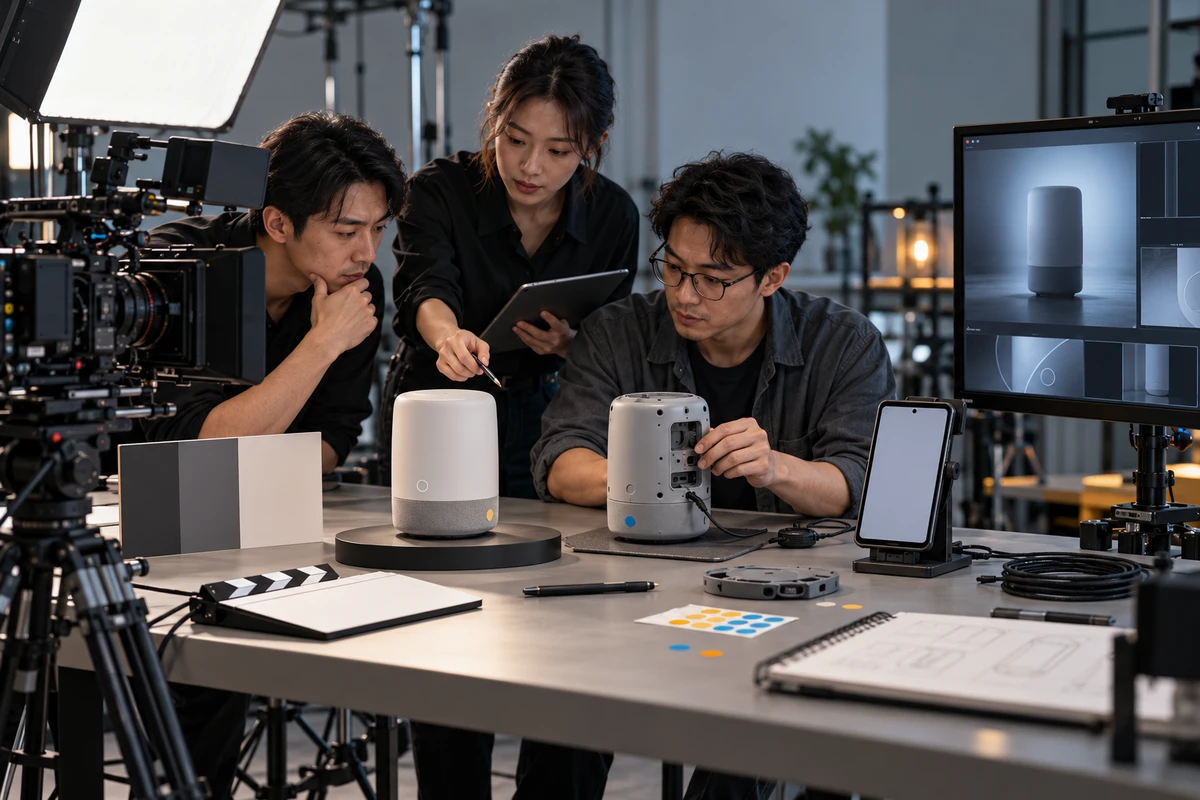
ONCE’s existing article on planning appearance, function and backup samples for product shoots explains why those units serve different roles. This guide addresses the next decision: enough samples do not automatically mean every shot is released. Each unit must be assigned to the fact it can truthfully support. For a broader launch workflow under prototype pressure, see Global Launch Content for Smart Hardware. Those pages describe production planning, not automatic approval of any sample or claim.
Do not force one unit to play three roles
Most projects should distinguish at least three objects:
| Object | Best suited to | Main risk | Release condition |
|---|---|---|---|
| Appearance sample | Hero shots, finish, scale, handling and setting | It looks complete while function is not real; hidden areas may still change | Brand or product owner confirms that the visible area represents the intended sales version and marks excluded angles |
| Functional sample | Pairing, controls, mechanics, sound and state change | Housing or UI is old; function succeeds only under special conditions | Repeats successfully under approved conditions, with version and reset method recorded |
| Release configuration | UI, language, units, packaging, accessories, plug and manual | It arrives late and differs by market | Product, compliance and brand owners approve the target-market version |
Different units can appear in the same film, but the edit must remain honest. Cutting from an appearance close-up to a functional action is not automatically misleading. The question is whether the sequence makes a viewer believe that one production-ready unit completed every action under one normal condition. When power-up, connection, response and result form the proof, they should preferably be recorded as one traceable functional chain. If split units are unavoidable, record that decision and evaluate whether the final film needs a qualification.
This is why “send the best-looking unit” is not a sufficient sample brief. The overseas client provides the intended sales configuration, target market, approved claims and version owner. The factory or product team identifies the sample, function status, accessories and expected changes. The production supplier schedules the rehearsal, splits the shots, manages continuity, prepares backups and records file versions. A production supplier is not a product-certification or quality-audit body.
Replace the general sample sign-off with a shot release table
Each row should include at least:
- Shot ID and viewer inference: not just “app operation,” but “the buyer may understand that this phone can control the device under the shown condition.”
- Sample ID and role: appearance, functional, backup or release configuration; include an internal or serial reference when appropriate.
- Current state: appearance parts, firmware, app, packaging, accessories, power, plug and replacements.
- Filming conditions: account, network, distance, environment, consumable, warm-up, reset and safety conditions.
- Evidence or approval owner: the person approving the claim, market version and safe demonstration.
- Release lane: shoot now, shoot after testing, reserve insert, or stop.
- Continuity dependencies: hand position, screen, indicator, sound, timecode, packaging orientation and adjoining shots.
- Replaceable element: UI, subtitle, label, package face, display or detail, with its source file.
- Invalidation trigger: the structural, colour, port, interface, response-time, claim, bundle or market change that forces review.
- Remedy: replace an insert, reshoot a shot, revise copy, add a qualification, create a market variant or retire the asset.
Update this table after a real unboxing and functional rehearsal in China, not from a product deck alone. Episode 03’s remote production approval chain supplies the surrounding workflow: the overseas decision owner freezes communication facts, the China team verifies the physical sample and execution conditions, and any change that affects viewer understanding becomes a written scope or reshoot decision rather than a casual “should be fine” in chat.
Which changes permit a local replacement, and which require a reshoot?
Not every change invalidates the film, and not every change can be corrected with a caption.
If only replaceable UI copy, currency, unit, package artwork or subtitles change—and hand movement, causal function, reflection and timing still match—a versioned replacement may be sufficient. If a colour shifts slightly but colour is not a purchasing identifier, bundle distinction or advertised feature, the brand owner may decide that a local asset revision is enough.
Reassess live action when the housing size or port location changes the grip or connection; the core operation changes; device response timing changes; a safety action, sound or indicator changes; box contents, plug or accessories change; an advertised material, performance result or compatibility claim changes; or a hidden engineering condition shown in the original is absent from the sales version. Making the shot look correct in post-production does not make its factual chain correct.
Stop when the product team cannot identify which version the footage represents, or when a core function works only intermittently but is expected to appear as a stable experience. Delaying one proof shot is often cheaper than building every language and platform cut on a false causal sequence.
The shoot-ready state is not “everything final”
An unfinished-sample project can proceed when four conditions are met:
- Every shot states the product fact a buyer may infer.
- Every sample, firmware build, app build, package and market configuration has a traceable ID.
- Each of the three lanes has an approver, cutoff date and failure action.
- Any change to core product identity or functional causality has an explicit reshoot or retirement trigger.
When hiring a China video supplier, do not ask only whether they can film an engineering sample. Ask whether they can separate stable facts, test-gated evidence and versioned assets; manage footage by sample and build; and tell you before the shoot which changes would invalidate an expensive shot.
If you are planning a China shoot for smart hardware or consumer electronics, send ONCE the product, factory or studio location, target market, intended use and date, sample count and condition, firmware and app builds, packaging and accessories, plus any current script. We can first route the planned shots into work that can start, work that waits for testing and replaceable version slots, then define a production scope that can be quoted. This is production and content-management guidance; it does not replace product certification, legal, platform or target-market compliance review.