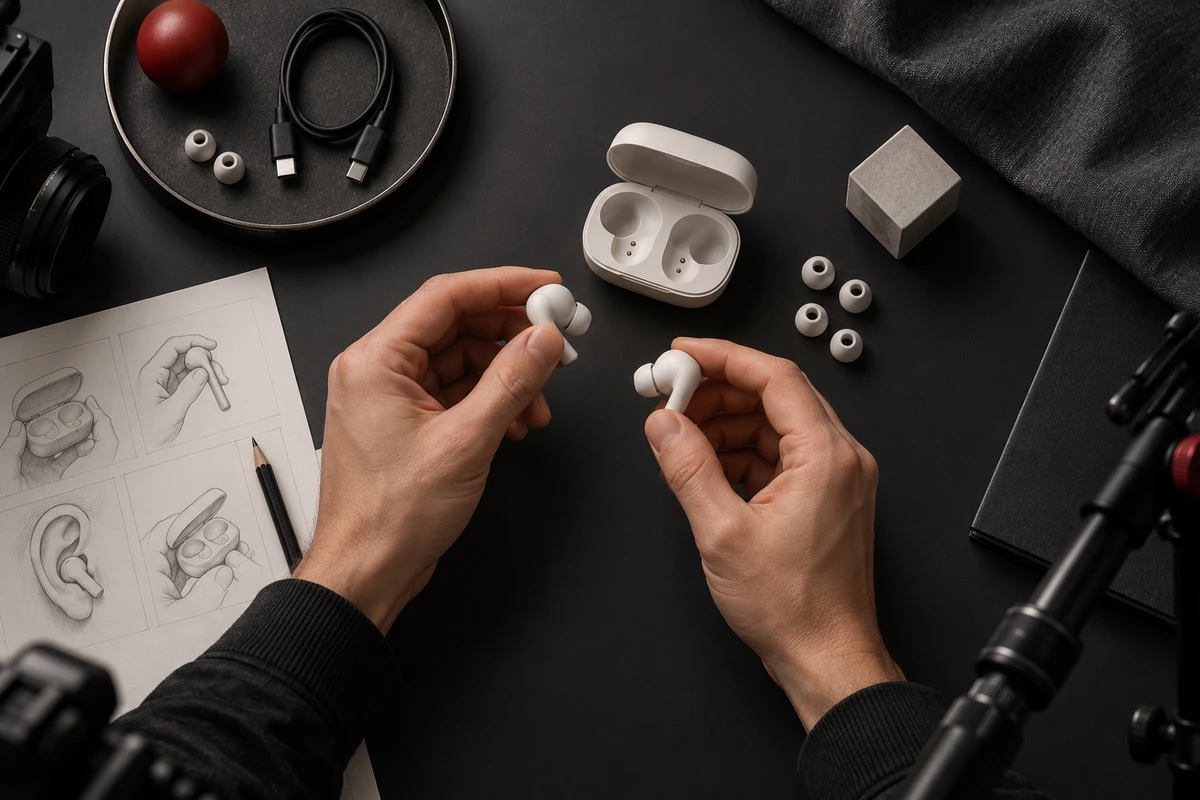
Imagine a new pair of earbuds already has a white-background hero image, lifestyle images, specifications, and five bullet points. The team now wants a polished film with atmosphere, emotion, and a strong brand tone. Yet shoppers still cannot tell whether the charging case opens with one hand, how clearly the touch control responds, how the product fits different ears, or how small it is when packed away. Another brand story may simply make the existing information more expensive without resolving the decision.
The starting point for Amazon listing video production should not be “What story should this film tell?” It should be “Which unanswered product-page question requires motion to answer?” Video is unusually good at showing time: where an action begins, how the product responds, what conditions apply, and how a result appears. Once those questions are ranked, the shot order becomes more useful than a borrowed brand-film arc.
Put the video back inside the product page
Amazon’s current US Shoppable Video Guide distinguishes product overviews, unboxing, operation and how-to content, setup, troubleshooting, brand stories, and other uses. These are not visual styles. They are different shopper jobs. Amazon’s May 12, 2025 seller article also separates shoppable videos in the main media block from the broader storytelling role available to A+ Content.
The listing video therefore needs a clear division of labour with the title, images, bullets, and A+ modules already on the page:
- If images already explain colour, included accessories, and static dimensions accurately, the video does not need another slow product orbit.
- Benefits that require a before-and-after state—folding, installing, cleaning, opening, fitting, storing, or receiving feedback—deserve motion.
- Brand history, design philosophy, and product-line context can live in A+ Content or separate brand content when they would interrupt the product explanation.
- An ad that must win a click in search or off Amazon needs a faster opening and a landing-page promise. It should not be a mechanical crop of the product-page master.
If the broader question is when to produce launch, page, and advertising assets, read Four readiness gates for product launch video planning. That article decides what is ready to be filmed. This one decides why the listing shots appear in a particular order.
Build an unanswered-question sheet before the script meeting
Do not copy a benefit list into voice-over. Ask the operations, product, and production teams to review the current detail page and record four items for each shopper question: the page’s existing answer, the missing information, the smallest visible action that could answer it, and the conditions the brand is allowed to show.
Suppose a smart lock claims fast unlocking, but the page does not show what happens between a finger touching the sensor and the door opening. The useful shot is not a louder “instant access” claim. It is a complete action: finger contact, recognition feedback, latch movement, and the door opening. Before filming, the team also needs to confirm firmware, the demonstration account, connectivity, and which interface may be shown. Post-production graphics should not invent a result that the sample cannot produce.
Or consider a stainless-steel pet fountain. Images can show the material, but they may not answer whether cleaning is awkward. The film can begin with removing the lid, then show the filter position, detachable parts, and reassembly in one readable sequence. If cleaning requires many steps, the main listing video can answer the most important disassembly question while a separate how-to video carries the full tutorial.
The question sheet should cover at least five categories:
- Recognition: Can viewers immediately identify the product and intended user?
- Action: What triggers the main function, and how does the product respond?
- Conditions: Which sample, environment, accessory, or setting makes the claim valid?
- Scale: How will size, capacity, storage, or the relationship to a person become clear?
- Result: Can the outcome be shown honestly, or should it remain a specification or test report?
Order shots by the sequence in which doubt disappears
There is no universal timing formula. A low-complexity product may finish the explanation quickly; an installation product may need a continuous sequence. A more useful structure is to make each shot group remove one question.
First, complete product recognition
The opening needs to establish the category, intended use, and meaningful difference. If the difference is structural, show that structure doing something. If the difference is scale, use a hand, body, or familiar object as a reference. Do not let a logo, an empty establishing shot, or atmosphere consume the shopper’s scarcest attention.
Second, turn the main benefit into a complete action
“Stabilisation,” “fast charging,” and “dual-zone cooking” are labels. A shot needs to show where the action begins, what the product does, and where the result appears. Folding, fitting, opening, loading, and assembly cannot be reduced to an attractive middle frame. Without the start and end states, viewers see movement but cannot judge effort or value.
Third, resolve the highest-risk use condition
Many product-page disputes are not about whether a function exists. They are about whether it works in the shopper’s situation. Earbuds need fit and storage context. Kitchen appliances need capacity, cleaning, and countertop context. Smart hardware needs interface feedback, connectivity conditions, and accessories. Prioritise conditions that could otherwise create a return, a negative review, or a customer-service question instead of giving every specification equal screen time.
Add brand and lifestyle expression after understanding is secure
Brand expression still matters. It can align lighting, environments, casting, and pace, and it can show the kind of life a product belongs in. But it should not hide the decisive action inside a lifestyle montage. High production value and functional clarity are not opposites: the material, operation, and result can all happen inside one coherent visual system.
Sound-off viewing is a separate acceptance test
Amazon’s seller article, Let Amazon product videos show customers what images cannot, recommends simple on-screen text for people who watch without sound and a thumbnail that communicates the key benefit. The production lesson is not to add more captions. It is to make the action legible first, then use text only for names, conditions, or numbers that the picture cannot communicate accurately.
Run three checks before final approval:
- Watch it muted. Can a viewer still identify the product, main action, and result? If captions have to explain what the action should have shown, the footage is incomplete.
- Shrink it to phone width. Are fingers, ports, indicators, buttons, and product feedback still visible? A wide lifestyle frame may look beautiful on a desktop and turn into background on a small screen.
- Pause around every product claim. Could any frame imply a result beyond the real conditions? Visual effects may clarify an invisible process, but they should not impersonate a test.
Subtitles belong in the delivery plan: language, line length, safe area, terminology source, units, and whether text is burned in should be agreed before editing. A late text swap can create German overflow, inconsistent units, or captions that no longer match the filmed action. ONCE’s ecommerce product video production approach plans product-page films, advertising cutdowns, and language versions together so these decisions happen before the shoot.
Turn platform rules into production constraints
As checked on October 6, 2026, Amazon’s US Shoppable Video Guide lists MOV or MP4 files, up to 1080p, a maximum size of 5 GB, horizontal 16:9 or vertical 9:16 aspect ratios, and a duration from 1 to 12 minutes. Each video must be associated with at least one ASIN. The guide permits demonstrations of product features, use, size, and setup, but prohibits external links, promotional calls to action, misleading information, unauthorised music, and third-party material. Account, category, and marketplace requirements may differ, so the team should still verify the actual Seller Central account before delivery.
These rules change the shoot. If the listing video cannot rely on an external CTA, the ending cannot require “visit our website” to make sense. If product information must be accurate, the set record needs the sample state, accessories, firmware, demonstration conditions, and approved claims. If footage may be mapped to several ASINs, the version matrix needs to say which shots are shared and which differences require replacements.
The same guide now contains an AI-generated people disclosure. When a
video includes a fully AI-generated photorealistic person, Amazon
requires the contains-synthetic-performer keyword in the
XMP dc:subject field before upload. This is an
asset-delivery requirement, not merely a creative note. The choice
between live talent, a synthetic performer, and product-only footage
must be settled during scripting and rights review, not after a
rejection.
The finish line is one fewer unanswered question
A listing video is ready when product recognition works in the opening; the core action has a beginning, process, and result; the function’s conditions and sample state are traceable; muted and mobile-width viewing still makes sense; picture, text, and voice-over do not contradict one another; each version has a defined ASIN, language, and placement; and platform and rights checks are complete.
The method also has limits. If the differentiator is mainly colour, static construction, or directly comparable dimensions, excellent images may be more efficient than video. If the central claim has not been approved by product and legal teams, strengthen the claim support before asking a film to endorse it. If pricing, variants, inventory, or reviews are the real page problem, video cannot repair them on its own.
The first shot worth filming is not necessarily the team’s favourite image. It is the shopper’s most important unanswered question. ONCE Visual can review the current listing, target marketplace, and recurring shopper questions, then turn them into a practical cross-border product video shot list before production begins. For a marketplace-specific scope, see the Amazon product video production solution.