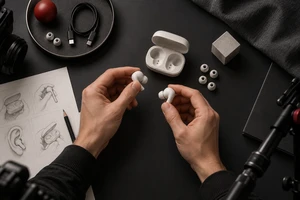
A brief asks for one Amazon listing video, one Shopify homepage film, three TikTok cuts, three Reels cuts, and a widescreen version for distributors. That appears to be nine videos. Pricing the work by multiplying nine, however, overstates what can be shared. Treating everything as one master with new crops and subtitles understates what must be designed separately.
A more useful cross-border product video quote counts three production units: product-proof units that must show a fact clearly, use-scene units constrained by talent and environment, and a channel packaging layer that reorganizes information for each placement. The first two shape the shoot. The third shapes versioning. Once those layers are visible, a brand can see what it is genuinely reusing and where a cheap shortcut is likely to become a reshoot.
Start with product facts, not finished runtimes
On a product page, viewers are checking the item. Size, ports, opening and closing, setup, operating feedback, cleaning, and storage should each be understandable on their own. Give every important claim a complete action: where the action begins, how the product responds, and where the outcome becomes visible. Leave handles before and after the action, and retain a clean source without titles, calls to action, or exaggerated sound design.
That is a product-proof unit. The same verified operation may appear on an Amazon listing, a Shopify detail page, in a sales presentation, and in later cutdowns. Reuse still has conditions. The model, finish, interface, and operating logic must remain consistent. If two SKUs differ only in colour, many camera positions and actions may be shared. If the ports, dimensions, or operating steps change, they are no longer the same proof unit.
Amazon's seller article from May 12, 2025 separates product videos into types including product overview, unboxing, how-to, setup, troubleshooting, and brand story. Uploading also involves selecting ASINs and a video language. That is useful evidence that a listing video answers a defined shopping task rather than functioning as a generic commercial. We do not use Amazon's self-reported sales-lift figures as a universal promise. Read Amazon's current seller guidance.
Talent, settings, and SKU changes create the real production turns
Adding a shot of a person holding the product can add casting, wardrobe, grooming, rehearsal, likeness rights, and production time. Moving from a kitchen to a bathroom is not merely changing a background: water, power, reflective surfaces, prop hygiene, and the route of the action may all change. An international project must also establish which countries, platforms, media types, and term the rights cover.
The better questions for a quote are therefore:
- Does a new SKU require new lighting, installation, or a different demonstration?
- Does a new setting change art direction, props, power, water, or safety planning?
- Does a new performer require separate styling, action rehearsal, and licensing?
- Does a new market change the product version, packaging copy, or approved feature claims?
ONCE's public Achedaway heated scraper case is useful as an observed content example. Personal-care performance, skin-structure animation, grip details, and storage each perform a different explanatory job. The case page does not publish media or sales outcomes, so it demonstrates a way to divide a handheld device into visual tasks, not proof that one treatment guarantees conversion.
Channels may share footage without sharing an argument
TikTok's In-Feed Ads specifications, updated in June 2026, recommend 9:16 for vertical non-Spark ads while also accepting 16:9 and 1:1. The safe zone changes with format, caption length, and additional ad formats. TikTok publishes the current dimensions and safe-zone files in its Ads Manager help centre.
Google's current Shorts guidance also recommends vertical, mobile-first creative. A horizontal asset can run in Shorts, but that does not make its composition or information order equivalent to native vertical work. The guide notes that horizontal assets may be presented with blurred areas above and below in the vertical experience. Review the current YouTube Shorts ad specifications.
Cropping a master therefore solves a file-shape problem, not necessarily a communication problem. A listing may need an uninterrupted demonstration and legible detail. Paid social may need the product, a tension, or the outcome much earlier. A distributor version may need widescreen framing, silent readability, and room for local contact information. All three can use the same verified operation, but they often require different openings, caption density, sound structure, and closing actions.
If the vertical version only needs a product close-up repositioned, channel packaging may be enough. If the widescreen frame puts the person on one side and the product on the other, a centre crop may remove the relationship that explains the feature. That calls for a vertical angle or a redesigned action on set. The question is not whether the image can be cropped. It is whether the product, action, outcome, and next step still form one readable sequence after the crop.
Put shared and independent work on the same scope sheet
A production scope becomes easier to compare when every requested asset includes four fields:
- Communication task: the buyer question it answers, such as size, setup, grip, cleaning, or storage.
- Capture conditions: the SKU, sample, performer, setting, and action required.
- Shared use: the destinations that can use the same clean source.
- Independent version work: the placements that require a new opening, vertical pickup, voiceover, subtitles, or call to action.
This makes the cost logic more honest. Adding a language may mean translation and subtitles rather than another shoot, but a longer voiceover can still change the edit. Adding a related SKU may need only packaging and exterior pickups, or it may require a full new demonstration because the controls have changed. Adding a channel may involve only a new export, or it may change viewing posture, information order, and the action expected from the viewer.
Duration alone cannot distinguish these cases. A 15-second social ad with a creator, location, demonstration, usage rights, and a market-specific close can require more independent work than a longer clean listing demonstration.
Approve a channel-to-shot map before the camera rolls
Do not approve only "nine videos." Place channels across one axis and shot tasks down the other, then mark every intersection as shared, reassembled, picked up separately, or not required. For each important shot, confirm:
- the correct SKU and packaging are visible;
- the action is repeatable and the right brand representative can approve it;
- both horizontal and vertical framing preserve the product, hands, and outcome;
- a clean version exists without subtitles or a call to action;
- music, performer, typeface, and source-material rights cover the intended markets and term.
Review in the same order. First approve the product fact. Then approve the person and setting. Only then approve each channel's information order, language, captions, and technical file. Approval of one listing edit should not silently become approval of every social and distributor version.
This method is most useful for brands with multiple SKUs, defined channels, and a reason to build a reusable product-content library. A single-market, single-placement demonstration can use a lighter version of the framework. If the channels are still unknown, buying a long list of aspect ratios and runtimes is premature. First decide where people will watch and what they need to judge.
ONCE's cross-border ecommerce product video solution shows how listing films, ad cutdowns, horizontal and vertical versions, and language masters can be scoped together. For a practical quote, send the SKU list, markets, placements, demonstrations, and language needs. We can turn them into a channel-to-shot map and identify what should be captured once, what should be reassembled, and what needs its own design.