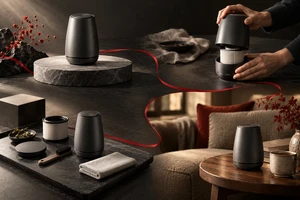
A TVC creative proposal can look complete in a meeting room: a forceful proposition, a sequence of cinematic references, a carefully chosen music track, then a product shot and logo at the end. The harder question is what the brand is actually approving.
Is it approving a mood, or a set of decisions that a director, producer, cinematographer, art department, post team and media team can execute together?
Evaluating a TVC proposal should go beyond choosing the route people like most. A more revealing method is to remove the things supporting the deck: hide the brand name, mute the voiceover, change the aspect ratio, take away one production resource, and finally force the idea into an acceptance sheet. If the idea survives, it is moving from inspiration toward a production plan. If it breaks, the team knows what needs work before the shoot.
Read the causal chain before scoring the mood board
A strong proposal should be able to explain one chain:
Business problem → intended memory → product role → observable action → filmmaking method → media version → acceptance item.
Effie Worldwide's current entry guidance asks judges to see a clear link between the challenge, objectives, strategic idea, creative execution and results. Effie evaluates completed marketing cases, not pre-production director treatments, so its framework should not be copied into a procurement scorecard. It does, however, offer a useful principle: strategy, idea and execution must be able to explain one another. Beautiful execution cannot answer a missing strategic question.
The five stress tests below are an ONCE editorial framework derived from public material and production logic. They are not a validated model for predicting campaign performance. They test whether a proposal is specific, producible, adaptable and auditable—not whether the finished ad is guaranteed to increase sales.
Stress test one: remove the brand name
Hide the logo, brand name and end-line. Look only at the people, product, space and actions. If a direct competitor could occupy the same film without friction, the issue is usually not insufficient polish. The brand proposition has not entered the dramatic mechanism.
A useful proposition should change at least one of these things:
- why the character acts, rather than only what the voiceover says;
- why the product appears at this moment, rather than serving as an end-frame beauty shot;
- why this setting is necessary, rather than merely attractive;
- why the ending can only reach this conclusion.
This does not mean the product must dominate every frame. It may appear briefly or arrive late, but it still needs a causal role: trigger, tool, proof, turn or resolution.
Instead of asking whether the deck feels “on brand,” ask a harder question: with the name removed, which relationship, action or contradiction could still belong only to this brand? If the answer returns only to colour, type and a slogan, the identity system and the story mechanism have not yet connected. Our study A Brand Aesthetic Is a Rule for Change, Not a Template explores that distinction further.
Stress test two: mute the voiceover
Many scripts read elegantly while the pictures merely illustrate the copy. Mute the voiceover and the character's action, obstacle and change suddenly become hard to understand. The film may still be shootable, but its most important explanation has been deferred to post-production.
Break each section into three questions:
- What can the audience actually see? An action, a material change, an interface response—or simply a performer holding the product?
- Where does the product fact come from? A demonstrable sample behaviour, approved brand information, an animation labelled as illustration, or an unverified advertising claim?
- What disappears if this section is removed? If neither story nor information changes, it may be atmosphere rather than structure.
Consider a fictional wearable whose proposition is “make rest more intentional.” A smiling morning routine is not enough to establish the product's role. If the film shows a performer viewing an approved interface response and changing the day's behaviour because of it, the product becomes part of the causality. This is a hypothetical evaluation example, not a claim about any real device or health outcome.
This test also exposes script conflict. A brand may want to express long-term value while the product section collapses into a list of specifications. It may want restraint while the camera and graphics manufacture constant excitement. The answer is not to choose emotion or information. Give each section a different job: emotion establishes the viewing relationship, product action supplies the fact, and the ending turns both into one judgment.
Stress test three: turn references into shot tasks
A mood board can communicate direction. It cannot, by itself, prove a production method. Every reference image should include a note explaining what is being borrowed: light, spatial relationship, blocking, material, camera movement, edit rhythm—or merely the adjective “premium.” The more unlabelled references a deck contains, the more films the room may be imagining.
Adobe's current Firefly Boards documentation describes tools for turning text and references into sequences, maintaining a degree of visual continuity, and collecting comments. That can make an idea discussable earlier. A generated storyboard is still not production proof. It does not establish that a physical product will hold its geometry under the intended light, or that a performance, mechanical movement, liquid effect or composite can be completed within the agreed schedule and budget.
Before approving the proposal, select the hardest frame and add four decisions:
- the intended path: live action, CGI, generative imagery, compositing or a hybrid;
- the critical dependency: sample state, location, performance, rig, lens or post test;
- the failure signal: the result that would make the route unusable;
- the fallback: whether it preserves the proposition or only imitates the reference.
A creative proposal does not need to become a call sheet. But its defining image cannot be covered by “we will solve it in post.” The more important a shot is to memory, the more it deserves a sample test, previs, technical breakdown or small proof before the main shoot.
Stress test four: remove one production resource
Temporarily remove the key location, celebrity, elaborate camera move, weather condition or major VFX beat. Does the idea still have a second route? This is not an argument for making every proposal conservative. It checks whether the team knows what it is protecting when budget or schedule conditions change.
A good fallback keeps the brand proposition and viewing mechanism while changing the resource. A crowd sequence expressing collective participation might be replaced by a chain of connected individual actions. If the fallback becomes a product turntable plus a slogan, it has preserved the delivery date, not the idea.
Mark each important section as:
- non-negotiable: remove it and the proposition fails;
- replaceable: the function remains but the method can change;
- enhancement: it adds scale or finish without carrying core meaning;
- decision date: the latest point at which casting, testing, scouting or rights must be confirmed.
This also makes quotations more comparable. A cost difference may not be about crew size or equipment. One team may have priced a test and fallback for the difficult beat, while another has left the risk inside a vague promise. See ONCE's commercial-film and TVC production scope for the wider production context.
Stress test five: force the hero film into versions and acceptance
A hero film is not the universal answer for every placement. Google Ads' current video specifications cover horizontal, vertical and square assets. That makes version planning more than an export setting: it affects composition, action placement, title-safe areas and opening information.
Apply three constraints to the proposal.
The vertical constraint
Can the person, product and decisive action remain legible together? If the landscape composition depends on a left-right relationship, does the vertical version need its own setup rather than a centre crop?
The cutdown constraint
At 15 seconds—or less—what is the smallest unit of the idea? One action, one reversal, one audiovisual rhythm, or a narrative that only works with a long setup? The short version need not retell the hero film, but it should retain brand recognition and the product's role.
The acceptance constraint
“Premium,” “young” and “impactful” cannot be accepted directly. Translate them into reviewable objects: which shots establish material quality; which action carries the product fact; which sound or pause creates recognition; which shots belong in landscape, vertical and square; and whether captioned, clean, localised and rights-cleared deliverables are listed.
The acceptance sheet should also separate three types of feedback. Factual errors must be corrected. Departures from the approved proposal need comparison. A new creative direction is a scope change. If these categories remain mixed, an offline review can easily confuse incomplete agreed work with a desire to redesign the film after seeing it.
Do not average away a broken link
These five tests should not become a pseudo-precise score out of 100. Strong brand interpretation and weak feasibility should not disappear inside an average. A beautiful landscape master does not compensate for a vertical version in which the idea no longer reads.
A practical decision has three states:
- approve: the causal chain holds, and the difficult beats and versions have clear treatment;
- approve with conditions: the direction holds, but named tests or delivery definitions must be completed before production;
- do not approve yet: the proposition, product role or core execution route still conflict.
Some brand films deliberately preserve ambiguity. Luxury imagery may not need to explain full functionality, and an emotional hero film may withhold the product for long stretches. These are not automatic failures. The tests do not reward maximum information. They ask whether the team knows what can remain open—and what responsibility cannot.
A proposal worth approving has not decorated every question. It has exposed the important ones early enough for the team to solve them together.
If you are reviewing a brand film or campaign treatment, send the brief, proposal, target placements and deliverables to ONCE VISUAL. We can identify where the causal chain holds, where it breaks, and which shots deserve to move into production.
Source scope: reviewed on October 4, 2026. This article uses Effie Worldwide's public entry guidance, Google Ads video specifications and Adobe Firefly Boards documentation. Effie's retrospective effectiveness framework is used only to explain logical coherence, not as a pre-production approval standard. Platform specifications can change and should be rechecked for the target account and placement before delivery.