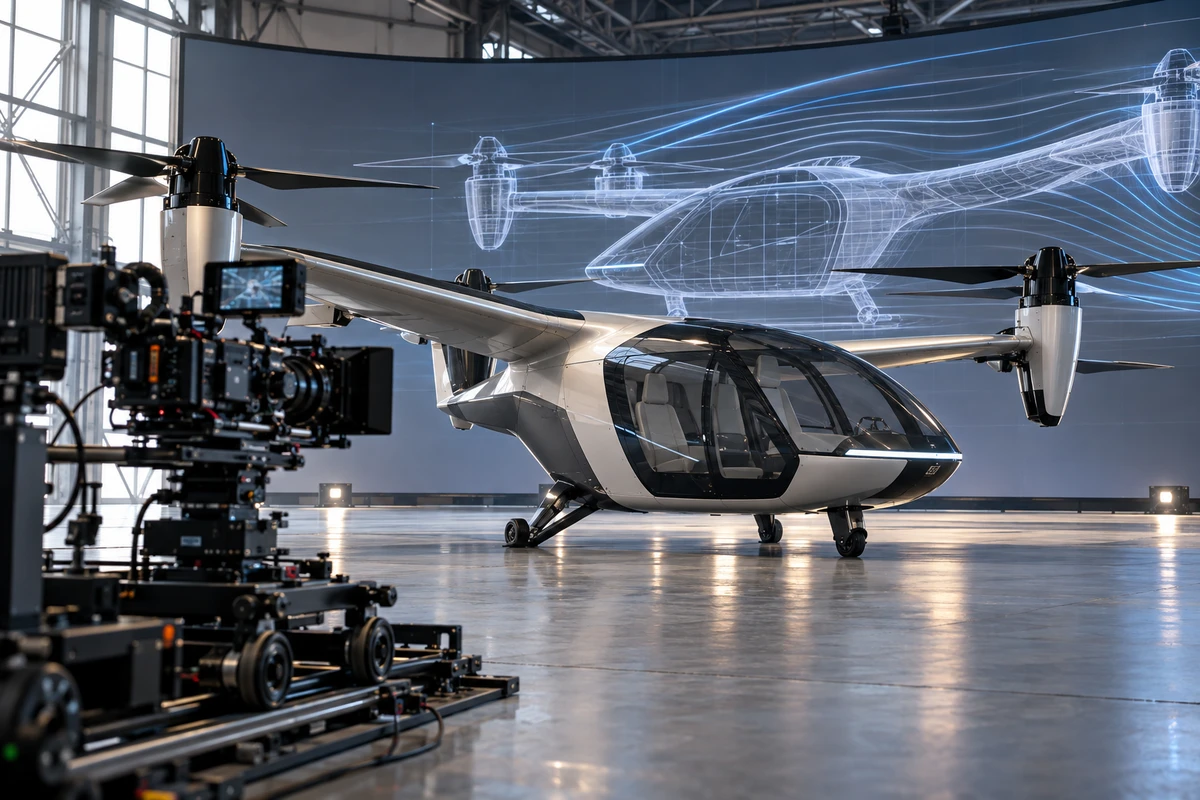
The short answer is that production does not have to wait until an aircraft has completed every flight-validation milestone. But CGI must not announce something the prototype has not yet achieved. A safer approach is to classify every shot as one of three layers: physical truth, engineering explanation, or a conditional operating scenario. All three may appear in the same hero film, but their identities should remain visible in the script, asset names, and approval records.
This matters more than deciding whether the project should be live action or CGI. An eVTOL program may need one content package for a product reveal, exhibition screen, partner conversation, and international market deck. Some viewers need proof of current progress. Others need to understand the flight concept. A third group wants to imagine a future passenger journey. When one edit collapses those jobs together, the audience cannot tell what has happened, what is being explained, and what still depends on future conditions.
Give every shot a status before choosing the technique
The first layer is physical truth. It shows only what existed when the camera rolled: the prototype exterior, cabin and doors, lift-unit arrangement, avionics hardware, power-on behavior, taxiing, tethered tests, hover, or the flight phase already achieved. The images may be restrained, but they should remain traceable to an aircraft, configuration, date, and source.
The second layer is engineering explanation. CGI is useful here because it can reveal relationships that practical photography cannot easily show: how vertical lift and cruise propulsion divide their work, how a transition is intended to occur, where energy and thermal-management paths sit, or how redundant systems are organized. The model, configuration, and terminology must be approved by the product and engineering teams. Post-production should not invent structures simply to make the sequence more dramatic.
The third layer is a conditional operating scenario. It can visualize passenger flow, a vertiport, charging, ground handling, dispatch, and city connections. The scene still needs a named target market and operating assumption. It is not proof that routine service already exists.
When Eve Air Mobility introduced video of its first full-scale eVTOL in May 2024, the company explicitly called it a non-conforming prototype and said production was continuing before the aircraft entered its flight phase. That phrasing is useful for content teams: a prototype does not lose value when its development stage is stated clearly. The stage itself is credible information.
Do not photograph a prototype as if every decision is frozen
The biggest risk in prototype filming is not a lack of polish. It is visual language that implies a production-ready aircraft too early. A clean hangar, finished livery, closed maintenance panels, and actors boarding can naturally suggest that delivery is near. If the aircraft is an appearance model, engineering prototype, or non-final configuration, that implication can exceed what the hardware supports.
Before production, the brand, product team, and filmmakers should approve a physical-status sheet:
- Is the aircraft an appearance model, engineering prototype, certification article, or another stage?
- Which structures, cabin elements, and interfaces are frozen, and which may still change?
- Which actions genuinely occur, and which are static demonstrations?
- May the aircraft identity, flight date, location, and configuration be disclosed?
- Which shots need a prototype, demonstration, or concept label?
China's civil-aviation authority described the EH216-S program through separate milestones for type certification, production approval, and the standard airworthiness certificate issued to an individual aircraft. Its April 2024 account of the production certificate does not define the path for every eVTOL program, but it demonstrates why type approval, production status, and individual-aircraft airworthiness should not be compressed into one vague claim that a product is certified.
Use CGI to explain relationships, not to manufacture completion
The most valuable CGI makes space, time, and system relationships readable. It should not turn an unverified performance claim into a beautiful flight.
For example, an animation can place flight phase, propulsion changes, and aircraft attitude in one continuous explanation of vertical takeoff and cruise. A cutaway can show the location of batteries and a thermal-management path. Every visible element still needs a source: a frozen CAD version, an engineering diagram, an approved parameter, or an explicitly named concept assumption.
EASA's Special Condition for small-category VTOL-capable aircraft addresses characteristics that differ from conventional rotorcraft and fixed-wing aircraft, with dedicated airworthiness objectives and evolving means of compliance. The production lesson is simple: explaining how a design is intended to work is not the same as demonstrating compliance. CGI can clarify a design objective; it cannot certify the aircraft.
The asset ledger should therefore give each CGI shot four fields: model version, engineering approver, communication purpose, and prohibited inference. If a shot explains architecture, its narration should not simultaneously introduce an unconfirmed range, noise, payload, or safety conclusion.
An operating scene needs infrastructure, not just a skyline
Many eVTOL concept films keep only the smoothest part of the journey: a passenger boards on a rooftop, flies above road traffic, and arrives minutes later. The aircraft is visible, but the operating conditions disappear.
The FAA's current Advanced Air Mobility overview discusses aircraft design, production, airworthiness, and operation as separate responsibilities. It also says initial operations are expected to use existing infrastructure such as helipads, routes, and air traffic services where possible, while vertiport standards develop. In practical terms, an operating scene should account for where the aircraft departs and lands, how it charges or turns around, who handles the ground operation, how passengers connect to surface transport, and which airspace and operating rules apply.
The hero film does not need to become a training video. But these conditions should exist in the storyboard. A waiting area, charging interface, safety distance, or dispatch moment can explain the system more clearly than another skyline shot. If the scene represents a target state, label it as a planned scenario or concept of operations with an appropriate market, date, or location qualifier.
Deliver three asset classes, not one truth-and-concept montage
A robust eVTOL product-video package separates at least three asset classes.
The hero film builds the overall understanding. It may combine live action, CGI, and a conditional operating scenario, but every layer remains traceable in the script and asset register.
Continuous function clips preserve real actions with few or no hidden cuts: a power-on sequence, door movement, ground test, hover, or approved flight segment. Each clip carries its configuration, date, and source so press, partners, and technical audiences can inspect it without relying on the hero edit.
Technical explanation assets include system animations, annotated and clean versions, key frames, and model-version records. They support exhibition talks, sales presentations, and later market adaptations without forcing teams to extract decontextualized moments from the master film.
For a complementary method for real flight footage, see ONCE's civil-drone flight mission-card guide. eVTOL content adds one more question to that workflow: is this frame a prototype fact, an engineering explanation, or a future operation that still depends on named conditions?
Hold one claim-grading meeting before production
The meeting can be short, but product, engineering, marketing, legal or certification stakeholders, and the production team should all be represented. Put every scripted claim into one of three columns: achieved now, explainable now, or intended after conditions are met. Then give each shot one primary job.
When a prototype cannot yet complete every intended flight, honesty does not reduce the scale of the film. Physical footage shows progress, CGI creates understanding, and the operating scenario shows direction. When those roles are clear, the brand no longer needs an ambiguous edit to borrow a sense of completion that the program has not reached.
If you are preparing launch content for an eVTOL, low-altitude aircraft, or aviation system, share the prototype status, target market, approved public materials, 3D assets, and three capabilities the film must explain with ONCE. We will separate the jobs of live action, CGI, and the operating scenario before deciding how the hero film should work.