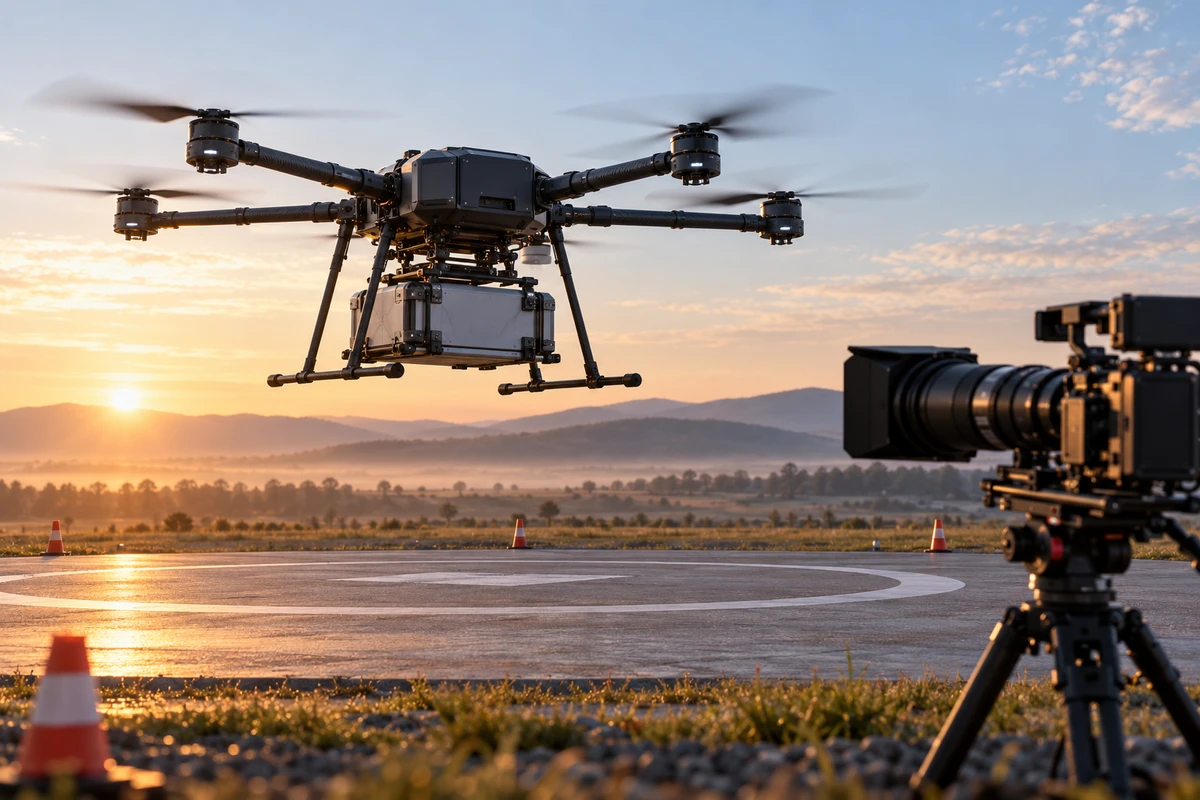
Imagine a call sheet that gives a civil drone one golden-hour flight. The same pass is expected to deliver a low tracking move, a backlit orbit, maximum-payload footage, onboard image samples, and proof of endurance, return-to-home, and obstacle avoidance. It looks efficient. In practice, it combines several tasks whose conditions often work against each other.
The most common mistake in a civil-drone product video is treating a beautiful shot as proof of the product. A smooth aerial image may come from the product's own camera or from a separate camera drone. A successful takeoff with a payload does not by itself prove the flight time, distance, or stability implied by the edit. The practical fix is to separate flight behavior, payload and endurance, and image quality into three flight mission cards.
Card one: flight behavior under named conditions
Start the card with the environment, then define the action. The environment is more specific than coast or mountain. It includes the takeoff surface, flight corridor, background obstacles, people routes, wind changes, usable light, and an alternate landing area. The action should be limited to what this pass needs to show clearly: a stable hover after takeoff, following a marked route, orbiting a known foreground object, or slowing into the landing zone.
Record at least:
- Aircraft model, prototype version, propellers, battery, firmware, and flight mode.
- Start and end points, expected altitude range, route direction, and stop conditions.
- Wind, temperature, visibility, light continuity, and ground hazards.
- The responsibilities of the pilot, observer, product owner, ground camera team, and location crew.
- Which aircraft performs the product action and which camera records it.
If the same route must also deliver mist, backlight, and a fast low pass, do not label the plan as simply flying it a few more times. Once light, wind, or ground positions change, it becomes another mission card. A successful orbit proves that the action happened in that pass. It does not automatically prove the same result with another payload, battery state, or weather condition.
Card two: keep payload and endurance tied to configuration
The most persuasive payload sequence is not a dramatic box on the ground. It is a visible relationship: how the payload is installed, how the aircraft lifts it, whether attitude remains controlled, and how the task ends. Cutting from a heavy payload on the ground to an unloaded aircraft in the air combines two configurations into one implied event.
Put payload mass, mounting method, battery configuration, takeoff weight, flight or hover mode, environmental conditions, and planned duration on the same card. DJI's official FlyCart 100 specifications illustrate why. The page lists different maximum flight and hover times for dual- and single-battery configurations, while its test notes specify a 149.9 kg takeoff weight, sea level, 25 C, no wind, and fully charged new batteries. This is not a benchmark for every drone. It is an example of why a performance image needs the conditions behind it.
A production day should not extrapolate official endurance from one filmed pass. Nor should the edit present different batteries, payloads, or lighting windows as one continuous task. Preserve a continuous function clip from installation and takeoff through stable flight and landing or unloading, with the corresponding aircraft, battery, and environment record.
Card three: identify who captured every image
A drone product film may contain at least three image sources: the product's onboard camera, an external camera drone, and a ground-based long-lens or low-angle camera. All three can belong in the hero edit, but they prove different things.
Onboard footage can show the real viewing angle, gimbal behavior, exposure, and encoded result. An external camera drone shows aircraft attitude, route, and payload relationship. Ground cameras preserve takeoff, rotor wash, people distance, and scene scale. If external aerial footage sits next to an onboard-image claim without a source label, viewers may attribute the filming platform's capability to the product being filmed.
The image card should record the camera or payload model, firmware, resolution, frame rate, color mode, filters, exposure method, stabilization or noise reduction in post, and the file-to-flight-card relationship. If AIGC or 3D extends weather, terrain, or inaccessible viewpoints, keep it in the concept layer. It should not replace the physical aircraft, real payload, or real onboard image when those details carry the product claim.
Compliance is an input to the call sheet
For production in China, asking whether the pilot has a certificate is not enough. The team must consider aircraft category, airspace, activity type, and current local requirements when determining whether real-name registration, suitable-airspace rules, flight-activity applications, pilot requirements, or other permissions apply.
The Civil Aviation Administration of China's notice on unmanned-aircraft regulatory services states that the UOM platform supports real-name registration, suitable-airspace lookup, and flight-activity applications. It also identifies circumstances in which micro, light, and small unmanned aircraft operating in suitable airspace do not need a flight-activity application, while controlled airspace and specified activities remain subject to applicable procedures. A mandatory national standard on real-name registration and activation took effect on May 1, 2026, adding system and process requirements for registration and activation.
These rules should not be compressed into claims that a shoot never needs an application or that an unlocked aircraft is cleared to fly. The call sheet needs a compliance status page: who confirms registration, where the planned airspace was checked, whether an application is required, who has final stop-flight authority, and how the day changes to ground filming if weather or people conditions change. The flight organizer and responsible parties must confirm the requirements in force for the actual operation. A production plan does not replace aviation-safety or administrative judgment.
Turn three cards into three deliverables
The hero film may combine flight behavior, payload, and image quality into one story. Its editing must still preserve configuration differences and must not present external camera footage as onboard imagery.
Continuous function clips preserve one key claim from preparation and takeoff to task completion with few or no hidden cuts. Each clip carries the aircraft, payload, battery, environment, and image-source record. It supports sales conversations, press kits, and technical review.
The mission log records file names, times, people, configurations, weather, anomalies, stop-flight reasons, and reshoot decisions for every pass. It may remain private, but it prevents post-production from combining different aircraft, equipment, and conditions into a single implied event.
For a related location-planning method, see ONCE's guide to coordinating aerials and ground filming. The principle here is narrower: decide what each pass is allowed to explain, then keep tasks that require different configurations or conditions separate.
Before filming, replace fly as much as possible with three mission cards. The flight team knows when to stop, the camera team knows where every shot came from, and the brand knows which real pass supports each statement in the film.
If you are preparing video for a civil drone, low-altitude aircraft, or payload system, share the aircraft, planned locations, payload configuration, target market, and three capabilities the film must explain with ONCE. We will separate flight tasks, camera positions, and deliverables before deciding how to build the hero film.