When an investment promotion film reaches the script meeting, one question often dominates the room: should the founder, chairperson, or senior executive appear on camera? One side believes leadership makes the film more authoritative. The other worries that the interview will feel like an annual-meeting speech. The useful decision is not whether the speaker is senior enough. It is whether the film contains a statement that must be owned by someone with actual decision-making authority.
Imagine a film that already includes aerials, an industrial park, production lines, laboratories, location graphics, and policy captions. It may look complete, yet a prospective investor can still ask: which projects are genuinely a priority, what long-term support will the organization commit to, and who will take responsibility after first contact? Attractive images cannot answer those questions alone. At the same time, a leader saying "we have strong capabilities" cannot replace evidence of the industrial base, equipment, logistics, or service process.
Separate the message into commitment, evidence, and action
China's official Invest in China service portal does not present investment promotion as a single image message. It separates information into industries, regions, company registration, taxation, hiring, costs, government services, policies, and local opportunities. Shenzhen's investment promotion authorities also describe their work in terms of industry research, promotion, cross-department coordination, and project follow-up. That is a useful editorial clue: an investor needs content that supports a next decision, not only a positive impression.
An investment promotion film can therefore assign information to three roles:
- Commitment: Which direction the organization has chosen, what it will support over time, and which projects deserve a serious next conversation. A founder, authorized executive, or accountable public-sector leader may need to own these statements.
- Evidence: Whether the supply chain, site, equipment, talent, transport, R&D, and service capacity actually exist. These claims should be supported by verifiable images, identifiable sources, and specific operating contexts.
- Action: Who the viewer should contact, what information to prepare, and what process follows. The film should lead to a concrete next step rather than end at "welcome to cooperate."
What is worth hearing directly from a senior leader
The most valuable executive interview does not recite the company history or repeat information already covered by narration. It performs three more specific jobs.
Explain a real choice
Why is the organization concentrating resources on a particular industry? Why was this region selected? Which capability will it protect even when conditions change? These are strategic choices. A candid answer helps a prospective partner understand that the organization is not trying to attract every possible project; it is looking for a workable match.
Confirm an organization-level commitment
A senior speaker can explain which level will sponsor an incoming project, how cross-department issues are handled, and which forms of support are part of a durable mechanism. The language must remain disciplined. Anything still under approval, subject to conditions, or likely to change should not be edited into an unconditional promise.
Set the tone of the relationship
Long-term industrial cooperation depends on more than physical resources. The investor is also evaluating how the organization communicates, handles uncertainty, and shares responsibility. A leader can explain the intended working relationship and what both sides must contribute. This is more informative than interchangeable phrases about shared success.
What the interview cannot prove
If a leader says the industrial ecosystem is mature while the film shows only an empty building, the message is weaker. The same problem appears when R&D capability is represented by a conference room, or when "efficient service" is followed by no named team or contact path.
Operational evidence can follow the viewer's decision sequence:
- Is this relevant to my project? Show real industrial nodes, upstream or downstream relationships, target company types, and site conditions rather than generic city footage.
- Can the project operate here? Show the transport, utilities, workspace, testing, manufacturing, storage, or talent collaboration that actually matters to the intended project.
- Can the information be checked? Identify policy names, data sources, and applicable dates. Avoid locking fast-changing figures into a spoken statement.
- Who owns the next step? Show the actual service team, project process, or contact mechanism and finish with a clear handoff.
For overseas investors or buyers, the factory and industrial footage also serves as a remote screening tool. Our article on what factory video should prove to a remote B2B buyer explains the same principle: a building is not evidence by itself; the footage must help the viewer decide whether the capability fits the project.
Four situations where an executive interview may be unnecessary
First, the film will mainly run on a trade-show loop. The environment is noisy and viewing sessions are fragmented. A long interview may not have time to establish context. Clear captions, strong evidence, and short commitment statements may communicate more effectively.
Second, the campaign requires many language versions. Synchronous executive speech increases the work required for translation, subtitles, dubbing, and lip-sensitive edits. When international distribution is the main task, keep an interview-led master if it adds value, but also deliver an evidence cut that does not depend on spoken dialogue.
Third, no speaker is authorized to own the promise. Putting the most senior available person on camera adds little if every answer stops at a general company introduction. It is better to use narration and evidence to explain confirmed facts than to manufacture an appearance of authority.
Fourth, the core policies and figures are changing frequently. Spoken details can make the entire film expire quickly. Keep long-term direction in the interview, while placing changeable figures in replaceable caption, graphic, or web modules.
How to avoid an interview that sounds memorized
A stiff interview is often caused by placing written corporate language directly into a person's mouth. Preparation should move from writing a full speech to designing questions that can produce usable answers.
- Replace "Please introduce our advantages" with "Which type of project can create the strongest local collaboration, and why?"
- Do not ask the speaker to deliver every point in one take. Separate direction, commitment, conditions, and next step into distinct modules.
- Let the speaker answer naturally first, then record one shorter version for editing.
- Use a teleprompter for policy names, exact figures, or formal openings that must be word-perfect. Obtain strategic judgment through conversation wherever possible.
- Keep a fact-check sheet beside the interview position so uncertain claims can be flagged during production rather than pushed entirely into post-production.
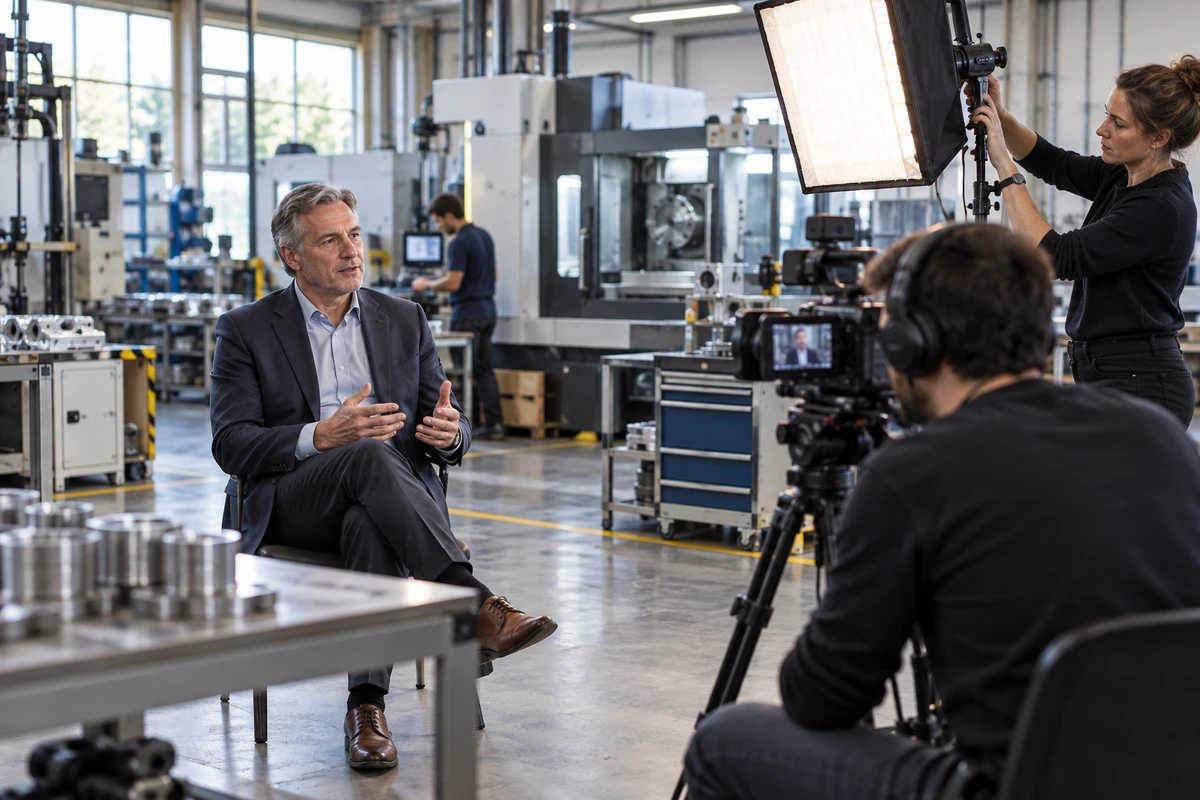
The setting does not always need to be a formal office. If the speaker is discussing manufacturing collaboration, place the interview in a quiet zone where relevant equipment is visible. If the subject is project service, show the actual operating environment. The background should support the statement, not merely decorate it.
The useful deliverable is two narrative systems, not one film
An investment promotion project may need to work in meetings, exhibitions, websites, roadshows, and international sharing. Instead of forcing every job into one master, design complementary deliverables:
- Interview-led master: Retains leadership judgment, accountable commitments, and the full industrial logic for meetings, websites, and targeted sharing.
- Evidence cut: Relies on operational images, verifiable information, and a clear CTA rather than long dialogue. It adapts more easily to trade-show loops, social channels, and multiple languages.
- Individual interview modules: Separate statements about direction, commitment, conditions, and next steps for future updates and short edits.
- Clean pictures and caption files: Preserve text-free masters, separated audio, and editable captions so a new language does not require rebuilding the film.
Captions should not be treated as an automatic afterthought. The W3C's guidance on captions and subtitles notes that automatic captions need accuracy review and that caption files can also support transcripts. Final delivery should therefore include reviewed language files and clearly named masters. Our video delivery checklist covers the practical relationship between masters, captions, and version control.
Five questions to answer before the shoot
- Which statement in the film is only credible when spoken by someone with decision authority?
- Can that statement be supported by a real location, document, process, or next action?
- Which policies and figures may change during the useful life of the film?
- Can the film still support a basic investment decision without sound or Chinese-language context?
- After watching, does the intended investor know whether the opportunity fits, whom to contact, and what to do next?
ONCE's corporate content production does not treat executive appearance as a default production item. We first determine who needs to own the commitment, what the footage must prove, and which information modules need to remain updateable.
If you are preparing an investment promotion film, send us the target investor profile, industry materials, intended viewing contexts, and available speakers. We can organize the commitment, evidence, and action layers before proposing the interview-led version, evidence cut, and production list. Request a film plan for your investment scenario.