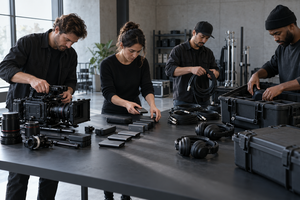
Shooting several products together is often treated as simple division: the studio, crew, art department and talent are already booked, so adding more SKUs should lower the average cost.
That is true only when each additional product can use the same set, lighting, action and approval logic. If every change requires a new set, wardrobe, camera position, reflection treatment and product review, “batch production” may simply compress two days of work into one rushed schedule.
The useful comparison is not one day versus two day rates. It is shared cost, changeover cost and reshoot risk.
Schedule by shot module, not by SKU
Imagine one brief containing three headphones, two charging products and a small desktop appliance. A product-by-product schedule films each item from unboxing through beauty shots and lifestyle use before moving to the next. It is easy to understand, but it may rebuild the same desk repeatedly and send talent back and forth between looks.
A better starting point is to separate reusable shot modules:
- Product standard: turntable, front-side-back views, material details, ports and packaging.
- Hand interaction: pick up, connect, charge, store, open and close.
- Lifestyle: office, commute, home, exercise or outdoor use.
- Channel: website landscape, product page, vertical advertising and short-form hook.
- Differentiating claim: a function or feature unique to one SKU.
Then identify which modules can be filmed in sequence. Three related headphones may share wardrobe, a wearing scenario and a lighting direction. A charging device may still require different cables, interfaces, indicator states and tabletop styling, even though it belongs to the same broad electronics category.
What can really be shared?
A combined shoot becomes efficient when at least five things can be reused.
1. Set and art direction. One office desk may support headphones, a keyboard and a charger. It may not make sense for a beauty device, kitchen appliance or outdoor product. Forcing every product into one room can save a reset while weakening category context.
2. Lighting logic. Matte plastic, polished metal, transparent parts and screens need different reflection control. Adding a glossy SKU may mean rebuilding flags, bounce and camera position rather than simply putting another object on the table.
3. Talent and styling. The number of SKUs one model and one look can cover depends on believable use. Business commuting and intense exercise may need different wardrobe, grooming and movement even when both products are wearable.
4. Action design. “Talent appears in the shot” is not a reusable action. Picking up, wearing, folding, plugging in and cleaning all require different hand positions, lens distances and repetitions.
5. Approval authority. If six product managers review six items separately, waiting may consume more time than filming. A batch project needs one on-set decision owner and a locked list of must-show and must-not-show details for every SKU.
Changeovers are the time most budgets fail to see
A quote normally shows studio, equipment, crew, talent and finished assets. It may not show how much time disappears between products:
- samples need cleaning, assembly, charging or firmware updates;
- dark and reflective surfaces need new dust and fingerprint treatment;
- accessories, cables and packaging can be paired with the wrong variant;
- a wardrobe change may also require new lighting and camera adjustments;
- a last-minute claim can affect performance, captions and pickups; and
- one delayed SKU can compress every product scheduled after it.
That is why “one hour per product” is rarely a sufficient call sheet. Product preparation, technical checks, lighting transitions, wardrobe changes, client approval and contingency need their own time blocks. Once those blocks are visible, the true capacity of a day becomes easier to judge.
When one combined day makes sense
The more of these conditions are true, the more valuable consolidation becomes:
- the products belong to one family and address a similar user;
- one or two core sets can support the full range;
- similar shots can be grouped before a planned changeover;
- samples, accessories, packaging, firmware and claims are final;
- talent and styling can cover the products naturally;
- there is one clear approval path; and
- deliverable versions are defined before the shoot.
The last condition matters because platform output is not one generic file. Current Google Ads video specifications recommend landscape 16:9, vertical 9:16 and square 1:1 assets, with safe areas affected by overlays and placement. Amazon seller video can be assigned to specific ASINs and, in some cases, extended to product variations. Shopify product media is organized on product pages and supports direct video files or YouTube and Vimeo embeds.
Those differences can require new framing, not a careless crop. If the crew knows which shots must work horizontally and vertically, the camera can preserve space or capture a second close shot. Asking for three orientations only at delivery can turn saved production time into expensive post-production repair.
When two days can be cheaper overall
Split the schedule when changeover cost is greater than the setup cost that can actually be shared. Common reasons include:
- products cross categories and require different sets, styling and lighting;
- talent availability creates long gaps rather than useful sequences;
- some products involve liquids, food, children, animals or complex assembly;
- sample readiness is uneven or important accessories are missing;
- one group is a brand story while another must document precise e-commerce functions; or
- several stakeholders cannot give timely on-set decisions.
Two days do not automatically double every cost. Creative planning, storyboards, production management and some equipment can still be shared. More importantly, each day gains a clear purpose. The expensive outcome is not an extra day; it is discovering before launch that a product detail is wrong after the talent and set can no longer be recreated.
Price the deliverable modules
Compare schedules by separating total cost into four parts:
- Fixed: creative, storyboards, production management, base studio and core crew.
- SKU increment: preparation, props, demonstrations and product review unique to each item.
- Changeover: set, wardrobe, lighting, reset and approval waiting time.
- Versioning: aspect ratios, languages, captions, platform hooks and calls to action.
Batching works when new SKUs mainly add the second category while the first remains shared. When changeovers and versions rise quickly, adding products may no longer reduce the average cost.
If the launch also needs brand, product-page and social assets, see why those jobs should be planned separately in Launch Video Systems: One Idea, Three Jobs. File naming, captions and masters should then follow a clear final-delivery checklist.
Sign in every product before cameras roll
For each SKU, prepare a primary sample, backup sample, complete accessories, cleaning tools, charging and connection plan, approved screen content, final packaging, confirmed claims, a no-film list and an on-set owner. Number and check these items when they arrive; do not rely on “everything is somewhere in the boxes.”
If you are planning a concentrated shoot with multiple products, models or channels, share the SKU count, product differences, sample status and target platforms through ONCE video production solutions. The schedule should be built from reusable shot modules and real changeovers before deciding whether one day or two is the lower-risk choice.