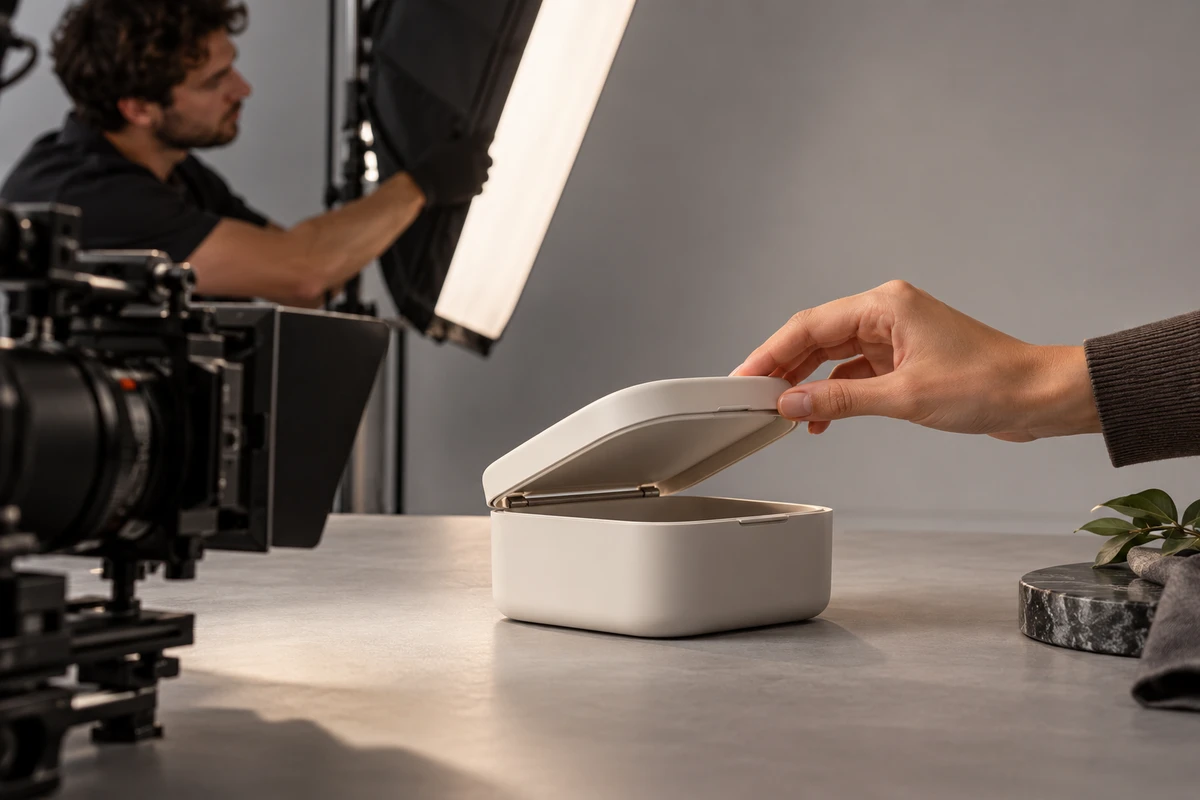
When a product’s final samples, packaging, engineering information, replacement parts and factory partners are already in South China, producing its marketing video somewhere else can mean paying for distance rather than for creative value.
That does not mean Shenzhen is always cheaper, or that the goal is to drive a production budget as low as possible. The logic is simpler: the closer a product is to the China supply chain, the closer production should be to the product. A local Shenzhen team can remove costs that do not improve the picture—flights, repeated sample movement, multi-layer handoffs and late rework—and protect the work that does.
Start with the right cost model: save on duplication, not on production
The core cost of a good product video—creative direction, directing, cinematography, lighting, art, locations, talent and post-production—should not be cut blindly. Those are the parts that determine whether a viewer stops, understands and trusts the product. The frequently overlooked costs sit around production:
Potential savings = cross-border travel removed + sample and rework logistics reduced + duplicated production coordination avoided + additional usable assets created from one shoot − the local communication and quality-control investment that remains necessary.
This is not a fixed quotation formula or a promise for every project. It is a decision rule: when most of the physical product and its technical answers are already in China, the production center does not have to be somewhere else.
Four places where the budget usually becomes more effective
1. Do not transport the brand decision-maker as if they were part of the crew
There are projects where an overseas team should absolutely be on set. But when the goal is to approve product condition, a hero setup and a few essential shots, international flights, hotels, ground travel, time-zone friction and schedule buffers do not automatically make the images better. A more efficient setup is for a Shenzhen team to run the shoot while the brand joins at agreed checkpoints: before cameras roll, after the first essential setup, and before wrap.
The client keeps control of brand language and product priorities without paying for a full day of waiting on set or for unnecessary international movement.
2. Keep the product, samples and engineering support close to the factory
The most expensive remote-production rework is rarely “one more edit.” It is filming the wrong version: the wrong color or port, outdated packaging, missing accessories, or a use sequence that an engineer later says is incorrect. When the product is in China, a local team can inventory samples before the shoot, check questions with the factory on set, and obtain a spare part or technical clarification when needed.
That reduces repeated cross-border shipping and waiting. More importantly, it lowers the chance that a problem is discovered so late that the project has to be re-shot. The saving comes from catching errors earlier—not from forcing cuts after the fact.
3. Avoid the three-way retelling of “overseas agency + local producer + factory contact”
Many cross-border projects become expensive not because shooting is expensive, but because information must move through too many layers: the brand explains it to an overseas agency, the agency briefs a China producer, and the producer asks the factory. Each handoff creates more time and more opportunity for a crucial detail to disappear.
When ONCE works directly with the brand and factory, the brand owns the market, audience and non-negotiable expression; the factory owns product accuracy; and ONCE turns both into a script, shots, on-set execution and finished assets. The point is not that one fewer person always equals one less fee. It is that fewer interpretation loops mean fewer expensive corrections later.
4. Make one shoot serve many channels instead of delivering one master film
What changes a video marketing budget is not only the cost of the hero film. It is whether every channel then requires a new shoot from zero. Google Ads’ official asset guidance repeatedly addresses multiple video orientations: its Performance Max video best practices recommend horizontal, vertical and square assets. Platform requirements change, but the implication for brands remains stable: a shoot should be designed as an asset library, not only as one horizontal master.
When product details, talent reactions, functional demonstrations and clean text-free shots are planned up front, one production day can serve product pages, paid ads, short-form cutdowns and later tests. For more on this approach, see our shot-asset map for overseas launches.
What to cut first—and what must not be cut
| Usually safe to reduce first | Never reduce just to be cheaper |
|---|---|
| Non-essential international travel and all-day set waiting | Creative preparation, scripting and sample verification |
| Samples repeatedly moved between countries | Cinematography, lighting, art direction and product-finish control |
| Layered project management and duplicated communication | Product claims, compliance and brand review |
| Separate re-shoots for a single platform’s basic format need | Finishing and quality control for critical deliverables |
Product claims are especially not something to rush. The U.S. Federal Trade Commission states that advertising claims must be truthful, not deceptive or unfair, and evidence-based. That is why a remote workflow has to define what can and cannot be said before the shoot, with both brand and factory involved. Faster local execution does not replace the brand’s responsibility for factual claims.
Not every project should be filmed in Shenzhen
Local production only makes sense when being close to the product genuinely matters. Shenzhen may not be the best choice when:
- The story must happen in a real overseas user environment, or depends on local founders, talent or communities;
- Final samples, brand design decisions and technical support are not in China;
- The product is still changing so frequently that any shoot will age immediately;
- You need a very simple, one-off, low-complexity piece rather than a content system that can keep working.
Location cannot replace strategy. If a project needs the authenticity of Los Angeles users, New York streets or a particular overseas founder, shoot there. ONCE’s value is not forcing every project to Shenzhen. It is turning Shenzhen’s proximity to the product, factory and operating rhythm into an advantage when that proximity is real.
How to make “local production” a genuine budget advantage
At the start of a project, the brand only needs to make six things clear: the final product list, target market, priority channels, substantiated claims, final approver and the sales problem the content must solve. The factory provides correct samples, accessories and a technical point of contact. ONCE then builds the shot-asset map, shoot-day approval points and delivery list.
Designed this way, a Shenzhen team is not a low-price substitute. It is a creative execution team close to your product and supply chain. Your budget still goes into better images, better judgment and better delivery; it simply does not get consumed by distance that creates no content value.
For overseas brands already sourcing in China
If your product is already in China, ask one simple question before your next video project: how much of the budget pays for the content itself, and how much pays simply to move people, samples and information across borders?
Starting from the product, factory and target channels, ONCE can help you decide whether the right move is a Shenzhen hero film, a set of functional demonstrations, or a modular marketing-asset package. Explore product video production and commercial shoots, or begin with a transparent discussion about the real cost structure of the project.
References
- Google Ads Help, “Best practices for video assets in Performance Max campaigns”, accessed September 2026.
- U.S. Federal Trade Commission, “Advertising and Marketing Basics”, accessed September 2026.
Production examples and next steps
Plan the product demonstration around what viewers need to understand. The realme GT7 film provides a reference for product detail and use scenes.
Review Ecommerce product video production in China. and realme GT7: Graphene Ice-Cooling Body Product Demo. To discuss your project, send the product sample, approved claims, use scenes and required formats through the English project enquiry form.