Replacing one poster with another usually marks the end of a campaign phase. But when repainting performs the very action the brand is talking about, the wall acquires a timeline. Someone passes once and sees a particular state; on a later visit, something has happened. The creative challenge is to make that change meaningful while still communicating with people who only pass once.
A historical collaboration between Patagonia and Colossal Media offers a useful starting point. The relevant question is how a finished image becomes an event that is still unfolding.
A Jacket Gets Repaired on a Wall
In IF IT'S BROKE, FIX IT, Colossal describes a fall 2015 project near Patagonia's SoHo store. Real photographs of a jacket before and after repair informed a mural that painters changed during its four-week run. The production team filmed painters and repair technicians for short brand videos. Matt Locascio's project record also describes the return to repaint the wall.
The arrangement connected three activities: a garment was being repaired, the wall was changing, and video linked the work in both places. The interpretation below is creative analysis based on the production accounts. It is not an audience, sales, or environmental-impact study, and the complete films were not viewed for this article.
A mural showing only the repaired jacket could still advertise a repair service. Adding a second painting phase made repair an action performed by the advertising medium itself. The message and the medium shared a verb.
The Change Should Complete a Brand Statement
Start with an action: repair, complete, connect, open, return, or make room. Then ask whether the physical medium can carry it out. A shift from blue to red is a change, but it does not necessarily deepen the brand idea.
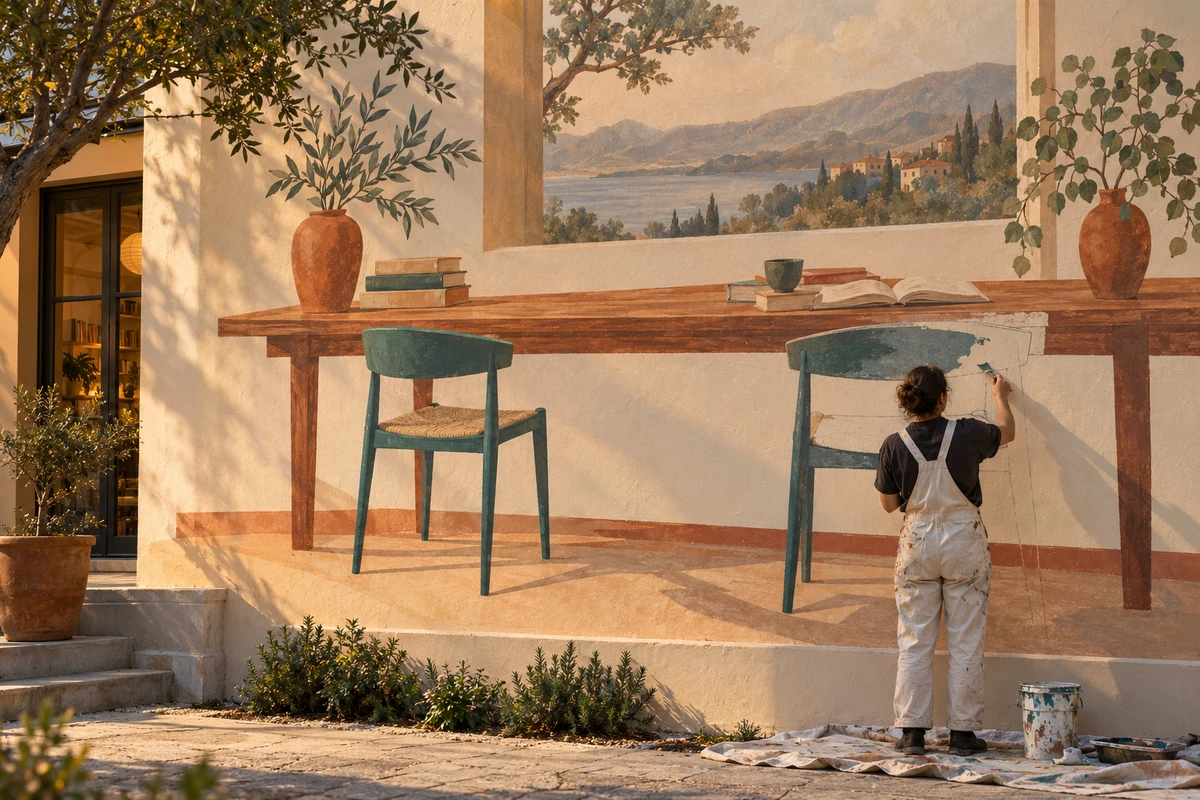
Consider a fictional shared reading space, not an ONCE project or a real campaign. Its entrance wall initially shows a desk and one chair. On opening day, a painter adds a second chair within the same scene. A place for solitary work becomes a place for reading together. The service's invitation to make room for more people gains a visible action.
The actual service still has to match. If access requires a reservation, the mural should not imply that anyone can enter free at any time. The image can express an attitude; accurate information must explain the terms of access. A generous visual gesture cannot stand in for a real arrangement.
The example also shows why change need not involve destruction, distressing, or an elaborate cliffhanger. Adding one object can alter a relationship more effectively than repainting everything.
Keep Something That Says This Is Still the Same Place
Viewers need stable elements to recognize a change: a pose, a product silhouette, the edge of a table, or a line in the building. Concentrating the alteration on the decisive action gives them a chance to compare.
In the reading-space concept, the desk and original chair can remain in place. The new chair carries the change. If composition, characters, color, and copy all change together, the second phase may read as a different ad. Viewers must find the connection before they can understand the added seat.
Filming should preserve comparable viewpoints. Record a wide position and framing that can be revisited, then cover the painting. Once the second phase is complete, return to a similar view so the edit makes the same wall recognizable. Daylight need not match perfectly, but a dramatic zoom, axis change, or unrelated transition should not hide the actual transformation.
Close shots reveal brushwork and physical labor. Wide shots reveal what that labor changed. With only close shots, the result may be an attractive painting-process film. With only two finished wide shots, the transformation can seem to happen without a cause. Linking the scales gives the work a narrative role.
Street Time and Video Time Work Differently
A physical change can take days, while its film may last seconds. The information does not need to arrive in the same order.
Review each street phase on its own. Does the first state express a clear question or attitude? Does the second still communicate what the brand offers without prior knowledge? Passersby cannot be assumed to remember an earlier image. Missing phase one should not prevent someone from understanding phase two.
Video can show both states in one viewing. An edit might establish the environment, identify the detail about to change, use the painter's action as the turn, then return wide to confirm the result. It compresses the waiting while retaining the reason for the change.
It can also connect two forms of real work: a creator changing the medium and a brand employee carrying out the corresponding service. That relationship should rest on visible actions and accurate facts. Similar hand movements should not imply that two scenes involve the same object or moment when they do not.
The Making Can Belong in the Main Film
When an idea depends on a later transformation, documentation needs to begin before the first phase. Deciding to film the original state after the wall has changed may require a reconstruction. A reconstruction can be a clearly identified creative device, but it cannot serve as an original event record.
Useful coverage includes the complete initial state, the start of the decisive modification, the hand or tool changing that area, and the finished relationship to the surrounding space. Select shots around the action viewers need to understand. A short film does not need every construction detail.
CG or AI previs can help compare the two compositions, the scale of the change, and camera positions. If the final scene is digitally created, present it as a concept or digital work. A convincing generated street scene should not be represented as documentation of a real activation. An event that happened and an event a brand imagines carry different meanings.
When Is an Evolving Ad Worth Developing?
The approach is promising when the brand has an action the medium can perform, the location can accommodate the planned change, and the key process can be recorded. If the only objective is another burst of attention and the later phase adds no meaning, a clear new ad may be the better choice.
Place the two states beside each other and complete this sentence: something happened here, making the brand's statement more specific. Brighter color or a more finished picture may remain a formal variation. Repairing something, giving someone a place, or changing a relationship allows the medium to participate in the story.
To develop an activation into a brand film, explore ONCE's brand film production services and plan the physical action, documentary coverage, and screen narrative together. Painting the wall twice earns its place when the second visit lets the brand do something worth seeing.
Sources were read on October 21, 2026. The two creator pages document the same historical project, not two independent cases. Their current page dates are not used to date the campaign. The reading-space example and original cover are fictional concepts; no campaign or audience testing was carried out.