A fragrance advertisement can give a scent a place, but that place needs to be more specific than “premium,” “natural” or “atmospheric.” A sheltered porch just after rain and a dry woodworking bench in sunlight can both contain wood. They suggest different experiences. Choosing between them determines whether water marks remain, whether a person pauses and what the film should sound like.
A screen cannot let viewers directly sample a perfume. Images can propose a recognisable world for a fragrance, showing where the brand is inviting us to go. That is neither a literal translation of every fragrance note nor a promise that everyone will make the same association.
Give the place a particular moment
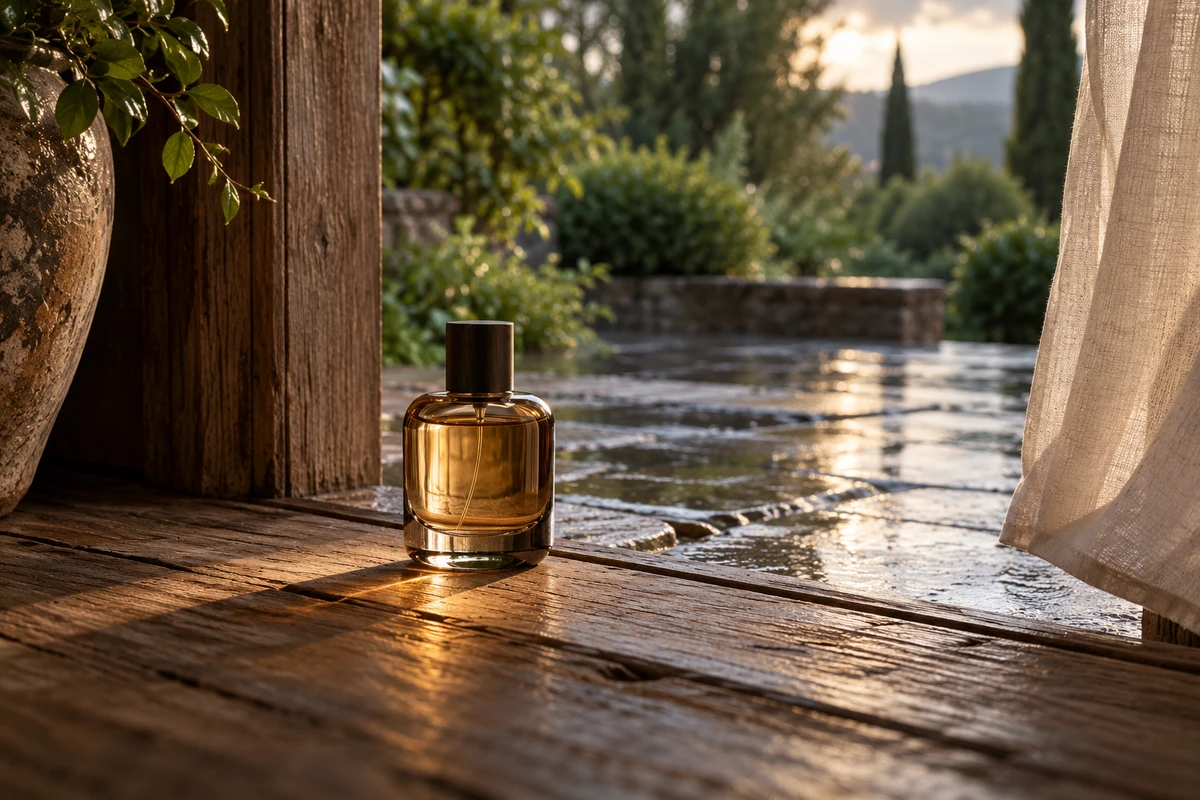
“Woody” is not yet a scene. It does not say where the wood is, what has happened to it or who encounters it. Develop it into “an old porch after rain, with wet paving outside and dry timber beneath the roof,” and the cinematographer, production designer and sound team have something specific to discuss together.
This is a creative choice, not the search for a single correct image of a smell. Put wood in a bright workshop, with fresh shavings and fingers moving over a newly sanded surface, and the emphasis can shift towards making, dryness and touch. Put wet stone outside a doorway and old timber in quiet light inside, and the meeting of two spaces can become the subject. Collecting both sets of references does not make them coherent simply because both are “woody.”
In the project text accompanying Aesop Fragrance Campaign Eremia Film Clip 1, Grace Margetson Studio connects the concept with memories of place and time, including the creator's return to the Irish countryside during lockdown. This is an account of a creative starting point, not research into how fragrance affects the brain. We draw on that starting point, without describing unseen shots or claiming an audience effect.
For a brand proposal, it prompts a more precise question than “make it feel like a memory”: whose memory, and of where? What relationship belongs to this particular moment? A character need not explain a personal history. A setting can retain traces of something used, awaited or recently experienced. Time can appear in the contrast between wet and dry wood rather than a date on screen.
LOEWE Perfumes' official Behind the scenes: Botanical Rainbow text for its 2023 campaign brings fragrance, natural phenomena and emotional responses together. It offers another reference for using nature in fragrance communication, not a prescribed set of floral shots for every brand. Here too, a brand's description is not treated as a consumer-research finding.
Ingredients explain composition; settings suggest associations
Flowers, leaves, fruit and timber can all belong in fragrance advertising. The question is what job they are doing. If an image explains the formulation, ingredient names and relationships need to follow information verified by the brand. If a plant's shape is an expressive association, accompanying copy should not imply that it must be a natural ingredient in the product.
A setting can create similar confusion. Our imagined porch is a fictional association. It does not establish where a perfume comes from or prove that it changes indoor air. The scene can sit alongside the actual bottle and an accurate fragrance description. It need not become an experiment, and experiment-like performance should not be used to guarantee a poetic idea.
Let sound establish where we are standing
Consider an original, fictional perfume film. A person walks from a garden after rain onto a porch, leaves a wet coat by the door and pauses. We see water marks on the paving outside, dry timber inside and a corner of linen moving gently. The product rests in a quieter part of the interior. The bottle does not glow, emit smoke or make plants suddenly grow.
Sound can follow the route. Outside, drips sit within a more open ambience. Under the roof, attention moves closer to footsteps and clothing. When the film cuts to the bottle, a faint drip can continue from outside, keeping the product in the place we have just established rather than moving it to an unrelated luxury pedestal.
Another edit could remove the ambience as the bottle appears and introduce distinctly different music. That would separate the product from the scene, making it more like a final signature. Either choice can work. The decision concerns whether we should still feel situated on the porch, not whether more or less sound is inherently more refined.
The concept does not require the character to smile immediately after smelling the perfume, close their eyes or enter a dream. Such performances are available, but consistently following a spray with complete relaxation could make the association feel more definite than intended. If the film is not making an efficacy claim, the person might simply choose to leave the bottle here and continue with their day.
Wet stone, dry timber and linen already offer contrasting textures. Forests, waves, petals and floating fruit need not all be added to represent every fragrance note. Removing an attractive element can clarify another relationship. And if the brand's subject is sweetness, exuberance or a city at night, this porch should be abandoned rather than presenting quietness as the universal language of premium fragrance.
Let the setting suggest and the product identify
A fragrance film can leave viewers able to describe the landscape but uncertain about the product. More bottle inserts are not the only response. A shared material, light or sound can connect the product to what came before, so its appearance does not require the film to establish a different world.
In the porch concept, the bottle could share a patch of light with the timber. Photography should accurately represent the selected packaging, colour and structure; approved copy can describe the fragrance. An attractive reflection in a concept image does not establish the product's real appearance. If transparency, liquid colour or the cap's surface differs from the sample, return to the actual product rather than changing it to preserve a reference image.
A short version might retain only wet paving outside, dry timber inside and the product's appearance, connected by sound. A longer version can develop the person's pause and relationship with the space. They share a particular place, not necessarily an identical shot count. The shorter film need not reenact the whole character story at higher speed.
When discussing an early treatment, temporarily hide the fragrance-note copy and ask the team to describe the place, the time and what has just happened. The aim is not to make everyone guess the formula. It is to discover whether “beautiful” remains the only thing the scene communicates. This is a creative discussion method, not a scent trial, shoot or audience test conducted for this article. It cannot predict recall or purchase intent.
Associations can remain open while visual choices become precise. A relationship between outside and inside may not explain an entire perfume, but it can have more character than an all-purpose montage of nature. Explain the necessary product facts separately, and the setting need not provide proof that images cannot deliver.
If you are developing a fragrance brand film, bring the actual product, an approved fragrance description and a place you want to explore to ONCE's brand film production discussion. Use them to develop production design, light and sound as one world.
Source note: The Grace Margetson Studio project text and LOEWE Perfumes' 2023 material were consulted on 20 October 2026. The former page did not show an explicit publication date. We did not watch the case films or expand written descriptions into shot-by-shot observations. The porch, perfume and original AI-generated cover are independent fictional concepts, not ONCE client work or a record of a shoot.