A supplier can reproduce a beautiful physical effect without demonstrating anything about your product. That distinction matters when an overseas marketing team commissions a shoot near its manufacturing partner: a reference image may specify the look, while leaving the actual assignment unresolved.
Decide whether you are buying a visual idea, an observable product demonstration, or a record intended to support a performance claim. These can share a set. They should not silently share the same assumptions.
A physical event can carry an abstract idea
In Creative Salon's October 6, 2026 interview with Phil Andraos, the Reuters Digital general manager describes a production choice: after using generative AI in part of the previous year's campaign, the team made this year's two new executions physically in a studio, using water to express ideas about news.
That is a first-person account of a particular commission, not evidence that practical production is generally more persuasive or less expensive. We have not watched both films in full and do not infer their complete technical workflow.
The useful distinction is between what happens in front of the camera and what that event establishes. Water can become cloudy for a brand metaphor without testing a water-treatment product. A real event does not, by itself, prove a commercial capability.
The same tabletop can sell three different assignments
Consider a hypothetical portable-speaker film. These are planning examples, not an ONCE production or a technical test.
For an abstract opening, paper shapes might move to an imagined rhythm. A motion rig, animation or compositing could be appropriate. The assignment is to make sound feel energetic, not to document acoustic performance.
Now place the shapes beside a visible speaker and cut from its power button to their movement. The sequence may imply that this particular speaker caused the motion. If that is the intended demonstration, the working product, its setting, the arrangement and the actual source of movement need to be agreed. An off-camera mechanism is no longer just an interchangeable art-department choice.
Add a line such as “more powerful at the same volume,” and the brief has changed again. A pleasing movement is not a substitute for a defined comparison. The brand's technical team must establish what can be supported and under which conditions; the production team then plans how to show it. Filming a test does not certify its validity.
The practical question is not whether live action is more authentic than CGI. It is which result the audience is being asked to attribute to the product.
ONCE's result-attribution storyboard
We propose a simple pre-production exercise. It is a planning method, not a tested performance standard.
Write the visible change, then the implied capability. “The paper rises after the speaker turns on” describes the sequence. “This speaker produces enough output to cause that movement” describes a possible inference. Seeing the two sentences together is more useful than approving a mood board labelled “power.”
Remove the product in the planning exercise. Could a rig, different material or post-production produce the same image? If so, the image alone cannot establish that the product caused it. That does not ban the technique. It tells the team to distinguish an expressive effect from a product-caused demonstration. No hazardous physical experiment is needed for this exercise.
Mark what is not freely art-directable. Background colour may be an aesthetic choice. The product's operating state and the event used to show its capability are different. If timing, movement or sound informs a performance judgment, changing those elements requires a fresh discussion, not just an attractive finish.
A soundtrack is particularly easy to confuse with a record of a speaker's output. In the hypothetical film, a dramatic music mix may be excellent advertising craft, but it should not be treated as a documented sample of what a specific unit reproduced. Decide which task the audio is doing before the mix is approved.
Put the failure conditions into the commission
For a practical-effect shot, failure might mean an unattractive motion, visible support or an image that does not connect to the brand idea. Preparation may involve material trials, rigging and camera rehearsals.
For a product demonstration, a different failure is possible: the agreed product state does not produce the expected result. That needs a decision about the product, conditions or proposed message. It should not automatically become an instruction to manufacture the result in post.
A third failure is incomplete coverage. The event happens, but the footage does not show enough of the setup or process to understand the relationship. That calls for a recording plan, which is different from buying a more polished hero shot.
Ask prospective suppliers to separate the creative mock-up from product preparation and operation. Specify who reviews a rehearsal, when filming should stop, and what process footage will be retained alongside the advertising edit. There is no universal surcharge: the additional work depends on the actual product and the claim.
For teams coordinating with a China-based supplier, the useful handoff is not “please match this experiment.” Send the proposed viewer takeaway, the product configuration, the available technical basis and the intended markets. ONCE's video production solutions can be a starting point for discussing that production task.
Recheck the meaning when the footage travels
An abstract sequence may be clear in a narrated brand film and ambiguous when isolated on a product page. A short edit can remove the sentence that established the metaphor. A translated line can introduce “faster,” “stronger” or another comparison that the original did not make.
Review each actual release in context. This does not mean every cut needs a new shoot. It means the expressive effect and the supported product demonstration must remain distinguishable after editing and localisation.
Before commissioning the next laboratory-style image, answer two separate questions: what should people feel, and what should they believe the product has done? If only the first answer is ready, commission that creative task openly. Do not ask a physical effect to supply a missing performance conclusion.
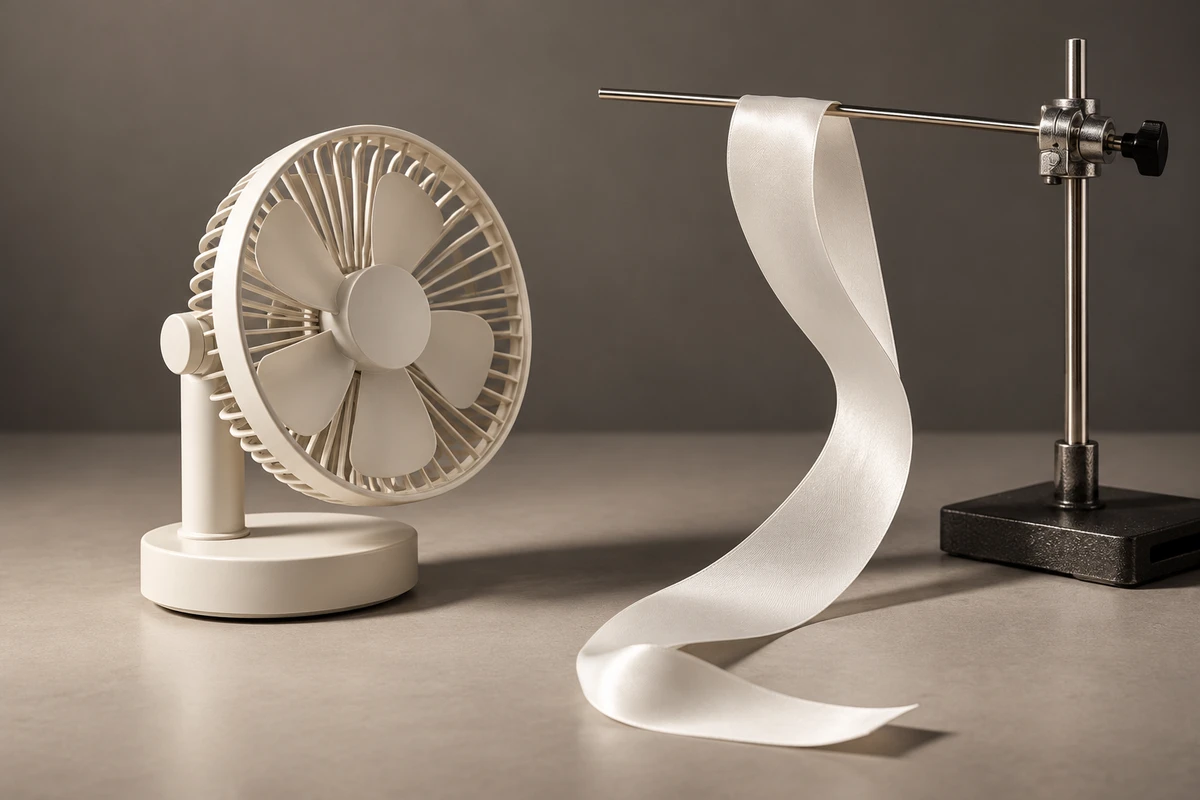
Sources checked October 19, 2026. The Reuters interview is used only for the speaker's production account; its campaign-effect claims and news-trust statistics are not adopted. This article is not product certification or legal advice. The AI-generated cover depicts a fictional tabletop creative setup, not the Reuters production or an ONCE client shoot.