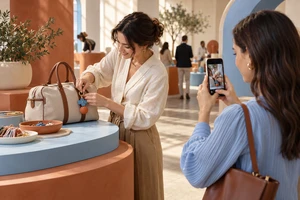
An overseas brand opening a showroom with products from a Chinese supplier needs more than a device that identifies the display. It needs an explanation worth delivering: what the object is, how its important features relate, what the approved product information establishes and how it is currently presented.
Treat recognition, interpretation and on-site support as different jobs. The first selects the content; the second helps a visitor understand it. Neither automatically supplies the third.
A recent pilot connects recognition to prepared interpretation
In a 14 October 2026 announcement, updated on 15 October, Meta describes a Pinacoteca di Brera pilot linking recognition of eight selected artworks to existing audio descriptions in the Grande Brera app. Development included testing and consultation with blind and low-vision people. We checked the account on 16 October.
That is a reported museum pilot, not proof of reliable recognition for arbitrary showroom products. The useful content principle is that an access mechanism connects to organized interpretation. We have not experienced the system or assessed its performance or independent-navigation safety.
The current Acoustiguide Services page, also checked on 16 October 2026, separately lists creative production, hardware and platforms, and site operations. Its creative scope includes scripting and recording. This is a supplier’s stated division of work, not a verified outcome claim.
Description is not a slower sales pitch
“Elegant, comfortable and durable” does not explain an object to someone who cannot see it adequately. A descriptive script needs a useful order: overall form, important parts and their relationship, then selected details relevant to the visitor’s purpose.
Keep observation distinct from interpretation. A visible woven surface does not establish abrasion resistance. A flowing outline does not prove structural performance. Approved design context can enrich the description without replacing it with praise.
Nor should a script list every visible detail. Relevant content and accessibility specialists should help choose what matters, how to sequence it and where to pause. A single promotional narration should not be assumed to serve every visitor’s needs.
ONCE’s Object Script and Display Notes
This is an original content-planning method proposed for this article—not a tested system or an accessibility certification. Maintain two linked pieces of writing for each exhibit.
The object script identifies the sample and version, describes its relevant form and carries approved material, design or use information. Display notes hold the current presentation conditions: whether contact or a demonstration is available and how to request staff assistance. They can play together without becoming one inseparable recording.
| Change | First content check |
|---|---|
| The same sample moves to another exhibition area | Review display notes and the real access mechanism before rewriting object interpretation |
| A new material or structural version replaces the sample | Recheck object identity, descriptive content and associated language versions |
| A hands-on display becomes viewing-only | Update the experience notes and confirm the actual arrangements |
Check the distinction before exporting the showroom
Consider a fictional furniture brand shipping a display chair from China to an overseas exhibition. This is an illustrative scenario, not an ONCE case study or a performance claim about a real model.
The approved object script could explain the relationship between the curved back and woven surface. The receiving exhibition might place the sample on a platform rather than offer seating. That presentation condition belongs in the display notes, not permanently in the product story.
Moving the chair into a supervised demonstration area requires another check of the local notes. Replacing its fabric while keeping the same exhibition position requires a check of the object script. A stable display location is not evidence that the product description is still current.
Separate a wrong match from an unclear explanation
First review sample identity and product facts independently of the technology. Then test whether the planned device, content configuration and real display call up the correct version. Fluent audio does not prove the match is correct; a correct match does not prove the explanation is understandable.
If the project is intended to improve access for blind and low-vision visitors, involve those visitors and appropriate accessibility professionals in content and on-site evaluation, with suitable consent. A sighted colleague listening with eyes closed may find wording issues. It is not a substitute for that participation and cannot establish that a venue is safe for independent navigation.
Specify an honest response to no match, an ambiguous match or unavailable content, with an actually supported staff-help or alternative access option. Do not have the system invent certainty. This article addresses interpretation content, not directions for walking, operating equipment or touching exhibits; those arrangements need separate assessment.
Start with one exhibit and name the delivery roles
Before procuring new hardware for the entire showroom, choose an important exhibit with sufficient approved information and permission to study it. Produce the object script, display notes, a sample recording and a record of feedback. Expansion should depend on understanding, site conditions and actual technical validation together.
Scope research and approval, specialist descriptive-content support, voice and language adaptation, recognition/playback integration, on-site testing and updates separately. ONCE’s video production solutions provide an entry point for discussing existing product material and content production. Name capable partners for accessibility consultation, recognition systems and venue operations rather than assuming a normal filming order includes them.
Retain approved writing, recordings, object identity and display versions. Reuse through another device or platform still depends on formats, permissions and real technical support—not possession of an audio file alone.
ONCE’s business inference is that maintainable interpretation around physical products could support ongoing content work. Actual revision frequency and effort must justify any managed service. Begin by judging what one exhibit’s audio genuinely explains; select the access technology with that purpose in view.