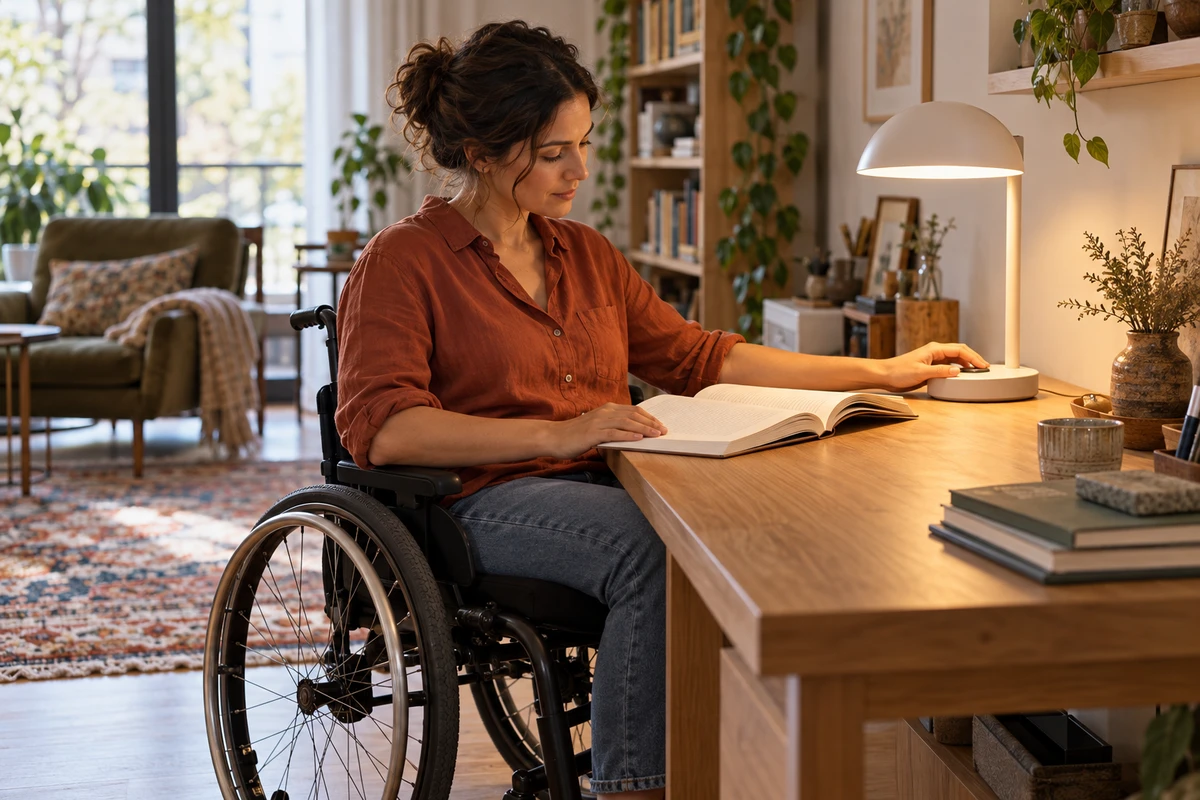
Imagine a reading-lamp advertisement. The light comes on and someone returns to a book. Written that way, switching on the lamp looks like an effortless transition anyone can make. Yet the reach, the point of contact and the precision a control demands can change that small part of daily life.
Inclusive brand advertising should ask more than whether different people appear on screen. Has the brand understood what the same product asks different users to do? Someone can be visible in an advertisement while their experience remains absent from the script.
IKEA ThisAbles offers historical material for that discussion. This article examines participant interviews and written project accounts, not the film shot by shot. Nor does it treat the project as a universal answer.
A control makes an abstract promise specific
Direct New Ideas dates its ThisAbles case record to March 2019. The Design Museum’s Q&A – IKEA ThisABles discusses the collaboration between IKEA Israel, McCann Tel Aviv, Milbat and Access Israel, developing add-ons for existing furniture rather than requiring its replacement.
The One Club project entry lists changes including sofa-height extensions and enlarged lamp buttons, alongside demonstration videos. This is the project account, not our independent assessment of compatibility, safety or usability.
For advertising creatives, the useful move is from a broad brand ambition to the relationship between a person and a control, handle or seat. What needs explaining may be why a particular action is awkward and what the design changes, rather than a sweeping social slogan.
That does not require dramatizing difficulty. Repeated failure followed by music announcing a life transformed can give a small intervention too much credit. It can also leave the person with only the role of waiting for help. A barrier can be visible without discomfort becoming a spectacle.
Compare “He could not do it, so the brand helped him” with “The original control did not suit him, and he helped find a better approach.” These are our illustrative alternatives, not quotations from the campaign. The difference is more than kinder wording. One locates the problem solely in the person; the other also examines the body and operating method the product assumed.
A specific design response should not become a solution for everyone. Show who uses it and under which circumstances rather than letting an inclusive slogan erase differences. Actual selection and installation of an adaptation require appropriate professional guidance and applicability information. Advertising analysis cannot replace them.
Participation begins before the approving nod
The Design Museum interview describes an idea originating with a copywriter who had relevant lived experience, followed by users and engineers discussing domestic difficulties together. The important point in this participant account is when experience entered the work: while the problem was being defined.
Inviting someone to try a finished proposal and provide an approving line is different. It may help assess the expression without changing its starting assumptions. If the brand has already decided that users need a large button, questions about its appearance may miss a difficulty involving position, posture or an unwanted operating method.
A creative conversation can begin with an experience: what were you trying to do last time? Where did it stop working for you? How do you handle it now? What would you prefer to keep? The answers may overturn the proposed selling point. These are our suggested questions, not the original project’s interview guide.
Co-creation does not require someone to make their entire life public. Discussing an operation does not imply consent to disclose medical history, show a private room or speak for a whole community. Agree separately on what informs product development, what enters the script and what may be published. Participation in an improvement should not automatically require an on-screen appearance.
Involving intended users and relevant specialists still does not establish universal approval. People can have conflicting habits. Retain those differences and identify whose situation the film presents, rather than choosing the person most willing to confirm the original proposal.
After the light comes on, life continues
Return to the fictional reading lamp. This is neither a ThisAbles scene nor an ONCE client project. Assume the actual product has a confirmed operating method appropriate for this participant, whose purpose is simply to continue reading.
Make room for operation and choice
Establish the everyday task, then frame the control and action clearly. After the light comes on, resist immediately cutting to the logo. Let the person adjust the pages and choose where to resume. Switching on a lamp becomes part of a life, not the whole story the brand has assigned them.
Reading is only one possible activity, and a failed attempt is not compulsory. Ordinary representation can begin with successful use. Introducing a specific design improvement may need enough context to explain what changed. Do not ask someone to repeat uncomfortable or unsafe actions merely to create a before-and-after contrast.
Close-ups can do different work. A control close-up explains operation. A face can show judgment, concentration, humor or impatience; it need not be reserved for a grateful smile. Framing and editing allocate agency: who makes decisions, and who appears only to validate the product?
For the broader connection between actions and a brand story, see how product use shapes advertising narratives. Here the additional question is who defines those actions and whether the audience sees someone with a purpose of their own.
Do not let imagery announce an unfinished improvement
If the product is a concept, discuss it as a concept. If feedback concerns one prototype, do not turn it into a comprehensive promise for a finished solution. Compositing or generated imagery can explore atmosphere and space; neither supplies a real participant’s opinion or proves a control is usable.
Someone can appear in an everyday advertisement without an explanation of disability. Inclusion can reside in who has choices, interests and relationships, not only in a story about overcoming a barrier. But when an advertisement explicitly claims to address a usability problem, its expression must match the improvement actually achieved.
The lesson is not to attach an accessory to every product. It is to reconsider actions the brand takes for granted. An advertisement can reveal difficulty without reducing a life to difficulty, and show a product’s contribution without handing the leading role to the brand.
Planning this kind of film? Bring a real use situation, what participants want changed and retained, and the product capabilities already confirmed to ONCE’s brand and product-video solutions. Establish what the person wants to get on with before deciding how the camera can support it.
Sources checked October 15, 2026. This is a historical 2019 project, discussed through the Design Museum interview, One Club entry and Direct New Ideas record. Embedded films were not watched; population figures and campaign-performance or sales statistics were not adopted. The reading-lamp scenario and AI cover are concepts, not adaptation instructions or records of an actual project.